

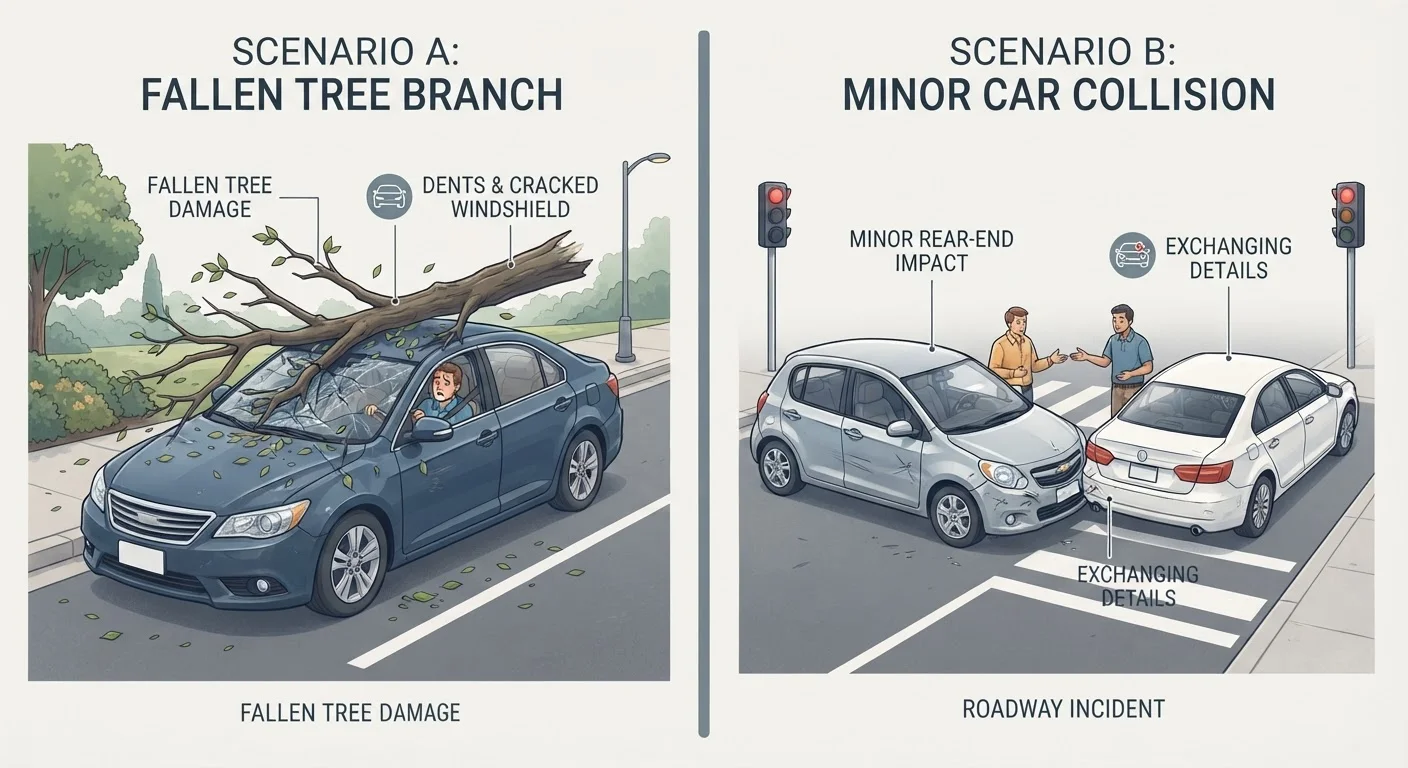
Key Takeaways
Option A
Comprehensive Coverage
The coverage for what you can't control.
Best for: Drivers who want protection from weather, theft, animals, and other non-collision events outside their control.
Option B
Collision Coverage
The coverage for when your vehicle hits something.
Best for: Drivers who need their vehicle repaired after an at-fault accident or an impact with another object, regardless of fault.
If you own your vehicle outright and it has low market value
Neither - consider dropping both
When a car's actual cash value approaches or falls below the combined annual premium plus your deductible, carrying either coverage may cost more than a payout would deliver.
If you live in an area with high theft rates, hail, or severe weather
Comprehensive Coverage
Comprehensive is typically the lower-cost of the two coverages and directly addresses the risks most likely to hit you in high-crime or storm-prone areas.
If you have a long daily commute or frequently drive in heavy traffic
Collision Coverage
More time on the road increases accident exposure. Collision coverage ensures your vehicle can be repaired even when you're at fault or the other driver is uninsured.
If your vehicle is financed or leased
Both coverages - required
Virtually all lenders and lease agreements mandate both comprehensive and collision. Dropping either typically violates your contract and can trigger lender-placed insurance at a much higher cost.
If you want broad protection on a newer or higher-value vehicle
Both coverages
The higher a vehicle's market value, the more financially damaging an uncovered loss becomes. Carrying both coverages limits your worst-case out-of-pocket exposure.
What Each Coverage Actually Does
Comprehensive coverage pays for damage to your vehicle caused by events that aren't a collision - think hail, flooding, wildfire, falling tree limbs, theft, vandalism, and animal strikes. If a deer runs into your door or a tornado deposits your car in a ditch, comprehensive is what responds.
Collision coverage pays for damage to your vehicle when it physically impacts another vehicle or object. That includes rear-ending another car, backing into a pole, or getting hit by an uninsured driver when collision is the mechanism of the loss. Fault generally doesn't change whether collision applies - it affects whether your insurer can recover costs from the at-fault party later.
Both coverages are subject to a deductible - the amount you pay out of pocket before insurance contributes. Common deductibles run from $250 to $1,500; a higher deductible lowers your premium but raises your exposure at claim time. For a plain-language breakdown of deductibles and other policy terms, see our auto insurance glossary.
| Criterion | Comprehensive | Collision |
|---|---|---|
| Triggering event | Non-collision: theft, weather, fire, animals | Physical impact with vehicle or object |
| Fault requirement | Not applicable - event-based | Not required - applies regardless of fault |
| Typical annual cost | Generally lower premium | Generally higher premium |
| Deductible applies | Yes | Yes |
| Required by lenders | Yes, on financed/leased vehicles | Yes, on financed/leased vehicles |
| Covers theft | Yes | No |
| Covers at-fault accident damage | No | Yes |
| Covers weather damage | Yes | No |
What Neither Coverage Includes
Both coverages are physical damage coverages - they protect your vehicle, not other people or other vehicles. Neither pays for:
- Bodily injury or property damage to others - that's liability coverage, which is separate and legally required in most states.
- Medical costs for you or your passengers - those fall under medical payments (MedPay) or personal injury protection (PIP).
- Mechanical or electrical failures - wear, breakdown, and defects are not covered by either, regardless of cause.
- Personal belongings stolen from the vehicle - comprehensive covers the vehicle itself, not items inside it; those typically fall under a homeowners or renters policy.
Gap Insurance Is a Separate Product
If you owe more on your vehicle loan than the car is worth, neither comprehensive nor collision will cover the difference between the payout and your loan balance. That shortfall is addressed by gap insurance - a separate, optional product typically available through lenders or insurers. It's worth understanding if you financed a vehicle with a small down payment or a long loan term.
Understanding these gaps matters before you assume a claim will be covered. If you're comparing policy options, what to evaluate beyond the premium explains the exclusions and claim-handling factors that quotes alone won't show you.
When Dropping Coverage Makes Financial Sense
The standard framework is straightforward: if your vehicle's actual cash value (ACV) - what the insurer would pay in a total loss - is close to or less than your annual premium plus deductible, the coverage may not be worth carrying.
For example: if a vehicle's ACV is $4,000 and you're paying $600 per year in combined comprehensive and collision premiums with a $1,000 deductible, a total-loss payout would net $3,000. The math starts to work against you.
~$192
Average annual comprehensive premium (US)
According to the National Association of Insurance Commissioners (NAIC), the average US expenditure for comprehensive coverage has historically tracked well below collision costs.
~$381
Average annual collision premium (US)
NAIC data consistently shows collision as the more expensive of the two physical damage coverages, reflecting the higher frequency of vehicle accident claims.
1 in 88
Likelihood of a vehicle theft claim
The Insurance Information Institute has reported roughly this frequency for comprehensive theft claims, underscoring why the coverage holds value in high-crime areas.
A few practical checkpoints before dropping coverage:
- Look up your vehicle's current market value through a recognized valuation resource.
- Add your annual premium (for the coverage in question) to your deductible amount.
- If that number represents more than roughly 10% of the ACV, most financial guidance suggests reconsidering the coverage.
- Factor in your ability to absorb an uncovered loss - if you couldn't replace the vehicle out of pocket, coverage has value beyond the pure math.
Keep in mind: if your vehicle is financed or leased, this decision is typically off the table. Your lender or lessor contractually requires both coverages for the life of the loan or lease.