

Key Takeaways
AAFCO Nutritional Standards
AAFCO - the Association of American Feed Control Officials - is a voluntary membership organization of state and federal regulatory officials that establishes model nutrient profiles and testing protocols for pet food. When a pet food label says "complete and balanced," it means the food meets AAFCO's defined minimum (and in some cases maximum) nutrient levels for a specific life stage, either by formulation or by feeding trials. AAFCO itself does not test or approve products; rather, it publishes standards that state regulators use to enforce pet food laws.
AAFCO publishes two sets of nutrient profiles - one for dogs and one for cats - updated periodically to reflect advances in animal nutrition science. Meeting these profiles does not guarantee optimal nutrition, only that stated minimums are reached.
What "Complete and Balanced" Actually Requires
Walk down any pet food aisle and you will see "complete and balanced" printed prominently on nearly every bag and can. Unlike terms such as "natural" or "holistic," which have no binding regulatory definition in pet food, "complete and balanced" is a legally significant phrase. A manufacturer may only use it if the food satisfies AAFCO's nutrient profiles for at least one recognized life stage.
AAFCO publishes separate nutrient profiles for dogs and cats. Each profile lists required minimum levels - and, for some nutrients, maximum safe levels - of protein, fat, essential fatty acids, vitamins, and minerals. These are not arbitrary targets; they are derived from decades of animal nutrition research and are revised as scientific understanding advances.
To see what these standards look like in practice alongside the guaranteed analysis panel they inform, see our practical walkthrough of the guaranteed analysis panel.
95%+
Commercial pet foods displaying an AAFCO adequacy statement
The vast majority of commercially sold dog and cat foods in the U.S. carry an AAFCO nutritional adequacy statement, making it one of the most consistent label elements pet owners can reference.
26 weeks
Minimum duration of an AAFCO feeding trial
AAFCO's feeding trial protocol requires dogs or cats to be fed the test diet as their sole food source for at least 26 weeks, with health indicators monitored throughout.
2
Distinct AAFCO nutrient profile sets (dogs and cats)
AAFCO maintains separate, species-specific nutrient profiles for dogs and cats, reflecting the fundamentally different dietary needs of each species - cats, for example, require dietary taurine, which dogs can synthesize.
Two Ways a Food Can Qualify: Formulation vs. Feeding Trials
There are two paths a manufacturer can take to substantiate a "complete and balanced" claim, and the label must disclose which one was used.
Formulated to Meet Nutrient Profiles
The more common approach is laboratory calculation. A manufacturer analyzes the nutrient content of every ingredient in the recipe and demonstrates mathematically that the finished product meets AAFCO minimums. The label phrase will include the words "is formulated to meet the nutritional levels established by the AAFCO Food Nutrient Profiles."
Substantiated by Feeding Trials
The more rigorous method involves feeding the actual finished product to animals under AAFCO's defined protocol - typically for a minimum of 26 weeks - while monitoring health markers. A food passing this test uses language such as "Animal feeding tests using AAFCO procedures substantiate that provides complete and balanced nutrition." Feeding trials account for factors that formulation calculations cannot, such as nutrient bioavailability and ingredient interactions.
How to Find the Adequacy Statement Quickly
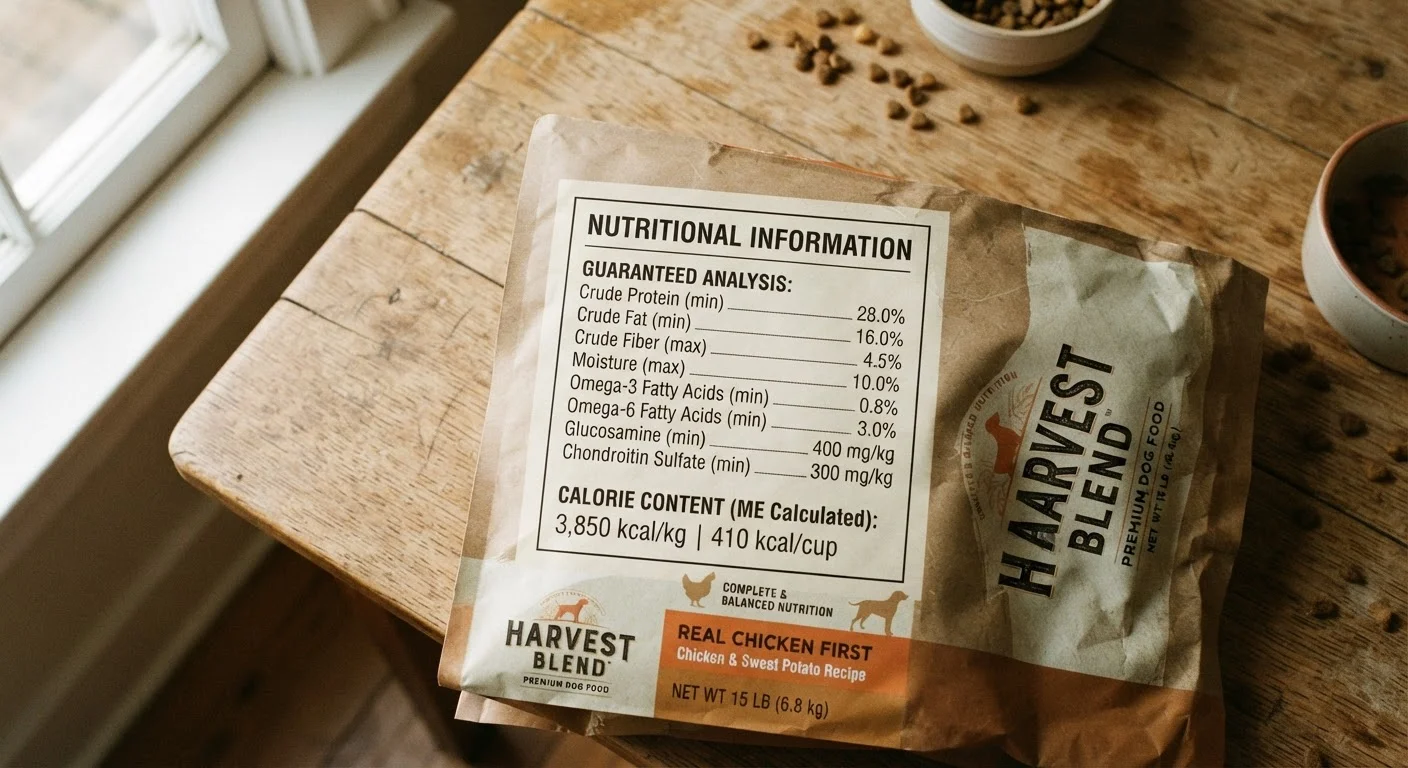
Look for a paragraph-length statement near the guaranteed analysis panel on the back or side of the package. It will name AAFCO explicitly and specify the life stage covered. If you cannot locate this statement, the food has not made a "complete and balanced" claim - treat its nutritional completeness as unverified.
Neither method guarantees a food is optimal for every individual animal, but together these pathways give pet owners a meaningful baseline assurance that basic nutritional requirements have been considered.
Life Stage Designations: Why They Matter More Than You Might Think
The nutritional adequacy statement always specifies a life stage: growth (puppies/kittens), adult maintenance, reproduction, or "all life stages." These are not interchangeable, and choosing the wrong one can have real consequences.
A food meeting only the adult maintenance profile, for example, may not supply adequate calcium and phosphorus ratios needed for skeletal development in growing puppies. Conversely, feeding a growth-formula food to a sedentary adult dog long-term can contribute to excess nutrient intake. "All life stages" foods meet the most demanding profile - growth and reproduction - making them suitable across the board, though they are not inherently superior in quality.
Understanding life stage labeling connects directly to the broader question of which feeding approach is right for your pet. Our overview of commercial, raw, and home-cooked feeding lays out where AAFCO-compliant foods fit within those choices.
What AAFCO Standards Do Not Guarantee
Meeting AAFCO standards is a floor, not a ceiling. The profiles establish minimum nutritional adequacy, but they do not evaluate ingredient quality, sourcing practices, palatability, or how a specific food performs for an individual animal's health history. Two foods can both be "complete and balanced" while differing substantially in ingredient composition and overall quality.
For a deeper look at what the ingredient list itself reveals - including how ingredient order reflects proportions by weight - see our guide to decoding pet food labels. You may also want to review ingredient red flags that nutrition experts flag as a complementary step.
Additionally, AAFCO compliance does not address contaminants, manufacturing consistency, or recalls - all of which are regulated separately by state and federal agencies. Staying informed through official sources and consulting your veterinarian remains the most reliable safety net for your pet's long-term dietary health.
This article is for general informational and educational purposes only and is not a substitute for professional veterinary advice. Always consult a licensed veterinarian before making significant changes to your pet's diet, particularly for animals with existing health conditions.