

Key Takeaways
Our Verdict
Commercial diets remain the most practical, nutritionally vetted option for most pet owners. Raw and home-cooked approaches can work, but each demands a significantly higher level of knowledge, planning, and veterinary oversight to be safe and nutritionally adequate. The best diet is one that meets your individual pet's needs while fitting realistically into your lifestyle.
| Best for | Recommended |
|---|---|
| Pet owners seeking convenience and regulatory oversight | Commercial (kibble or wet food) |
| Those who want full ingredient transparency with professional guidance | Home-cooked (veterinary-formulated) |
| Owners willing to invest in rigorous food-safety protocols | Raw (with veterinary supervision) |
Why the Feeding Debate Matters
Walk into any pet supply store or open a pet-owner forum and you'll encounter passionate advocates for every feeding style. The intensity of those conversations can make a straightforward decision feel overwhelming. The reality is that each approach - raw, home-cooked, and commercial - rests on a distinct set of nutritional assumptions, practical demands, and safety considerations.
Understanding those differences clearly is the first step toward making a confident, well-grounded choice for your animal. This article maps all three approaches against the criteria that matter most: nutritional completeness, food safety, cost and time investment, and suitability across different pet health situations. For a closer look at how age affects these considerations, see our guide on nutritional needs at every life stage.
This article is for general educational purposes only and is not a substitute for veterinary advice. Always consult a licensed veterinarian before changing your pet's diet.
Commercial Diets: Convenience With a Regulatory Framework
Commercial pet foods - whether dry kibble, wet canned food, or semi-moist formats - are the most widely used option in the United States. One key reason: they are subject to nutritional standards set by the Association of American Feed Control Officials (AAFCO). Foods carrying an AAFCO nutritional adequacy statement have either been formulated to meet established nutrient profiles or have passed feeding trials, providing a meaningful baseline assurance of completeness.
That said, "complete and balanced" labeling doesn't mean all commercial foods are equal. Ingredient quality, protein sources, and processing methods vary considerably. Learning to read a pet food label is a skill worth developing - our explainer on what terms like "chicken meal" and "by-products" actually mean can help decode the fine print.
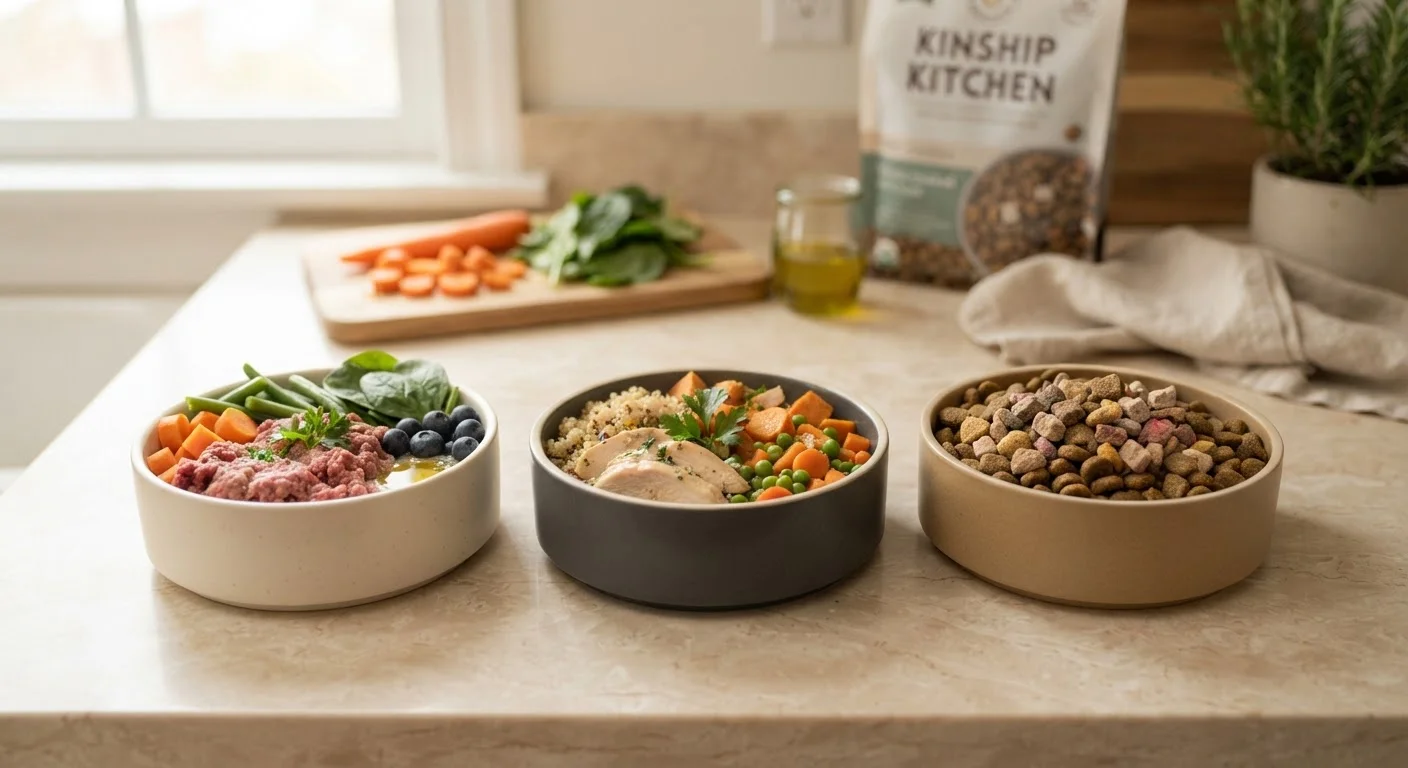
| Commercial | Raw | Home-Cooked | |
|---|---|---|---|
| Nutritional completeness | AAFCO-verified when labeled | Often incomplete without expert formulation | Usually incomplete without veterinary nutritionist |
| Food safety risk | Low (cooked, tested) | High (bacterial pathogens) | Low-moderate (depends on handling) |
| Ingredient transparency | Moderate - label required | High - owner-sourced | High - owner-selected |
| Time investment | Very low | Moderate to high | High |
| Cost | Low to moderate | Moderate to high | Moderate to high |
| Veterinary guidance needed | Routine checkups | Strongly recommended | Essential |
| Suitability for immunocompromised pets | Generally suitable | Not recommended | Suitable if properly formulated |
For owners weighing format choices within the commercial category, our breakdown of dry kibble vs. wet food nutritional differences covers the trade-offs in detail.
Raw Diets: Potential Benefits and Real Risks
Raw feeding - typically called BARF (Biologically Appropriate Raw Food) or "prey model" feeding - centers on uncooked meat, bones, and organs, sometimes supplemented with vegetables and fruits. Proponents argue it more closely mirrors what animals would eat in the wild and may support coat health and digestion.
The scientific evidence for these claimed benefits is limited and inconsistent. What is well-documented, however, are the risks. Major veterinary organizations, including the American Veterinary Medical Association (AVMA), caution against raw diets because of the potential for bacterial contamination - particularly Salmonella and Listeria - which poses risks both to pets and to the humans handling the food. Pets with compromised immune systems, households with young children or elderly adults, and pregnant individuals face elevated concern.
Raw Diets and Household Safety
Handling raw meat for pet food carries the same contamination risks as handling raw meat for human consumption - but spread across more surfaces and more frequently. The AVMA and the Centers for Disease Control and Prevention (CDC) both note that raw pet food has been linked to human illnesses caused by Salmonella and Listeria. If anyone in your household is immunocompromised, pregnant, very young, or elderly, discuss this risk explicitly with both your veterinarian and your own healthcare provider before considering a raw diet.
Raw diets also frequently fail nutritional completeness standards when formulated without professional guidance. Calcium-to-phosphorus imbalances from bone-heavy diets are a documented concern, especially in growing puppies.
Home-Cooked Diets: Ingredient Control Requires Expertise
Home-cooked meals appeal to owners who want full visibility into every ingredient their pet consumes - a reasonable goal, particularly for animals with food allergies or sensitivities. Cooking also eliminates the pathogen risks associated with raw feeding.
The critical challenge is nutritional balance. Research published in veterinary nutrition literature has found that the vast majority of home-cooked recipes available online or in popular books fail to meet established nutrient requirements for dogs or cats. Deficiencies in calcium, zinc, vitamin D, and several B vitamins are especially common when recipes are followed without veterinary oversight.
A board-certified veterinary nutritionist can formulate a complete, balanced home-cooked recipe tailored to your specific pet. This is not an optional step - it is what separates a genuinely nourishing home diet from one that causes slow, cumulative nutritional harm. For an honest look at both sides of this approach, see the pros and cons of home-cooked pet diets.
Switching Approaches: Making Transitions Safely
Whichever direction you choose - or if you decide to adjust within a category - how you transition matters as much as what you transition to. Abrupt dietary changes commonly cause gastrointestinal upset: vomiting, loose stools, and temporary appetite loss. A gradual switchover, typically over seven to ten days, allows the gut microbiome to adjust.
Our practical guide on transitioning your pet to a new diet without digestive upset walks through a structured approach. If your pet is currently on a grain-containing food and you are evaluating grain-free options, the evidence base for that decision is worth reviewing separately: grain-free vs. traditional pet diets - what the research actually shows.
Regardless of the feeding method you land on, regular veterinary checkups and periodic bloodwork are the most reliable tools for confirming that your pet's diet is actually working for their individual biology.