

Key Takeaways
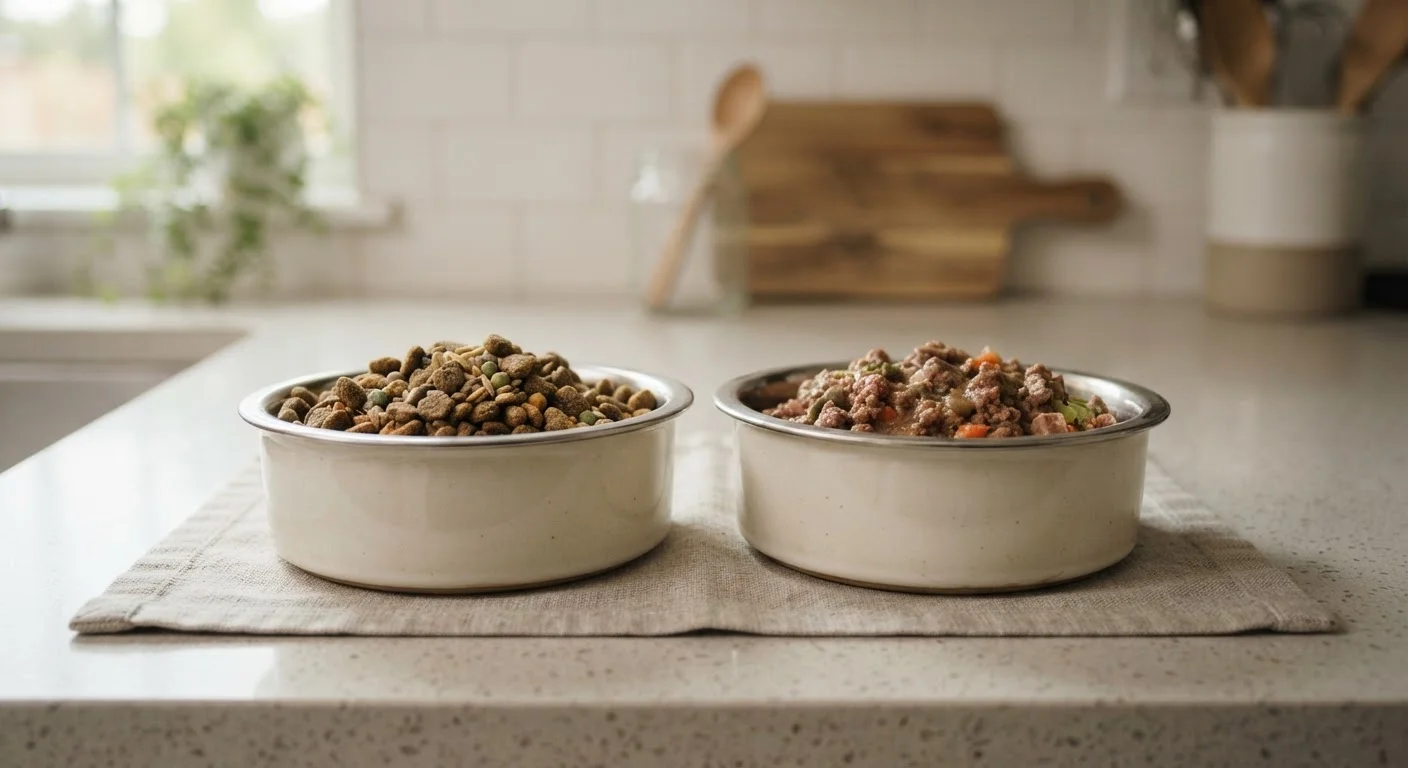
Option A
Dry Kibble
The convenient, shelf-stable staple of most pet households.
Best for: Pets with healthy teeth and normal hydration levels whose owners value cost-efficiency and long shelf life.
Option B
Wet Food
The moisture-rich option prized for palatability and hydration support.
Best for: Pets with urinary concerns, reduced thirst drive, dental challenges, or picky eating habits that make dry food difficult.
If your cat has a history of urinary tract issues or kidney disease
Wet Food
Higher moisture content helps increase daily fluid intake, which supports urinary tract health and kidney function. Veterinary guidance is essential for pets with diagnosed conditions.
If budget and convenience are your primary concerns
Dry Kibble
Kibble delivers more calories per dollar, has a longer shelf life, and doesn't require refrigeration after opening, making daily feeding simpler and more economical.
If your senior pet has a reduced appetite or chewing difficulty
Wet Food
Wet food's stronger aroma and softer texture tend to be more palatable for aging pets whose sense of smell or chewing ability may have declined.
If dental health is a primary concern for your dog
Dry Kibble
The mechanical action of chewing dry kibble can help reduce plaque buildup, though it is not a substitute for regular dental care or veterinary cleanings.
If you want to balance palatability and cost
Wet Food
Adding a small portion of wet food to dry kibble can improve palatability while managing cost, provided total caloric intake is carefully monitored.
The Moisture Divide: Why Water Content Changes Everything
The single most significant nutritional difference between dry and wet pet food is water content. Wet food - whether sold in cans, pouches, or trays - typically contains between 70% and 80% moisture. Dry kibble, by contrast, usually sits at just 8% to 12%. This gap has real consequences for how you interpret the label and how your pet's body responds to each meal.
Because wet food is so much heavier with water, the nutrients visible on the guaranteed analysis panel look more dilute than they actually are. To compare the two formats fairly, nutritionists use a dry-matter basis calculation - stripping out all moisture to compare what's left. When you do this math, the protein, fat, and carbohydrate profiles of many quality wet and dry foods are closer to each other than a raw label comparison suggests. Our guide to reading pet food labels accurately walks through this calculation step by step.
For cats especially, moisture intake matters greatly. Cats evolved in arid environments and have a naturally low thirst drive, meaning many do not compensate adequately for dry food's low moisture content by drinking more water. Over time, chronic low fluid intake is associated with increased risk of urinary and kidney issues in cats - though individual risk varies and no food change should replace a veterinarian's guidance.
| Criterion | Dry Kibble | Wet Food |
|---|---|---|
| Moisture content | 8-12% | 70-80% |
| Typical protein level (dry-matter basis) | Moderate to high | Often higher, especially meat-forward |
| Carbohydrate content | Generally higher (needed for extrusion) | Generally lower |
| Cost per calorie | Lower | Higher |
| Shelf life (opened) | Several weeks (sealed container) | 1-2 days (refrigerated) |
| Palatability for picky eaters | Variable | Generally higher |
| Dental benefit | Modest (chewing action) | Minimal |
| Hydration support | Low | High |
Protein, Fat, and Carbohydrates: Reading Past the Percentages
Once moisture is accounted for, the macronutrient profiles of dry and wet food still differ in meaningful ways. Wet foods - particularly those marketed as pâtés or meat-forward stews - tend to be higher in animal-sourced protein and fat, and lower in carbohydrates. Dry kibble, because carbohydrates are essential to the extrusion process that shapes and binds the pieces, generally contains more starch than wet alternatives.
This matters most for cats, who are obligate carnivores. Their metabolism is specifically adapted to derive energy from protein and fat rather than carbohydrates, and they have limited ability to regulate carbohydrate metabolism the way omnivores like dogs can. Dogs are more metabolically flexible, meaning moderate carbohydrate levels in kibble are generally well tolerated - though individual health conditions may change this picture.
Ingredient quality within each format also varies widely. A high-quality dry food can outperform a poorly formulated wet food, and vice versa. That's why the format alone doesn't determine nutritional adequacy - the full ingredient list and the AAFCO (Association of American Feed Control Officials) nutritional adequacy statement both matter. For a broader view of how diet format fits into overall feeding philosophy, see our overview of the main approaches to feeding pets.
70-80%
Moisture content in typical wet pet food
Compared to roughly 8-12% in dry kibble, this difference substantially affects daily fluid intake for pets that eat wet food exclusively.
~6x
More moisture in wet food vs. dry kibble
This rough ratio illustrates why cats with low thirst drive may consume significantly more water through wet food than through drinking alone.
AAFCO
Nutritional adequacy standard to look for on labels
The Association of American Feed Control Officials sets the model regulations used by US states to determine whether a pet food meets minimum nutritional standards for a given life stage.
Practical Considerations: Cost, Storage, and Feeding Ease
Beyond nutrition, the day-to-day logistics of each format shape which one fits a household's rhythm. Dry kibble has a clear advantage in cost per calorie - it is generally less expensive to produce and ship, and those savings tend to pass to the consumer. An opened bag stays fresh for several weeks when stored in a sealed container away from heat and moisture. Wet food, once opened, must be refrigerated and used within a day or two, which can create waste if you have a small or finicky eater.
Portion control is also more straightforward with kibble: measured cups or weight-based portions are easy to replicate daily. Wet food portions require attention to caloric density on the label, since a 3-oz can of one product may contain very different calories than another of the same size.
For multi-pet households or owners managing specific health conditions across different animals, the format question becomes more complex. Life stage is another key variable - nutritional needs shift meaningfully from puppyhood through senior years, as detailed in our article on feeding pets at every life stage. A senior cat with kidney disease and a young active dog in the same home may genuinely need different solutions.
This article is for general informational and educational purposes only. It is not a substitute for veterinary advice. Always consult a qualified veterinarian before making significant changes to your pet's diet, especially if your pet has a health condition.