

Key Takeaways
Pet Food Label
A pet food label is the regulated panel of information printed on every commercially sold pet food package. It includes the product name, ingredient list, guaranteed analysis, feeding guidelines, and manufacturer contact details. In the US, these labels are governed by the Association of American Feed Control Officials (AAFCO) and individual state feed laws.
AAFCO sets the model regulations that most US states adopt, but enforcement varies by state. The label's "complete and balanced" claim has a precise regulatory meaning tied to AAFCO nutrient profiles or feeding trial standards.
How the Ingredient List Is Structured
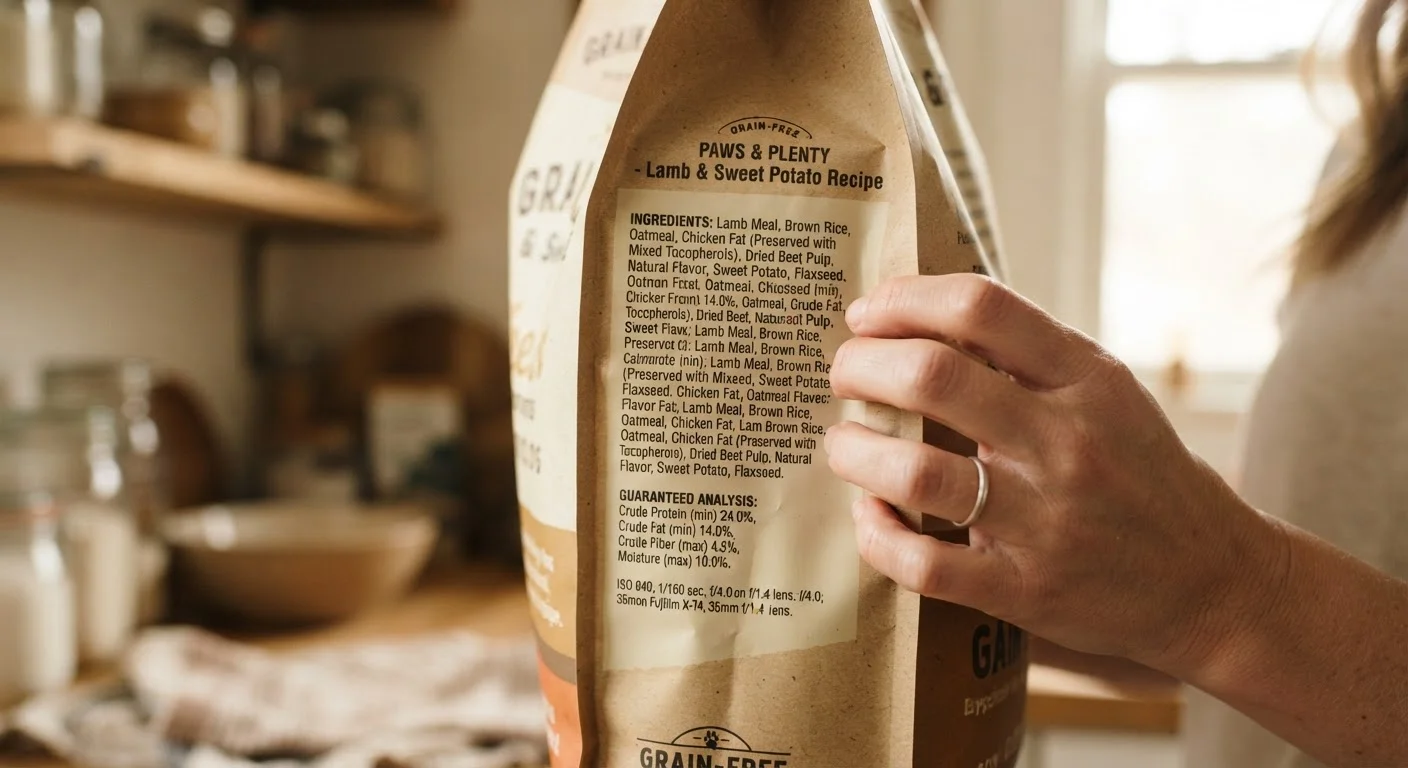
Every ingredient on a US pet food label must be listed in descending order by weight - measured before processing. This sounds straightforward, but it creates a key distortion: whole meats like chicken or beef contain 60-75% moisture by weight. Once that moisture cooks off during manufacturing, the actual contribution of that meat to the finished product shrinks considerably.
This means a bag that prominently lists "chicken" as its first ingredient may still be largely composed of grains or legumes by the time it reaches your pet's bowl. Reading just the first one or two ingredients gives an incomplete picture. Scan the full list, paying attention to how many protein sources appear before the first carbohydrate ingredient.
For a broader look at how similar label logic applies to human food, see our guide to reading nutrition labels - many of the same principles carry over.
Ingredient Names Are Standardized
AAFCO publishes an official list of defined ingredient names that manufacturers must use on labels. This means 'chicken meal' has a specific regulatory definition - it is rendered, dried chicken tissue - and cannot be used loosely. Knowing that these terms are defined (not invented by marketing teams) makes the ingredient list more reliable as a reference tool.
Ingredient Splitting: A Common Labeling Tactic
Ingredient splitting occurs when a manufacturer lists the same base ingredient under several distinct names, each appearing separately on the label. For example, a formula might list "ground corn," "corn gluten meal," and "corn flour" as three separate entries. Individually, each appears lower on the list than they would if combined into a single "corn" entry.
This practice is legal and common. It doesn't automatically signal a poor-quality food, but it does mean that a high-ranking meat protein might be outweighed in total by a fragmented carbohydrate source. Learning to mentally group related ingredients helps you estimate their combined proportion more accurately.
Our article on pet food ingredient red flags covers additional labeling patterns that are easy to overlook.
Group Related Ingredients Mentally
When you spot multiple forms of the same base ingredient - like 'pea protein,' 'pea flour,' and 'pea starch' - mentally add them together. Their combined weight may place that ingredient higher on the list than any single entry suggests. This quick habit gives you a more accurate read of what dominates the formula.
The Guaranteed Analysis: What Those Numbers Mean
Below the ingredient list, you'll find the guaranteed analysis panel - a table showing at minimum: crude protein (minimum %), crude fat (minimum %), crude fiber (maximum %), and moisture (maximum %). These are regulatory thresholds, not precise values. A food guaranteeing "18% crude protein minimum" may actually contain 22%; the label simply promises it won't fall below 18%.
The word "crude" is also significant. Crude protein is measured by detecting nitrogen content, which reflects the presence of protein but not its digestibility or biological value. A food high in crude protein isn't automatically high in usable protein for your pet. Digestibility data is rarely listed on labels and typically requires consulting manufacturer resources or veterinary nutritionists.
For a full breakdown of how to work with these numbers, our guaranteed analysis walkthrough steps through each line item in practical terms.
4
Required sections on every US pet food label
AAFCO model regulations require a product name, ingredient list, guaranteed analysis, and nutritional adequacy statement at minimum.
~70%
Typical moisture content in whole raw meat
This pre-processing water weight is why whole meats listed first on labels shrink significantly in relative proportion after cooking.
2
Ways AAFCO allows a 'complete and balanced' claim
A food can qualify either by meeting AAFCO nutrient profiles through formulation, or by passing a controlled feeding trial - two meaningfully different standards.
Life Stage Claims and the 'Complete and Balanced' Statement
One of the most important - and most misunderstood - statements on a pet food label is the nutritional adequacy statement. This is the line that reads something like: "Formulated to meet the nutritional levels established by the AAFCO Dog Food Nutrient Profiles for all life stages."
This statement tells you two things: whether the food is nutritionally complete (as opposed to a treat or supplement) and which life stage it's designed for. Life stages recognized by AAFCO include growth (puppies/kittens), reproduction, adult maintenance, and "all life stages." A food labeled for adult maintenance is not formulated to meet the higher nutrient demands of a growing puppy or a pregnant animal.
The AAFCO standards explainer goes deeper into what it takes for a product to earn this claim - and why it matters more than any marketing phrase on the front of the bag.
This article provides general educational information about pet food labeling and is not a substitute for guidance from a licensed veterinarian or veterinary nutritionist regarding your specific pet's dietary needs.