

Key Takeaways
What the Guaranteed Analysis Panel Actually Tells You
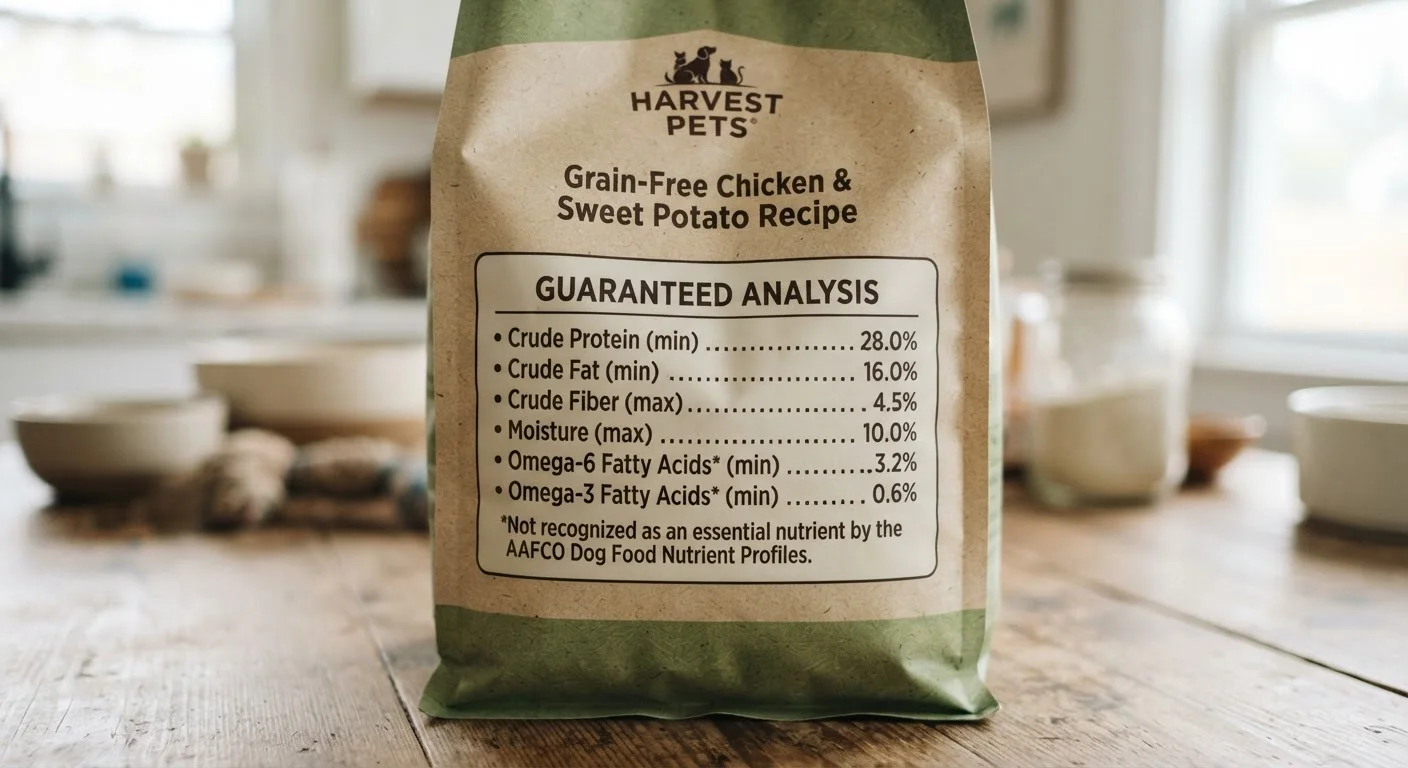
The guaranteed analysis is a standardized disclosure block required on every commercial pet food sold in the United States. It does not describe the food's full nutritional makeup - it provides legally binding minimum or maximum thresholds for four core nutrients. Think of it as a regulatory floor and ceiling, not a complete nutritional report.
The four required entries are crude protein (minimum), crude fat (minimum), crude fiber (maximum), and moisture (maximum). Some labels voluntarily add rows for other nutrients. Regulators, primarily state feed control officials operating under AAFCO model guidelines, use these figures to verify that foods meet baseline standards - not to give consumers the full picture of nutritional quality.
Understanding this limitation upfront helps you use the panel correctly: as one reliable data point to compare alongside the ingredient list, the AAFCO adequacy statement, and your veterinarian's guidance. For a broader look at how feeding approaches differ, see the main approaches to feeding pets.
What you will need
Step-by-Step: How to Read and Use the Panel
The walkthrough below moves from finding the panel to making cross-food comparisons. Keep your pet food packaging and a calculator nearby.
Pet food label or packaging
Provides the guaranteed analysis figures you will read and interpret.
Calculator
Used to perform the dry matter basis conversion when comparing foods.
Notebook or notes app
Lets you record and compare figures across multiple food options side by side.
Locate the guaranteed analysis panel
Find the section of the label explicitly titled Guaranteed Analysis. US regulations enforced by the Association of American Feed Control Officials (AAFCO) require all commercially sold pet foods to include this panel. It is usually on the back or side of the bag or can, and it will list at minimum: crude protein (minimum %), crude fat (minimum %), crude fiber (maximum %), and moisture (maximum %). Some manufacturers voluntarily add more rows - calcium, phosphorus, taurine, omega fatty acids - which can be useful but are not required.
Understand what 'minimum' and 'maximum' mean
Each figure is a legal guarantee, not an exact measurement. Minimum values (protein, fat) mean the food contains at least that percentage - the actual amount could be higher. Maximum values (fiber, moisture) mean the food contains no more than that percentage - the actual amount could be lower. This matters because you cannot assume you know the precise nutrient content; you only know the floor or ceiling. When a food lists 30% crude protein minimum, it meets or exceeds that threshold but may differ from batch to batch within legal tolerances.
Note the moisture percentage first
Before interpreting any other number, record the moisture percentage. Dry kibble typically runs 8-12% moisture; wet or canned food commonly runs 75-82%. This difference dramatically dilutes every other nutrient figure in wet foods. Comparing a wet food's as-fed protein directly to a dry food's as-fed protein will almost always make the wet food look less nutritious than it may actually be - a misleading picture that the dry matter conversion in the next step corrects.
Convert figures to a dry matter basis
Dry matter basis (DMB) removes the effect of water so nutrients are expressed as a proportion of the food's solid content only. The formula is straightforward:
- Subtract the moisture percentage from 100 to get the dry matter percentage.
- Divide the nutrient's as-fed percentage by the dry matter percentage.
- Multiply by 100 to express the result as a percentage.
Example: A wet food with 9% crude protein and 78% moisture has a dry matter protein of 9 ÷ (100 − 78) × 100 = 40.9%. A kibble with 28% crude protein and 10% moisture yields 28 ÷ 90 × 100 = 31.1%. On a dry matter basis, the wet food actually delivers more protein per unit of solid content.
Interpret crude protein and crude fat in context
Crude protein is measured by estimating total nitrogen content, which is a proxy for protein. It does not indicate digestibility or the quality of the amino acid profile. A food with high crude protein from a well-digestible animal source is nutritionally different from one hitting the same number via less bioavailable plant proteins. Pair the protein figure with the ingredient list to understand the source. Our article on what "chicken meal" and "by-products" actually mean explains those terms clearly.
Crude fat (minimum) signals energy density. Higher fat generally means more calories, which may be desirable for working dogs or underweight animals but less so for sedentary or overweight pets.
Evaluate crude fiber and consider your pet's needs
Crude fiber (maximum) measures indigestible plant material. Most maintenance adult pet foods fall in the 3-5% fiber range on a dry matter basis. Foods marketed for weight management often run 8-10% or higher - fiber adds bulk and promotes satiety without adding significant calories. Foods designed for diabetic cats may also use elevated fiber to slow glucose absorption. Conversely, a very low-fiber food may be chosen for pets with certain gastrointestinal conditions. Match the fiber level to your veterinarian's recommendation for your individual animal rather than a general rule.
Cross-reference with the AAFCO statement and ingredient list
The guaranteed analysis tells you how much of the key macronutrients are present; it does not tell you whether the food is complete or appropriate for your pet's life stage. Check the label separately for an AAFCO nutritional adequacy statement. Our explainer on what "complete and balanced" actually means walks through exactly what that statement requires. Then scan the ingredient list for quality and composition cues - for a deeper look at common red flags, see ingredient red flags owners routinely miss.
Use the Dry Matter Formula Every Time
To convert any nutrient to a dry matter basis, divide the as-fed percentage by (100 minus the moisture percentage), then multiply by 100. For example, a wet food with 8% protein and 78% moisture: 8 ÷ (100 − 78) × 100 = 36.4% protein on a dry matter basis. Keep this formula in your notes app for quick label checks at the store.
Guaranteed Analysis Is Not a Complete Nutritional Profile
The panel lists only four required figures - crude protein, crude fat, crude fiber, and moisture. It does not disclose amino acid profiles, vitamin levels, mineral ratios, or caloric density. If your pet has a diagnosed health condition requiring a specific diet, work with a veterinarian or board-certified veterinary nutritionist rather than relying solely on this panel to make feeding decisions.
This article provides general pet nutrition education and is not a substitute for personalized advice from a licensed veterinarian or board-certified veterinary nutritionist.
Common Misreadings and How to Avoid Them
Even careful readers can fall into predictable traps with the guaranteed analysis panel. Here are the most frequent mistakes and how to sidestep them:
- Treating minimums as exact values. A 30% minimum protein food might actually contain 34% protein - minimums are floors, not measurements.
- Comparing wet and dry foods without converting. See the warning note in the step guide and always apply the dry matter formula before drawing conclusions.
Don't Compare Wet and Dry Foods As-Is
A wet food showing 10% crude protein and a dry kibble showing 28% protein are not directly comparable - the wet food may actually deliver more protein per calorie once water is removed from the equation. Always convert both foods to a dry matter basis before drawing conclusions about relative nutrient density.
- Equating high protein percentage with high quality. Crude protein measurement does not distinguish between highly digestible animal proteins and less bioavailable sources. The ingredient list provides that context.
- Ignoring caloric density. The guaranteed analysis does not include calorie content, yet calorie density drives portion size significantly. Many manufacturers voluntarily list kilocalories per cup or can - look for it near the feeding guidelines.
Reading the guaranteed analysis alongside the full label takes only a few minutes but substantially improves the quality of information you have before choosing a food for your pet. If you want to sharpen your general label-reading skills beyond pet food, our guide to reading nutrition labels without getting lost covers the core concepts clearly.