

Key Takeaways
Why the Nutrition Facts Panel Exists - and What It Can Do For You
The Nutrition Facts panel is a federally mandated label that appears on most packaged foods sold in the United States, governed by FDA regulations. Its current format - updated in 2020 - was redesigned to make calorie counts more prominent, add a mandatory line for added sugars, and align serving sizes more closely with how people actually eat.
Used correctly, the label is one of the most practical tools available for making informed food choices without requiring advanced nutrition knowledge. But its usefulness depends on knowing which numbers to look at, in what order, and what they actually mean. If you're newer to thinking about nutrition broadly, our practical introduction to nutrition fundamentals provides useful background context.
What you will need
The steps below walk through the label systematically, from top to bottom - the same order the FDA designed it to be read.
Packaged Food Item
Provides a real nutrition facts panel to practice reading during each step.
USDA FoodData Central (fdc.nal.usda.gov)
A free government database for looking up detailed nutrient information on thousands of foods.
How to Read a Nutrition Label, Step by Step
Find the serving size and servings per container
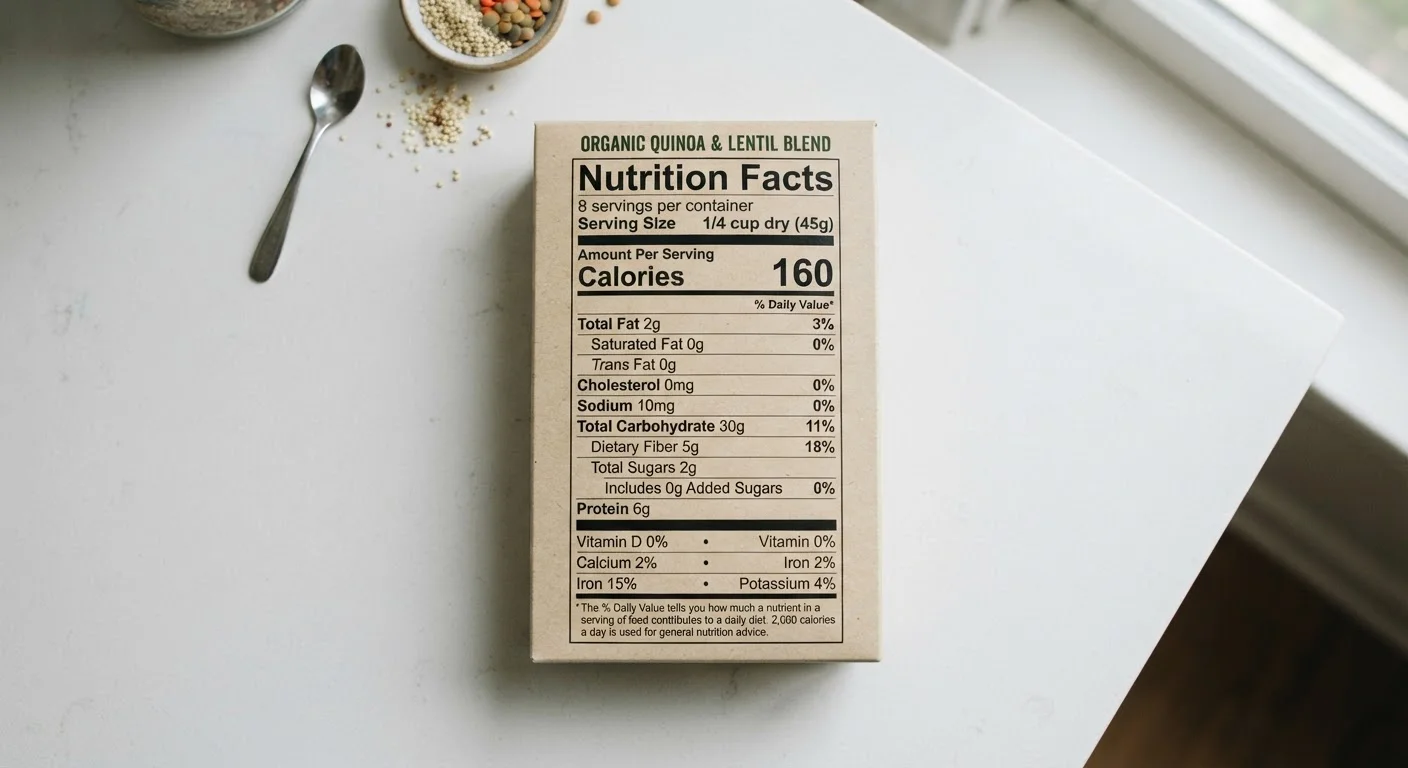
Before any other number means anything, you need to know the serving size. The FDA requires this information to appear at the top of the panel in a large, bold font. Serving sizes are standardized reference amounts - they reflect how much people typically eat of that food, not necessarily a recommended portion.
Crucially, every calorie count and nutrient figure on the label applies to one serving, not the whole package. Check how many servings are in the container. If there are 2.5 servings and you eat the whole thing, multiply every number by 2.5.
Read the calorie count in context
The calorie count shown is per serving. Calories measure the energy a food provides - a concept explored in more depth in our guide to what calorie numbers actually represent. A number in isolation doesn't tell you much without considering the serving size and the nutrients that accompany it.
High-calorie foods aren't inherently problematic if they deliver significant nutrients; low-calorie foods aren't automatically beneficial if they're nutritionally sparse. Consider calorie count alongside the nutrient profile - not instead of it.
Interpret Percent Daily Value (%DV)
The right-hand column lists %DV - the percentage of a nutrient that one serving provides relative to a 2,000-calorie daily reference diet established by the FDA. This figure is a standardized benchmark, not a personal target; your actual needs may differ based on age, sex, activity level, and health status.
%DV is most useful as a quick comparison tool. You can use it to see whether a food is a strong or weak source of a given nutrient, and to compare two similar products side by side.
Identify nutrients to limit and nutrients to seek
The label separates nutrients into two functional groups. Limit these: saturated fat, trans fat, sodium, and added sugars. Consistently high intake of these nutrients is associated with increased risk of cardiovascular disease, hypertension, and metabolic conditions, according to established dietary guidelines.
Seek these: dietary fiber, vitamin D, calcium, iron, and potassium - nutrients many Americans under-consume. For a deeper look at why fiber earns so much attention, see why fiber keeps coming up in every nutrition conversation.
Read the ingredient list strategically
Ingredients are listed in descending order by weight - the first ingredient is the most abundant. If a refined grain or added sugar appears in the first two or three positions, that ingredient makes up a substantial portion of the product.
Sugar goes by many names on ingredient lists: corn syrup, dextrose, maltose, evaporated cane juice, and fruit juice concentrate are all forms of added sugar. Scanning for these terms gives you a more complete picture than the ingredient name alone.
Put front-of-package claims in perspective
Terms printed on the front of a package - 'natural,' 'light,' 'low-fat,' 'multigrain' - are largely marketing language. Some have loose regulatory definitions; others have none. A 'low-fat' product, for instance, may compensate with higher added sugar content. The nutrition facts panel and ingredient list are the authoritative sources; front-of-package claims are not.
For a fuller picture of how these marketing signals can subtly skew food choices, our overview of common nutrition traps is worth reading alongside this guide.
Use %DV as a Quick Compass
As a general rule, 5% DV or less for a nutrient is considered low, while 20% DV or more is considered high. This shorthand helps you quickly assess whether a food is a meaningful source of a nutrient - or a significant contributor to one you're trying to limit.
Front-of-Package Claims Can Mislead
Terms like 'natural,' 'multigrain,' and 'made with real fruit' are not strictly regulated nutrition claims. A product displaying these phrases may still be high in added sugars or sodium. Always flip to the nutrition facts panel and ingredient list before drawing conclusions about a food's healthfulness.
Putting Labels to Work in Everyday Decisions
Reading a label fluently is most valuable when it's fast. With practice, a 15-second scan - serving size, calories, a glance at %DV for sodium and fiber, a quick look at the first few ingredients - gives you enough information to make a reasonable comparison between two products.
Labels are best used comparatively rather than in isolation. Holding two similar products side by side and comparing their %DV figures for saturated fat or added sugars is often more informative than evaluating either product alone. For a structured way to apply this kind of thinking across your overall eating patterns, the weekly eating audit checklist offers a practical framework.
Understanding labels also pairs well with broader principles around how foods are evaluated - concepts like nutrient density versus calorie density and building a balanced plate give you the conceptual foundation to make label data actionable.
This Is General Information, Not Medical Advice
Nutrition labels are a public health tool, but individual dietary needs vary significantly based on health status, age, medications, and other factors. This article provides general educational guidance only. For personalized dietary recommendations, consult a registered dietitian or qualified healthcare provider.
This article is for general informational and educational purposes only and does not constitute medical or dietary advice. Consult a qualified healthcare provider or registered dietitian for guidance specific to your health needs.