

Key Takeaways
Why Labels Trip Up Even Attentive Owners
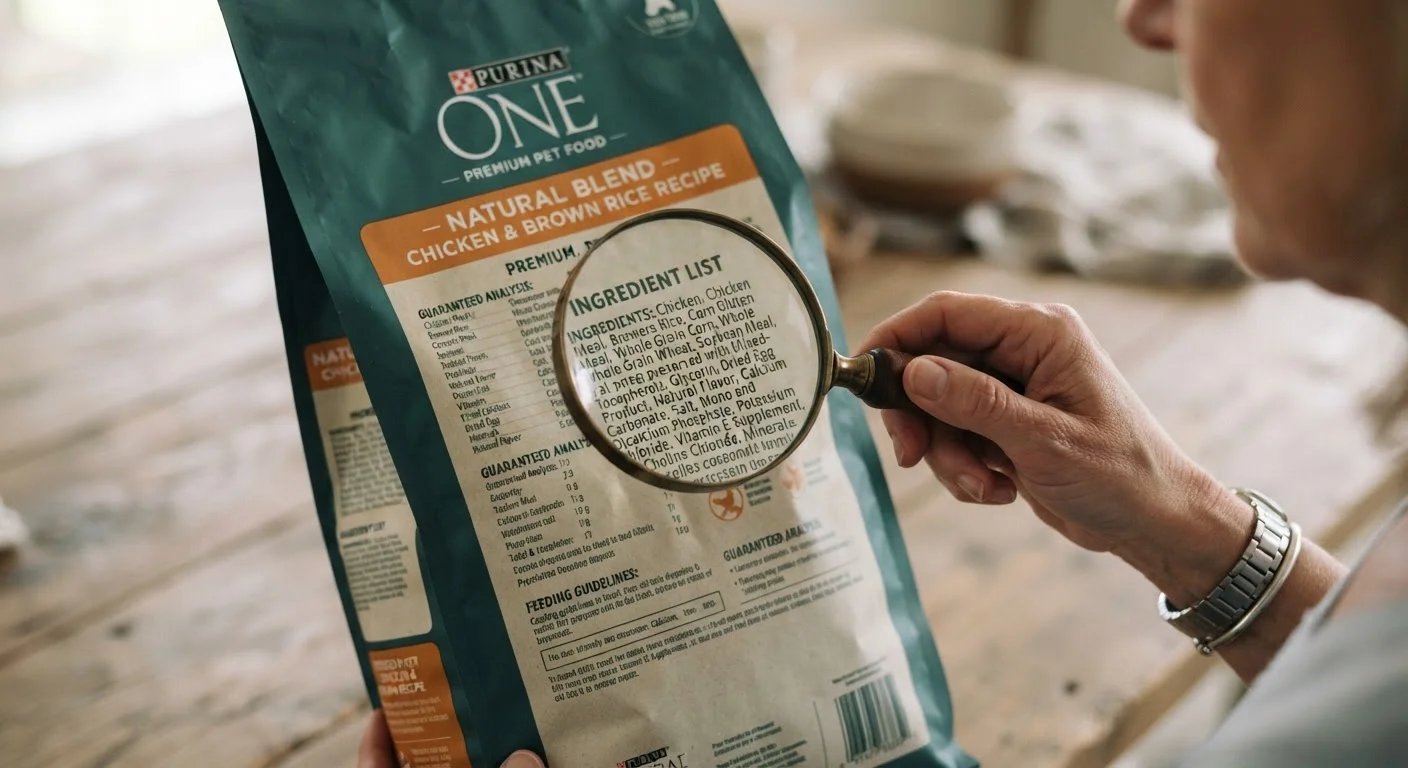
Pet food labels are governed by a patchwork of federal and state rules, but the regulations leave room for terminology that sounds precise while conveying surprisingly little. Most owners scan for a named protein near the top of the ingredient list and move on - a reasonable instinct, but one that misses several layers of label complexity.
Understanding the mistakes below won't make you a board-certified veterinary nutritionist, but it will help you ask better questions and spot patterns worth flagging with your vet. For a thorough primer on how ingredient lists are structured, see our full guide to reading pet food labels.
Accepting vague protein source names without scrutiny.
Why it happens: Owners reasonably assume that any named protein - 'meat meal,' 'animal protein,' or 'poultry digest' - is equivalent to a clearly identified source like 'chicken' or 'salmon.' The terminology feels official and specific enough.
Overlooking ingredient splitting, which obscures how much of a substance is actually present.
Why it happens: Ingredients are listed by pre-cooking weight in descending order, a fact most owners know. What's less obvious is that a manufacturer can list variations of the same ingredient separately - such as 'ground corn,' 'corn gluten meal,' and 'corn bran' - which pushes each entry down the list even though their combined weight may exceed that of the named protein.
Dismissing artificial preservatives without understanding why they're flagged.
Why it happens: Terms like BHA (butylated hydroxyanisole) and BHT (butylated hydroxytoluene) appear infrequently in marketing materials, so many owners don't recognize them on an ingredient panel. When they do notice, they're uncertain whether the concern is evidence-based or just marketing noise from competing brands.
Ignoring - or misreading - the AAFCO nutritional adequacy statement.
Why it happens: The small-print statement that a food meets AAFCO (Association of American Feed Control Officials) nutritional profiles is easy to overlook, and its significance is rarely explained on packaging. Some owners also confuse 'for supplemental feeding only' products with complete diets.
Assuming 'grain-free' automatically means higher quality or lower risk.
Why it happens: Grain-free positioning has been marketed heavily as a premium, more 'natural' option, and many owners adopted it under the impression that grains are inherently poor ingredients for dogs and cats.
Treating a long ingredient list as a sign of nutritional richness.
Why it happens: In human food culture, a wide variety of ingredients is often associated with a more diverse, nutrient-dense product. Owners transfer this assumption to pet food, feeling reassured by a long list of named vegetables, fruits, and supplements.
How to Use This Information Wisely
Spotting a red flag ingredient doesn't automatically mean a food is harmful or nutritionally inadequate - context matters enormously. A single controversial additive at the tail end of a long ingredient list poses a very different situation than a diet built around unspecified proteins with no AAFCO statement.
Don't Let Label Anxiety Drive Hasty Switches
Rapidly changing a pet's diet - even with good intentions - can cause digestive upset, including vomiting and diarrhea. Any food transition should occur gradually over seven to ten days, mixing increasing proportions of the new food with the old. If your pet has a diagnosed health condition, always involve your veterinarian before making any dietary change, however minor it may seem.
Before switching your pet's food based on label concerns, consult your veterinarian or a board-certified veterinary nutritionist. Individual health conditions, life stage, and breed can all influence what a particular animal actually needs. If you're curious about the guaranteed analysis panel - the crude protein, fat, and fiber numbers - this practical walkthrough explains what those figures mean in real terms.
Some owners respond to label anxiety by switching to home-cooked diets, which carries its own set of nutritional risks. An honest look at home-cooked pet diets covers both the appeal and the pitfalls of that approach.
This article is for general informational purposes only and is not a substitute for professional veterinary or nutritional advice. Always consult a qualified veterinarian before making significant changes to your pet's diet.