

Key Takeaways
The Distraction Problem Is Bigger Than Your Phone
Smartphone bans have dominated road safety messaging for over a decade - and for good reason. But focusing exclusively on phones leaves drivers blind to a wide range of equally hazardous habits that most people never think twice about. Distracted driving is formally defined across three dimensions: visual (eyes off the road), manual (hands off the wheel), and cognitive (mind off the task of driving). The most dangerous distractions hit all three simultaneously.
According to the National Highway Traffic Safety Administration (NHTSA), distraction is a reported factor in thousands of fatal crashes each year - and phone use is just one entry on a much longer list. Understanding the full picture is the first step toward actually reducing your risk behind the wheel. For a related look at how fatigue compounds inattention, see what sleep deprivation does to drivers.
Eating and Drinking at the Wheel
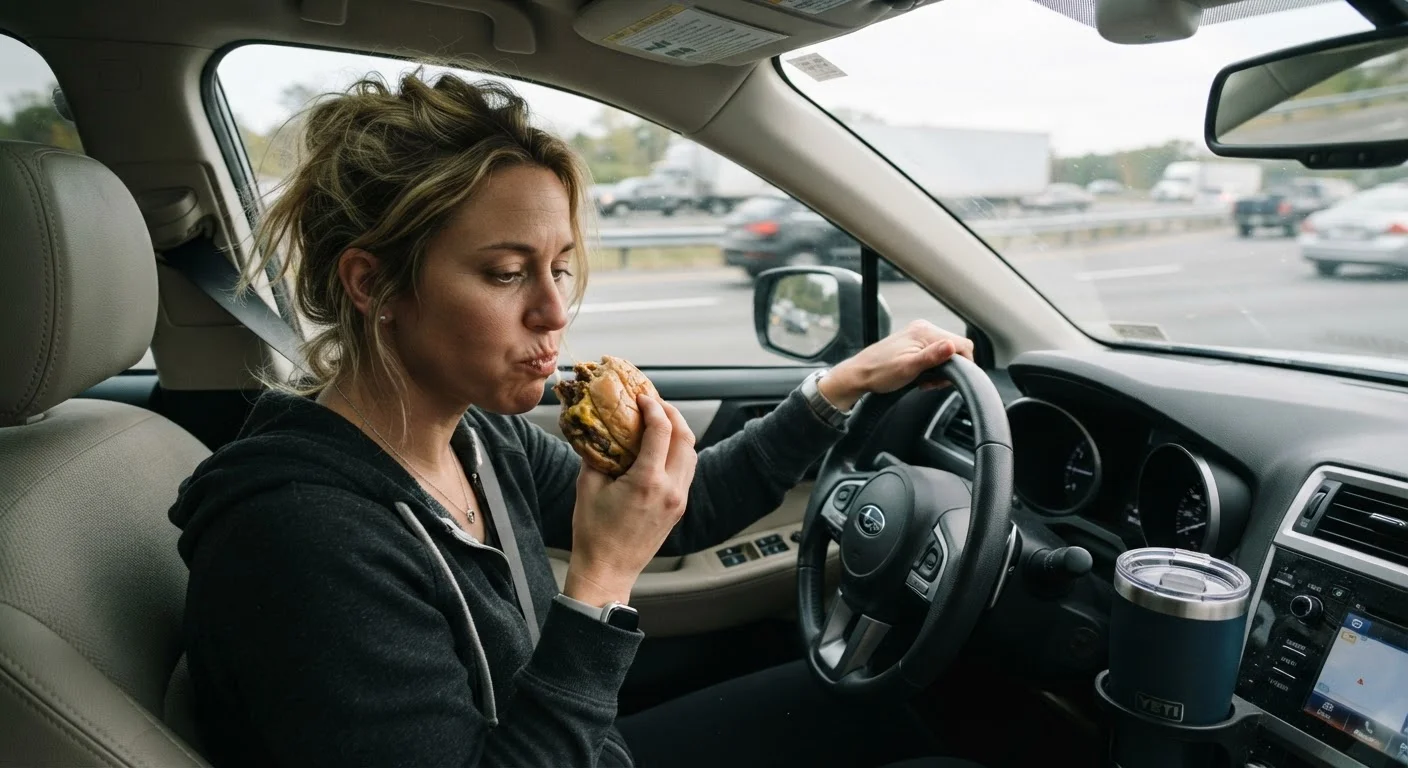
Grabbing a drive-through meal on the way to work feels harmless and efficient. In practice, it involves taking one or both hands off the wheel, repeatedly glancing down at food or a cup, and mentally tracking what you're doing - a three-type distraction event. A spill or a dropped item adds an unpredictable physical reaction on top of that.
Research cited by the NHTSA has found that eating while driving increases crash risk meaningfully, with some estimates placing it in the same risk tier as handheld phone use. If you're hungry, build in two extra minutes to eat parked. It's the simplest fix on this list.
Eating while driving hits all three distraction types - visual, manual, and cognitive - simultaneously.
Adjusting In-Vehicle Controls While Moving
Modern vehicles are loaded with touchscreens, climate zones, seat heaters, and infotainment systems that require eyes and fingers to operate. Even controls that were once simple knobs now demand visual confirmation on a screen. Studies from AAA's Foundation for Traffic Safety have found that interacting with in-vehicle infotainment systems can take a driver's attention off the road for more than 40 seconds on complex tasks.
The fix: learn your vehicle's controls well enough to operate common functions - fan speed, radio - by feel or voice command. Anything that requires reading a screen should wait until you're stopped.
Complex infotainment tasks can occupy a driver's attention for over 40 seconds, according to AAA research.
Hands-Free Doesn't Mean Risk-Free
Hands-free phone calls and voice-activated navigation feel like the responsible compromise. They keep your hands on the wheel - but they don't eliminate cognitive distraction. The brain's processing of a conversation competes directly with the processing required to monitor traffic, read signs, and anticipate hazards.
Research consistently shows that drivers engaged in phone conversations - handheld or hands-free - react more slowly and miss visual cues more often than drivers who aren't on a call. Hands-free technology reduces manual and visual distraction but leaves the cognitive component largely intact.
Hands-free calls still cause cognitive distraction - reaction time suffers whether or not hands are on the wheel.
Passenger Conversations and Dynamics
Passengers aren't inherently distracting - in fact, adult passengers can sometimes act as a second set of eyes. The problem is emotionally engaging or demanding conversations: arguments, stressful discussions, or conversations that pull your mental attention away from the road. Teen passengers in particular have been associated with elevated crash risk for young drivers, a pattern reflected in graduated driver licensing restrictions across many US states.
You don't need to drive in silence. But it's worth recognizing that a heated conversation has the same cognitive distraction profile as a phone call - regardless of what your hands are doing.
Emotionally charged passenger conversations carry the same cognitive distraction load as a hands-free phone call.
Daydreaming and Mind-Wandering
This is the distraction almost no safety campaign addresses - because there's no device to ban. Mind-wandering, sometimes called "highway hypnosis" on long monotonous routes, is consistently cited as one of the most common factors in inattention-related crashes. A driver can have eyes open, hands on the wheel, and still be functionally absent.
Fatigue amplifies this risk significantly. If you notice your mind drifting repeatedly, treat it the same way you'd treat drowsiness: pull over, take a break, and reset. See also how darkness and fatigue combine to raise risk at night for related context on sustained attention.
Mind-wandering is among the most common inattention factors in crashes - and has no device to ban.
Navigation and GPS Interaction
GPS has made driving to unfamiliar places dramatically easier, but how drivers interact with it creates real hazard. Reprogramming a route while moving, zooming in on a map, or reading turn-by-turn text on a screen all introduce visual and manual distraction. Sudden re-routing announcements can also cause abrupt, reactive decisions at intersections.
Best practice: enter your destination before you start moving. If you miss a turn, continue safely to a stopping point before adjusting. The device will recalculate - a moment of patience costs far less than a lane departure. Proper mirror use and situational awareness around your vehicle also helps when navigation changes demand quick decisions; see how to maintain full-surround vehicle awareness.
Reprogramming GPS while moving is one of the most common - and most avoidable - in-car distraction sources.
Making Awareness Work for You
The common thread across every distraction on this list is normalization. Drivers rarely feel distracted when they are - the brain tends to underestimate its own divided attention. That overconfidence is its own hazard; for more on how experience can breed complacency, see the cognitive biases that affect seasoned drivers.
The most practical countermeasure isn't willpower in the moment - it's removing temptation before you pull out of the driveway. Set your GPS route, finish your coffee, brief your passengers on conversation expectations, and adjust mirrors and climate controls while parked. Every task completed before motion begins is one fewer split-second decision competing for your attention at speed. Awareness of what actually distracts you is the foundation everything else is built on.
Build a Pre-Drive Routine
Treat the two minutes before you put the car in drive as your setup window. Set navigation, adjust mirrors, stow food, and handle any urgent communications before you move. Drivers who complete these tasks while parked remove the in-motion temptation entirely - which is more reliable than relying on discipline at 60 mph.