

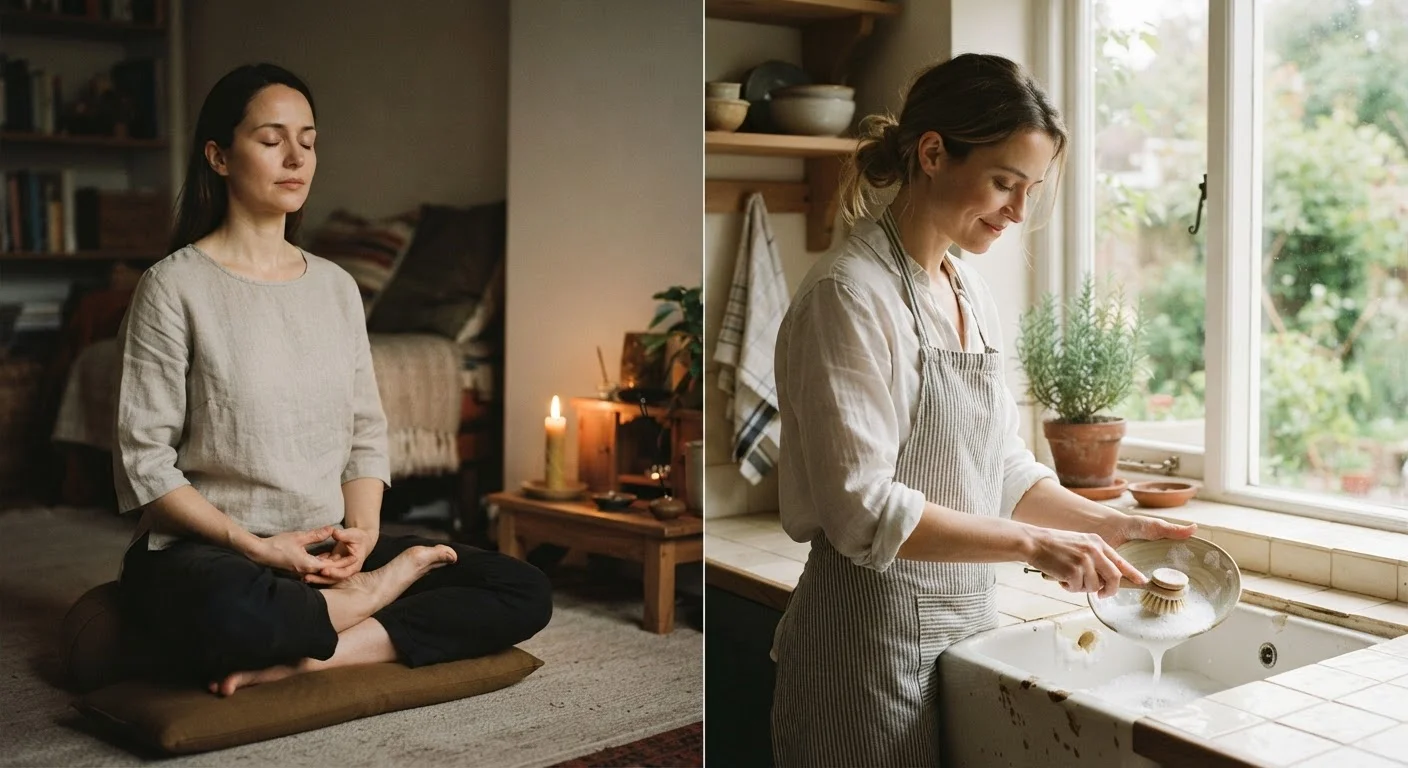
Key Takeaways
Option A
Mindfulness
The always-available awareness practice.
Best for: Anyone who wants to bring greater presence and calm into everyday moments without setting aside dedicated practice time.
Option B
Meditation
The structured, intentional training session.
Best for: People who want to build focused mental skills through consistent, dedicated practice with a defined technique.
If you have limited time and want something you can do anywhere
Mindfulness
Mindfulness requires no equipment or scheduled session - it can be woven into commuting, eating, or conversations without adding anything to your day.
If you want to systematically build concentration and emotional regulation
Meditation
Structured meditation sessions - especially practices like mindfulness-based stress reduction (MBSR) - have the strongest research backing for measurable, lasting mental skills.
If you're entirely new to mental wellness practices
Mindfulness
Starting with informal mindfulness in daily tasks lowers the barrier to entry and builds the attentional muscle that formal meditation later relies on.
If you're managing chronic stress or anxiety and want structured support
Meditation
Clinically validated programs like MBSR use formal meditation to deliver structured, progressive skill-building - consult a healthcare professional to find the right approach for you.
Two Words, One Muddle
Scroll any wellness feed and you'll see "mindfulness" and "meditation" used as if they mean the same thing. They don't - and the distinction matters if you actually want to use either one. Understanding the difference helps you choose the right tool and set realistic expectations. For a broader grounding in mental wellness language, the Mental Health Glossary is a useful companion reference.
The short version: mindfulness is a mental quality - a particular kind of open, non-judgmental attention to the present moment. Meditation is a formal practice - a deliberate, time-set activity you do to train your mind. Many meditation styles use mindfulness as their core technique, which is where the conflation begins. But mindfulness can exist without any meditation at all, and meditation can be practiced without much mindfulness (think focused visualization or loving-kindness practices).
What Mindfulness Actually Is
Mindfulness, at its root, is the capacity to notice what is happening - in your body, your thoughts, or your surroundings - without immediately reacting or judging. Psychologists often describe it as present-moment awareness with acceptance. It isn't a blank mind or a special state; it's simply attention directed intentionally at the here and now.
Crucially, mindfulness is portable. You can be mindful while eating, walking, talking, or doing the dishes. When you notice the temperature of the water, the weight of a plate, or the sound of traffic without your thoughts spiraling elsewhere, that is mindfulness in action. Research published in clinical psychology journals consistently links trait mindfulness - the natural tendency toward this awareness - with lower perceived stress, reduced rumination, and greater emotional resilience.
| Criterion | Mindfulness | Meditation |
|---|---|---|
| What it is | A quality of awareness | A structured practice or exercise |
| When it happens | Any moment, ongoing | Scheduled, time-limited sessions |
| Requires dedicated time | No | Yes |
| Requires a technique | No formal technique needed | Yes - breath, body scan, mantra, etc. |
| Can be done without the other | Yes - no meditation required | Yes - some styles don't use mindfulness |
| Primary research support | Stress reduction, emotional regulation | Anxiety, depression, focused attention |
| Ease of entry | Very low barrier | Moderate - needs consistent scheduling |
What Meditation Actually Is
Meditation is a deliberate, structured mental exercise. You carve out time, adopt a position, and follow a technique - whether that's attending to the breath, repeating a phrase, scanning body sensations, or visualizing an image. The session has a beginning and an end. That formal container is what makes meditation a practice rather than a quality.
The most studied form in Western clinical settings is mindfulness meditation, which sits at the heart of programs like Mindfulness-Based Stress Reduction (MBSR) and Mindfulness-Based Cognitive Therapy (MBCT). Meta-analyses have found these programs associated with meaningful reductions in anxiety and depressive symptoms, though individual results vary and these programs work best alongside, not instead of, professional care when that is needed.
MBSR and MBCT: A Quick Distinction
Mindfulness-Based Stress Reduction (MBSR) is an eight-week group program developed at the University of Massachusetts to address chronic stress and pain. Mindfulness-Based Cognitive Therapy (MBCT) was later adapted specifically for people with recurrent depression, combining meditation with cognitive behavioral techniques. Both are evidence-based and typically delivered by trained instructors - they are not the same as a general meditation app. If you're considering a structured program for a clinical concern, speak with your healthcare provider first.
Other meditation styles - transcendental meditation, loving-kindness, body scan - have their own research profiles and do not all use mindfulness as their core method. The category is broader than it first appears.
Which One Is Right for You?
There's no universal answer, and neither approach is medically prescribed here. What the evidence does suggest is that both serve real purposes and the two complement each other well.
If your schedule is packed and you struggle to carve out quiet time, starting with informal mindfulness - deliberate attention during existing activities - is a low-friction way to build the mental habit. Over time, that foundation makes formal meditation easier to sustain. Conversely, if you're motivated to build concentration and stress-response skills more systematically, a structured meditation routine gives you a training ground with a measurable dose.
For those who are new and feeling overwhelmed about where to begin, the guide on starting a mental wellness routine offers a practical first-step framework. And if you want the full picture of how these practices fit into psychological health more broadly, the complete mental wellness resource covers the wider landscape.
This article is for general informational and educational purposes only and is not a substitute for professional medical or mental health advice. If you are experiencing significant psychological distress, please consult a qualified healthcare provider.