

Key Takeaways
How Fat Got Demonized - and Why That Story Is Incomplete
Starting in the 1960s and accelerating through the 1980s, public health messaging converged on a simple directive: eat less fat. The logic seemed sound - fat contains more calories per gram than protein or carbohydrates, and saturated fat appeared linked to elevated LDL cholesterol in early research. Food manufacturers responded by engineering low-fat and fat-free products, and dietary fat became shorthand for dietary failure.
What followed is now recognized as one of nutrition science's more instructive missteps. Many reduced-fat products replaced fat with added sugars and refined starches to preserve palatability. The population cut fat but did not become measurably healthier - and some markers, including rates of obesity and type 2 diabetes, worsened during the same period. Researchers and clinicians have since argued that the oversimplification of fat as a single, uniformly harmful nutrient obscured the genuine complexity of how dietary components interact.
Understanding what the evidence actually says requires separating fat into its distinct categories - and resisting the pull of a narrative that was always tidier than the science. See our guide to common nutrition traps for more on how well-intentioned dietary decisions can go sideways.
Myth
All dietary fat makes you gain weight and is bad for your heart.
Fact
Fat type and overall dietary pattern, not fat consumption in isolation, are what the evidence links to health outcomes.
Dietary fat provides essential fatty acids the body cannot synthesize, supports fat-soluble vitamin absorption (vitamins A, D, E, and K), and plays structural roles in cell membranes and hormone production. Lumping all fats together ignores meaningful biochemical differences. Large-scale dietary studies, including the PREDIMED trial examining Mediterranean-style eating patterns, have associated diets rich in unsaturated fats with reduced cardiovascular risk - not increased risk.
Myth
Saturated fat is definitively proven to cause heart disease.
Fact
The relationship between saturated fat and cardiovascular disease is more nuanced than early research suggested, and current evidence is contested among researchers.
Earlier studies established a link between saturated fat, LDL cholesterol elevation, and heart disease risk. However, subsequent meta-analyses have complicated that picture, noting that saturated fat's effects differ depending on what replaces it in the diet. Replacing saturated fat with refined carbohydrates, for instance, does not appear to reduce cardiovascular risk, while replacing it with unsaturated fats shows more consistent benefit. The food source of saturated fat - dairy versus processed meat, for example - may also matter. Most major health organizations still recommend limiting saturated fat, but the reasoning is now more precisely framed.
Myth
Trans fats and saturated fats are essentially the same problem.
Fact
Industrial trans fats occupy a distinct and uniquely harmful category; they are not interchangeable with saturated fats in the evidence base.
Partially hydrogenated oils - the primary source of industrial trans fats - have been shown to simultaneously raise LDL ("bad") cholesterol and lower HDL ("good") cholesterol, a combination associated with increased cardiovascular risk. This profile is more clearly harmful than the effects of most saturated fats. Regulatory agencies in the US phased out partially hydrogenated oils in the food supply as a result. Naturally occurring trans fats, found in small amounts in dairy and some meat, have a different chemical structure and are not associated with the same risks - illustrating again why category-level generalizations often obscure more than they reveal.
Myth
Eating a low-fat diet is the most reliable way to protect your heart.
Fact
Dietary pattern - including what replaces fat - matters more than simply reducing fat intake, according to decades of subsequent research.
The low-fat dietary era demonstrated that reducing one macronutrient without attention to its replacement has unpredictable effects. When fat was replaced with refined carbohydrates and added sugars, the anticipated cardiovascular benefits largely failed to materialize at the population level. By contrast, dietary patterns such as the Mediterranean diet - which is moderate to high in fat from unsaturated sources - show durable associations with reduced chronic disease risk in large observational studies and some randomized controlled trials. The evidence now points toward food quality and dietary pattern rather than any single macronutrient threshold.
Myth
Omega-3 fatty acids are only relevant if you have a diagnosed heart condition.
Fact
Omega-3 fatty acids support multiple physiological functions and are relevant to general health, not only clinical cardiovascular management.
Omega-3 fatty acids - particularly EPA and DHA found in fatty fish, and ALA found in flaxseed and walnuts - are considered essential because the body cannot produce adequate amounts independently. Research has examined their roles in inflammation regulation, brain development, and cardiovascular function. While high-dose supplementation for specific clinical conditions is a separate discussion requiring medical guidance, ensuring adequate dietary intake of omega-3s through food sources is broadly supported by nutritional science as part of a balanced diet.
Reading Fat Labels Without the Confusion
Food labels list total fat alongside saturated, unsaturated, and trans fat sub-categories, but without context those numbers are easy to misread. A product high in total fat from nuts or olive oil occupies a very different place in the evidence base than one high in total fat from partially hydrogenated oils.
~8%
Average US daily calories from saturated fat
The 2020-2025 Dietary Guidelines for Americans recommend limiting saturated fat to less than 10% of total daily calories.
30%
Reduction in trans fat consumption since regulations
The FDA's phaseout of partially hydrogenated oils, completed in 2020, significantly reduced industrial trans fat in the US food supply.
7.4g
Daily omega-3 intake gap in typical US diets
Research published in nutritional epidemiology literature consistently finds most Americans fall short of recommended omega-3 intake from food sources.
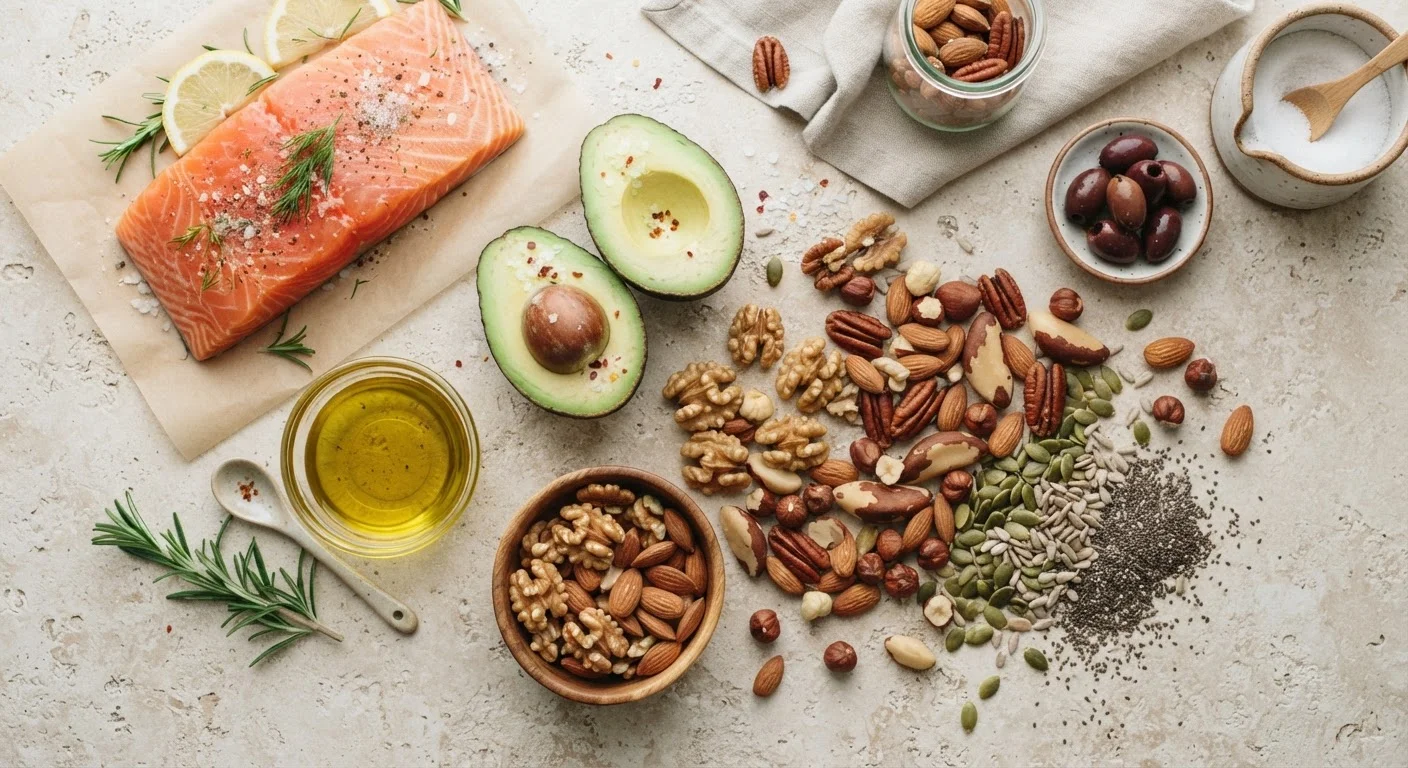
The most actionable framework is to focus on fat source rather than fat quantity alone. Whole-food sources of fat - fatty fish, nuts, seeds, avocados, and minimally processed oils - carry the nutrient package (fiber, phytonutrients, omega-3s) that isolated fat does not. Processed foods engineered to be high in fat while stripped of that surrounding context deserve more scrutiny.
That distinction - between food and isolated nutrient - sits at the heart of ongoing nutrition research and is increasingly reflected in how dietary guidelines are written. Practical plate-building principles that hold up across different dietary patterns tend to emphasize food variety and nutrient density over macro-counting.
Fat Restriction Isn't Risk-Free
Aggressively limiting all dietary fat can impair absorption of fat-soluble vitamins (A, D, E, and K) and reduce intake of essential fatty acids the body cannot produce. Very low-fat diets are sometimes clinically indicated for specific conditions, but they require medical supervision. If you are considering a significant reduction in dietary fat, consult a registered dietitian or physician first.
This article is for general informational and educational purposes only and does not constitute medical or dietary advice. Speak with a qualified healthcare provider or registered dietitian before making significant changes to your diet, particularly if you have existing health conditions.