

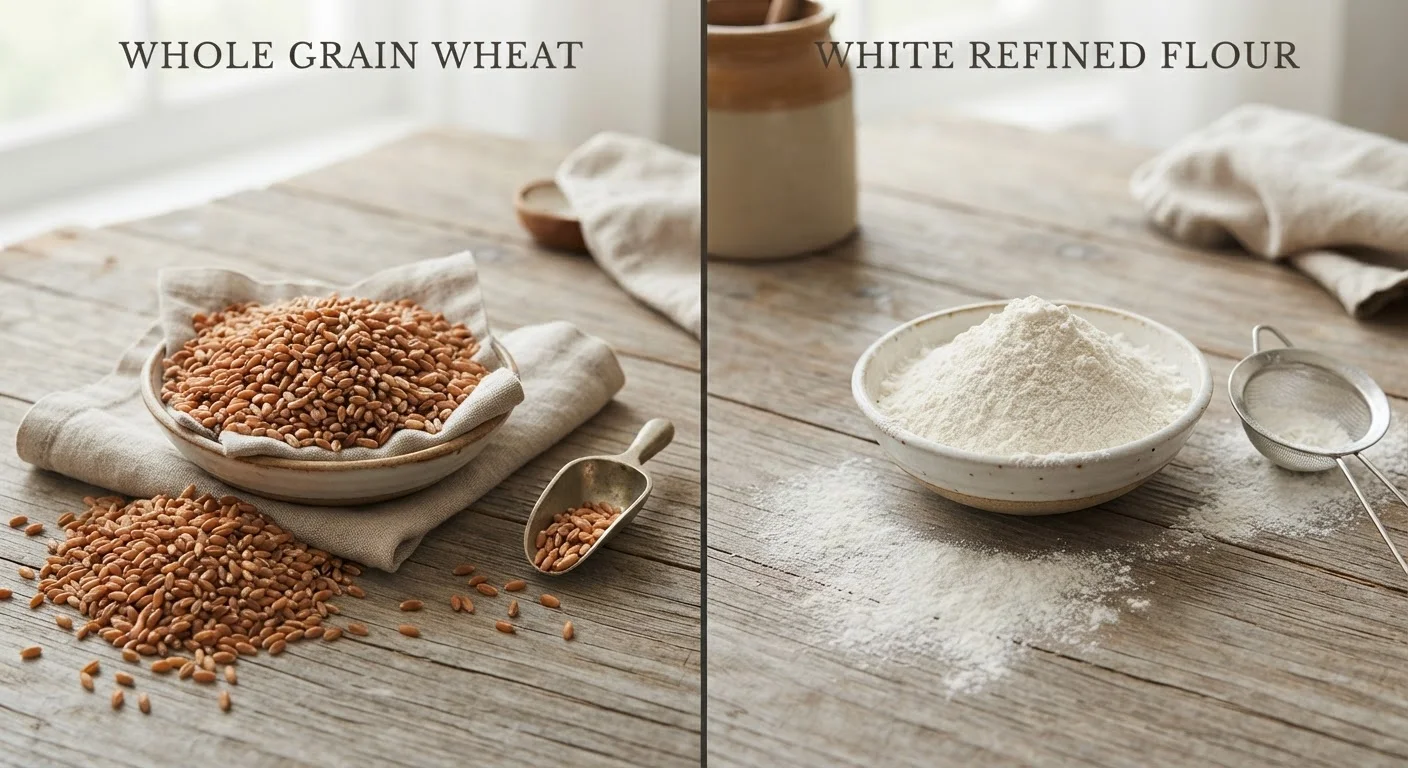
Key Takeaways
Option A
Whole Grains
The complete, minimally processed kernel.
Best for: People seeking sustained energy, higher fiber intake, and a broader micronutrient profile from their carbohydrate sources.
Option B
Refined Grains
The stripped-down, widely available staple.
Best for: Situations where longer shelf life, softer texture, or easier digestibility is a practical priority.
If you want more fiber and sustained energy throughout the day
Whole Grains
The intact bran slows digestion, supporting steadier blood glucose and contributing significantly to daily fiber goals.
If digestive sensitivity makes high-fiber foods uncomfortable
Refined Grains
Lower fiber content means gentler digestion for some people; discuss individual needs with a registered dietitian.
If you want a broader range of vitamins and minerals from carbohydrate foods
Whole Grains
The germ retains B vitamins, vitamin E, healthy fats, and minerals that are largely absent from refined products.
If shelf stability and versatility in cooking are the main priorities
Refined Grains
Removing the oil-containing germ extends shelf life considerably, making refined grains more practical for long-term storage.
What Milling Actually Does to a Grain
Every grain kernel has three distinct parts: the outer bran, the nutrient-dense inner germ, and the starchy center called the endosperm. A whole grain, by definition, retains all three in roughly their original proportions. Refined grains have had the bran and germ removed during milling, leaving primarily the endosperm.
That's not an arbitrary process - removing the bran and germ produces a lighter texture, a milder flavor, and a longer shelf life. The germ contains oils that can turn rancid over time, so stripping it out is partly a preservation decision. But the bran and germ also happen to be where most of the nutritional value lives.
| Criterion | Whole Grains | Refined Grains |
|---|---|---|
| Parts retained | Bran, germ, and endosperm | Endosperm only |
| Fiber content | High (bran intact) | Low (bran removed) |
| B vitamins & minerals | Naturally present in germ | Mostly removed; some added back via enrichment |
| Vitamin E & phytonutrients | Present | Largely absent; not restored by enrichment |
| Glycemic response | Generally slower (lower GI) | Generally faster (higher GI) |
| Shelf life | Shorter (germ oils can oxidize) | Longer (oils removed) |
| Texture & flavor | Heartier, nuttier | Lighter, milder |
The Nutritional Gap: Fiber, Vitamins, and Minerals
The bran layer is the grain's primary source of dietary fiber - both the insoluble kind that adds bulk to stool and the soluble kind that feeds gut bacteria and helps moderate cholesterol. When bran is removed, fiber content drops dramatically. A slice of whole wheat bread typically provides two to three times the fiber of an equivalent slice of white bread made from refined flour.
Beyond fiber, the germ supplies meaningful amounts of B vitamins (including thiamin, niacin, folate, and B6), vitamin E, magnesium, zinc, and iron. It also contains phytonutrients - plant compounds such as lignans and ferulic acid - that research associates with various health-supportive effects, though the science on many specific compounds is still developing.
To partially address the nutritional loss, many countries - including the United States - require enrichment of refined grain products. Enrichment adds back iron and several B vitamins (thiamin, riboflavin, niacin, folic acid) to levels approximating what was in the original grain. However, enrichment does not restore fiber, vitamin E, magnesium, or the phytonutrients removed during milling. It's a partial correction, not a full one. For a deeper look at what fiber contributes beyond digestion, see why fiber keeps coming up in every nutrition conversation.
~25%
Fiber retained after standard milling
Estimates from grain science literature suggest refined white flour retains roughly one-quarter of the fiber found in whole wheat flour, varying by milling method.
50%+
Recommended whole grain share of daily grains
The USDA Dietary Guidelines for Americans recommend that at least half of all grain servings consumed daily come from whole grain sources.
~7
Nutrients restored by enrichment
Standard U.S. enrichment programs restore iron and four B vitamins to refined grain products, out of the broader range lost during milling.
Glycemic Impact: Why Processing Speed Matters
Because refined grains consist mostly of starch with little fiber to slow things down, they are digested and absorbed more rapidly than whole grains. This produces a faster and generally higher rise in blood glucose - a pattern captured by the concept of the glycemic index (GI), which ranks foods by how quickly they raise blood sugar relative to a reference food.
Whole grains tend to have a lower GI than their refined counterparts, though the actual value varies considerably by grain type, cooking method, and what else is eaten alongside them. Brown rice, for example, has a meaningfully lower GI than white rice, while some whole grain breads still have relatively high GI values depending on how finely the flour is milled.
The practical relevance is that slower glucose absorption tends to support more sustained energy and a longer-lasting sense of fullness after eating. It's also a reason why health authorities, including the USDA and the American Heart Association, recommend choosing whole grains as the majority of grain servings. That said, glycemic impact is one factor among many; it shouldn't be read in isolation from total diet quality. Understanding related distinctions - like added sugar versus natural sugar - can help build a fuller picture.
Putting It in Perspective
The whole grains vs. refined grains conversation can sometimes tip into all-or-nothing thinking - but nutrition science doesn't support that framing. Whole grains carry clear advantages for fiber, micronutrients, and glycemic response. At the same time, refined grains are a staple in many healthful eating patterns worldwide, particularly when the overall diet is varied and balanced.
A useful framework from major dietary guidelines: aim for at least half of daily grain servings to come from whole grain sources. That leaves room for refined grains without treating them as off-limits. Swapping white rice for brown, choosing oats over processed cereals, or picking whole wheat pasta over regular are incremental shifts that compound over time without requiring an overhaul of how you eat.
This article is for general informational purposes only and is not a substitute for personalized nutrition advice. Speak with a registered dietitian or qualified healthcare professional for guidance tailored to your individual health needs.