
Key Takeaways
Zero financial barrier to entry
Free courses let anyone begin learning immediately without financial risk, making them ideal for exploration, career pivots, or supplementing existing knowledge without budget pressure.
Access to university-level content
OpenCourseWare from major universities and open-access MOOCs often use the same syllabi and materials as paid programs, providing genuine academic depth at no cost.
Flexible, self-paced exploration
Without enrollment deadlines or graded stakes, free courses allow learners to move at their own pace and sample multiple subjects before committing time or money to a single path.
Breadth of subject availability
The range of free courses now spans nearly every discipline, from data science to art history, giving learners an unusually wide field to explore without financial commitment.
No verifiable certificate in most cases
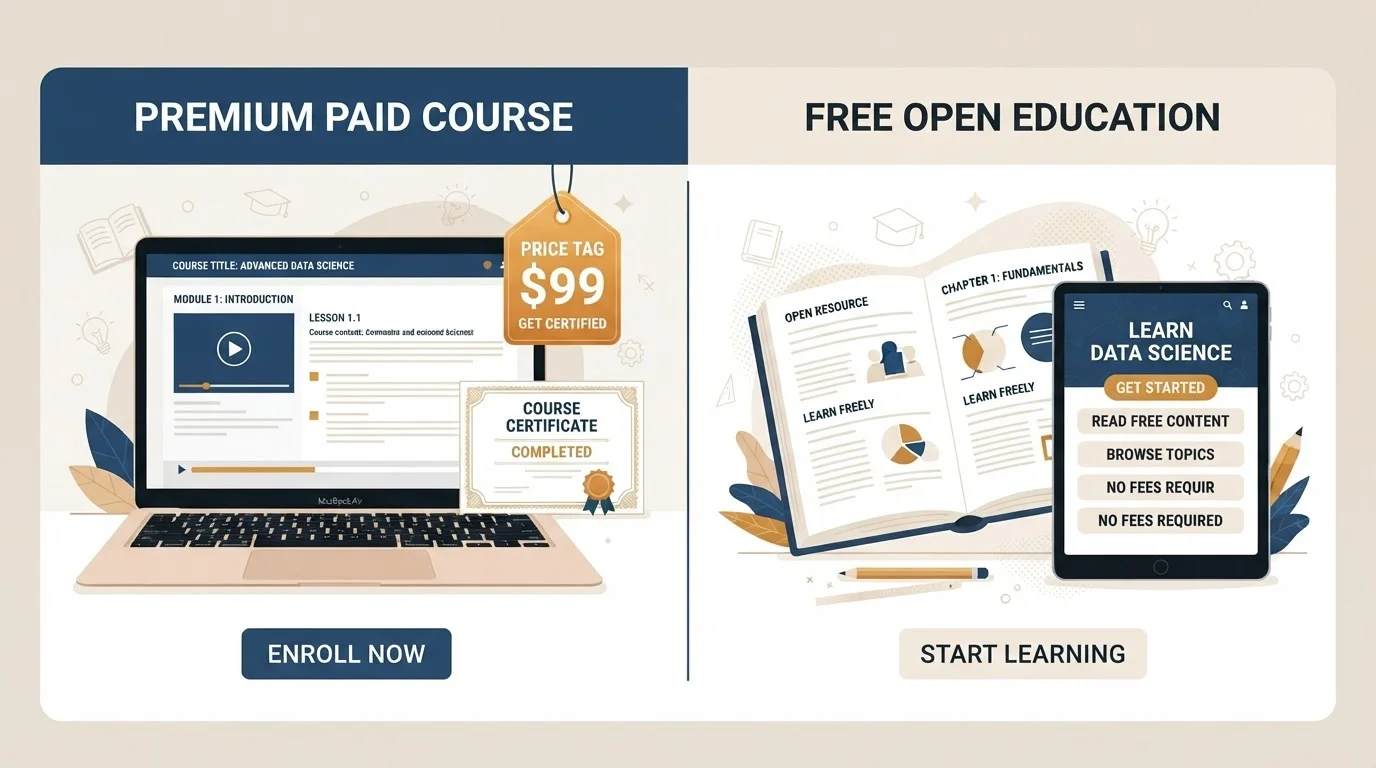
Free tiers on major platforms typically withhold certificates of completion, which limits the credential's usefulness when job applications or professional development records require documented proof.
Low built-in accountability structures
Without graded assignments, deadlines, or financial stakes, learner dropout rates in free courses are significantly higher - making self-discipline the primary determinant of success.
Limited or no instructor feedback
Most free enrollments exclude direct instructor interaction or graded peer review, removing the corrective feedback that is often essential for developing applied skills accurately.
Variable and inconsistent quality
Free content ranges from rigorously designed university courseware to hastily produced recordings with no clear learning objectives, requiring learners to evaluate quality carefully before investing significant time.
Our Verdict
Neither free nor paid online courses are categorically better - each serves different goals. Free options are genuinely effective for exploration, self-directed skill development, and low-stakes learning, while paid courses add value when a credential, structured progression, or graded feedback is essential. The most strategic learners use both, matching the format to the specific outcome they need.
Free courses suit self-motivated learners exploring new fields or building skills without credential requirements; paid courses are worth the investment when a verifiable certificate, career advancement, or guided accountability is the primary goal.
What You Actually Get for Free
Free online courses - including university OpenCourseWare, open-access MOOCs (Massive Open Online Courses), and public library learning tools - provide genuine educational content at no cost. Many come from respected institutions and cover subjects ranging from introductory programming to advanced economics. For a fuller picture of where to find these resources, see the landscape of free online education.
The catch is in what's typically withheld. Most free tiers strip out graded assignments, instructor interaction, and shareable certificates. You get the lectures, readings, and sometimes quizzes - but not the feedback loop that accelerates real skill development. That distinction matters more in some fields than others.
Zero financial barrier to entry
Free courses let anyone begin learning immediately without financial risk, making them ideal for exploration, career pivots, or supplementing existing knowledge without budget pressure.
Access to university-level content
OpenCourseWare from major universities and open-access MOOCs often use the same syllabi and materials as paid programs, providing genuine academic depth at no cost.
Flexible, self-paced exploration
Without enrollment deadlines or graded stakes, free courses allow learners to move at their own pace and sample multiple subjects before committing time or money to a single path.
Breadth of subject availability
The range of free courses now spans nearly every discipline, from data science to art history, giving learners an unusually wide field to explore without financial commitment.
Free courses also carry a structural disadvantage that's easy to underestimate: no financial commitment means no consequence for stopping. Research on MOOC completion consistently finds that free enrollments have far lower completion rates than paid ones - not because the content is worse, but because accountability is absent.
What Paid Courses Add - and What They Don't Guarantee
Paying for a course typically unlocks graded work, peer interaction, instructor feedback, and a verifiable certificate upon completion. These additions are meaningful when the credential itself has professional or academic value. For a structured comparison of how certificates translate into career outcomes, see online certifications vs. degree programs.
What paid status does not guarantee is quality. Course pricing varies enormously and does not reliably track with instructional rigor, production quality, or learning outcomes. A high price tag can reflect marketing costs or brand positioning as much as educational value.
No verifiable certificate in most cases
Free tiers on major platforms typically withhold certificates of completion, which limits the credential's usefulness when job applications or professional development records require documented proof.
Low built-in accountability structures
Without graded assignments, deadlines, or financial stakes, learner dropout rates in free courses are significantly higher - making self-discipline the primary determinant of success.
Limited or no instructor feedback
Most free enrollments exclude direct instructor interaction or graded peer review, removing the corrective feedback that is often essential for developing applied skills accurately.
Variable and inconsistent quality
Free content ranges from rigorously designed university courseware to hastily produced recordings with no clear learning objectives, requiring learners to evaluate quality carefully before investing significant time.
There's also the sunk-cost problem in reverse: some learners over-commit to a paid course that isn't the right fit, continuing past the point of diminishing returns because they've already spent money. Paid enrollment is a tool, not a guarantee.
3-6%
Typical free MOOC completion rate
Research published in education journals has consistently found that free MOOC completion rates often fall between 3 and 6 percent, compared to significantly higher rates for paid enrollments.
~40%
Learners who pay report completing the course
Studies examining MOOC behavior suggest that learners who pay for a course or certificate track complete at substantially higher rates, pointing to the role of financial commitment as an accountability mechanism.
Matching the Format to Your Actual Goal
The most useful frame isn't "free vs. paid" - it's "what outcome do I need?" If you're exploring a new field, testing whether a subject interests you, or building a skill for personal use, free courses can deliver exactly what you need. The approach of building a personal curriculum from free resources is well-documented and genuinely effective for self-directed learners.
If your goal is a credential an employer will recognize, structured progression with feedback, or accountability to complete a defined program, a paid option typically justifies the cost. The decision point often comes down to whether auditing content is enough or whether full enrollment - with its assessments and certificate - serves your purpose. That distinction is explored in depth in audit or enroll: when paying actually pays off.
A practical hybrid strategy: use free courses to explore a subject, then pay for a course only once you've confirmed genuine interest and identified a specific credential worth earning. This approach respects both your budget and your time. For more on separating format from outcome, common online learning myths worth examining are worth examining before committing either way.
When Platform Type Changes the Equation
The free vs. paid distinction plays out differently depending on whether you're using a structured learning platform or open courseware from a university. Platforms often gate credentials behind payment while keeping content open; university OpenCourseWare may not offer credentials at any price tier. Understanding how these formats differ helps you set realistic expectations before enrolling. See open courseware vs. learning platforms for a detailed breakdown.