

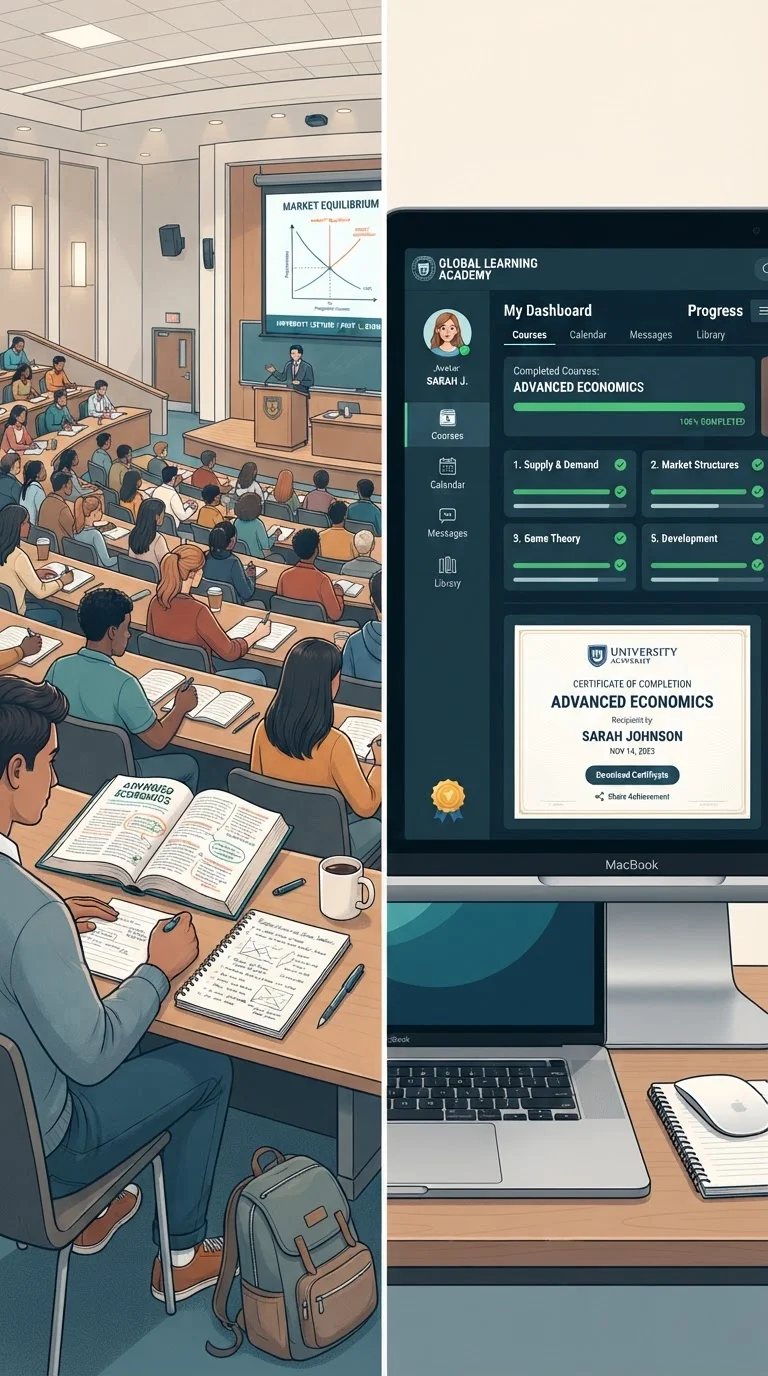
Key Takeaways
Option A
Open Courseware (OCW)
The academic archive - raw, rigorous, and free.
Best for: Self-directed learners who want university-level content without structure or cost constraints.
Option B
Structured Learning Platforms
The guided pathway - organized, supported, and outcome-focused.
Best for: Learners who need accountability, pacing, and verifiable credentials to meet career or professional goals.
If you want to explore a subject for personal enrichment at zero cost
Open Courseware (OCW)
OCW gives you access to full lecture series, reading lists, and problem sets from leading universities without requiring payment or registration.
If you need a verifiable credential to show an employer or for career advancement
Structured Learning Platforms
Platforms issue certificates and track your progress, giving you a tangible artifact that OCW alone cannot provide.
If you are highly self-motivated and already understand how to study independently
Open Courseware (OCW)
Disciplined learners can extract substantial value from OCW without paying for the scaffolding that structured platforms provide.
If you struggle with consistency or have tried self-study before without finishing
Structured Learning Platforms
Built-in deadlines, cohort communities, and instructor feedback reduce dropout risk significantly compared to unguided open materials.
If you want to go deep on a topic while keeping costs low
Open Courseware (OCW)
Pair free OCW syllabi with a single structured course for foundational context - you get academic depth without paying for every module.
What Each Format Actually Is
Open courseware (OCW) refers to educational materials - lecture notes, videos, syllabi, assignments, and readings - that universities publish publicly and freely online. The materials are typically identical or close to what enrolled students receive, but they come with no instructor access, no graded feedback, and no formal completion record. MIT's OpenCourseWare, launched in 2002, pioneered the model and remains one of the most comprehensive examples.
Structured learning platforms, by contrast, are purpose-built environments designed to guide a learner from enrollment to a defined outcome. They typically combine video lessons, quizzes, discussion forums, peer review, and - in paid tiers - graded assignments and shareable certificates. Some platforms partner with universities to offer this structure around the same academic content you might find in OCW, but wrapped in a managed experience. For a broader picture of where these and other free resources fit, see the landscape of free online education.
| Criterion | Open Courseware (OCW) | Structured Learning Platforms |
|---|---|---|
| Cost | Free | Free to paid (audit or subscription) |
| Instructor Access | None | Limited to full, depending on tier |
| Graded Feedback | None | Available in paid tiers |
| Verifiable Certificate | No | Yes (typically paid) |
| Pacing | Entirely self-directed | Structured (weekly or cohort-based) |
| Content Source | Universities (original syllabi) | Platform-created or university-partnered |
| Completion Accountability | None | Deadlines, reminders, peer cohorts |
| Depth of Material | High - full academic syllabi | Varies - often curated and condensed |
Where They Diverge: Support, Credentials, and Cost
The practical gap between the two formats becomes clearest when you look at three factors: support, credentials, and cost.
Support: OCW offers none by design. You receive the materials; how you engage with them is entirely up to you. Structured platforms vary - free tiers typically limit interaction to discussion boards, while paid tiers may include mentor feedback, live Q&A sessions, or direct instructor grading.
Credentials: Completing an OCW course leaves no verifiable record. A structured platform's certificate, by contrast, can be added to a professional profile and reviewed by employers. Whether those certificates carry meaningful weight depends on the specific credential and field - a nuance worth understanding before paying. Our comparison of online certifications vs. degree programs explores how employers typically evaluate each.
Cost: OCW is free by definition. Structured platforms range from fully free (audit mode) to subscription-based or per-course fees. Auditing often removes graded elements and certificates, putting free platform use closer to the OCW experience in practical terms.
~3-6%
Typical MOOC completion rate
Research published in academic journals on MOOC completion consistently finds rates in this range for unstructured or audit-track enrollment.
2,500+
Courses available on MIT OpenCourseWare
MIT OpenCourseWare publicly reports covering materials from nearly all MIT courses, spanning undergraduate and graduate levels.
~40-60%
Higher completion in structured cohort courses
Studies on cohort-based online courses suggest meaningful completion-rate improvements when deadlines and peer interaction are built in.
How to Choose - and How to Combine Both
The most effective online learners rarely treat OCW and structured platforms as an either/or decision. A practical approach is to use OCW for depth and breadth - following a full syllabus, reading the assigned texts, watching lectures - while using a structured platform for one course in the same subject to anchor your self-study with graded feedback and a credential.
If you are building a coherent learning path across multiple subjects, OCW materials can serve as the backbone. See building a personal curriculum from free online resources for a practical framework for doing this without paying tuition.
When choosing between the formats, ask yourself two questions: Do I need an external credential? and Do I finish what I start without external accountability? If both answers are no, OCW is likely sufficient and far more cost-effective. If either answer is yes, a structured platform - even at the free audit tier - offers infrastructure that OCW cannot replicate. For a related angle on how the format of study connects to career goals, the article on skill-based vs. degree-oriented study adds useful context.
This article is for general informational and educational purposes only. Credential value and employer recognition vary by industry and organization. Readers should research specific platform offerings and verify current content availability before making decisions.