

Key Takeaways
Human Memory
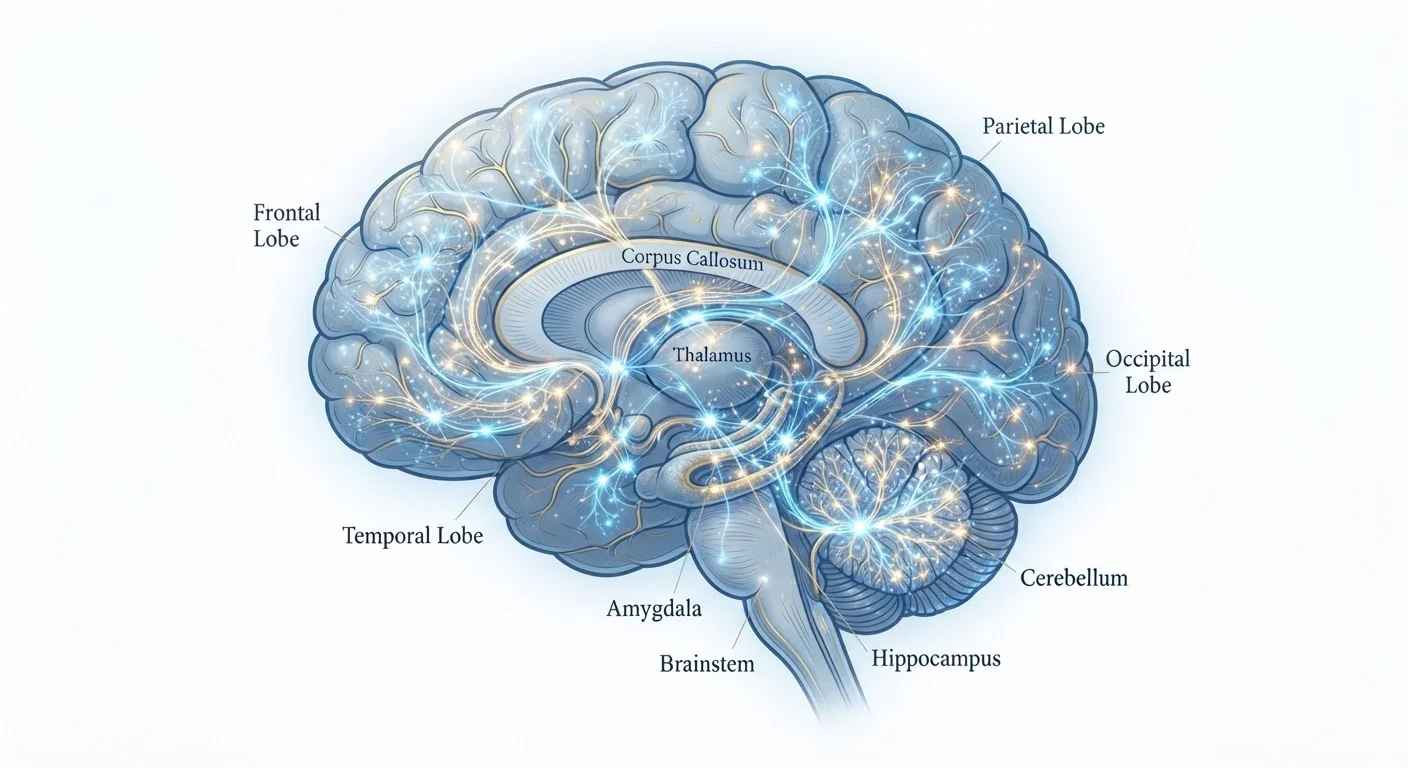
Memory is the brain's ability to encode, store, and later retrieve information and experiences. It is not a single system but a collection of interconnected processes that work together to help us learn and function. Different types of memory - such as short-term and long-term - serve distinct roles and rely on different brain structures.
At the neurological level, memory formation involves synaptic plasticity: the strengthening of connections between neurons through repeated activation, a process summarized by the phrase 'neurons that fire together, wire together.'
The Three-Stage Model of Memory
Most cognitive scientists describe memory using a three-stage framework: encoding, storage, and retrieval. Understanding each stage helps explain why some study habits work and others quietly waste your time.
Encoding is the process of converting incoming information into a form the brain can work with. Not all encoding is equal. Shallow encoding - skimming a page or re-reading highlighted text - creates weak, easily lost traces. Deep encoding, which involves connecting new material to what you already know or generating your own explanations, creates far more durable representations.
Storage refers to how the brain retains encoded information over time. Memories are not filed away in a single location; they are distributed across neural networks and must be actively consolidated - a process that continues for hours or days after initial learning, and is heavily supported by sleep.
Retrieval is the act of accessing stored information. Research consistently shows that the act of retrieval itself strengthens memory - which is why active recall techniques outperform passive review in study after study.
~50%
Information forgotten within an hour without review
Ebbinghaus's forgetting curve research showed that without reinforcement, people forget roughly half of newly learned material within 60 minutes.
4 chunks
Average working memory capacity
Cognitive researcher Nelson Cowan's influential work revised earlier estimates, placing working memory capacity at approximately four discrete units of information.
2x
Recall advantage of spaced over massed practice
A meta-analysis published in Psychological Science in the Public Interest found spaced practice roughly doubled long-term retention compared to equivalent massed study time.
Working Memory: Your Brain's Limited Workspace
Before information reaches long-term storage, it passes through working memory - sometimes called short-term memory. Working memory functions like a mental whiteboard: it holds information temporarily while you actively manipulate or make sense of it.
The critical limitation is capacity. Research by cognitive psychologist George Miller originally suggested a limit of seven items; more recent work by Nelson Cowan points to roughly four chunks of information at a time. When that limit is exceeded, earlier items are displaced - which is why cramming large volumes of new content in a single session is so inefficient.
This is also why cognitive load matters during study. When your working memory is overwhelmed by unfamiliar vocabulary, complex formatting, or multitasking, less capacity is available for the deeper processing needed to encode information into long-term memory. Reducing unnecessary cognitive load - by breaking material into smaller segments, for example - directly improves learning outcomes.
Reduce Cognitive Load Before You Start
Before a study session, minimize competing demands on working memory: silence notifications, close unrelated browser tabs, and break complex material into clearly labeled sections. These small adjustments free up cognitive capacity for the deeper processing that actually moves information into long-term storage.
How Long-Term Memory Is Built and Why It Fades
Long-term memory is not a passive archive. It is reconstructive - every time you recall something, you subtly reprocess it, which can strengthen it or, in some cases, introduce distortions. This is one reason eyewitness memory is famously unreliable, and why repeated retrieval practice - not just repeated exposure - is what makes knowledge stick.
The German psychologist Hermann Ebbinghaus mapped what he called the forgetting curve in the 19th century: without reinforcement, people forget the majority of new material within days. The remedy is spaced repetition - reviewing material at strategically increasing intervals just before it would otherwise be forgotten. This approach exploits how memory consolidation works, forcing the brain to reconstruct and strengthen the memory trace each time.
Emotional significance also plays a role. The amygdala, a structure involved in emotional processing, interacts with the hippocampus - central to memory formation - to flag emotionally resonant information as worth retaining. This is why you likely remember where you were during a personally significant event far better than what you read last Tuesday.
For a broader look at how these principles translate into structured study plans, see The Complete Guide to Studying Effectively Across Any Subject.
What Memory Science Means for How You Study
The neuroscience of memory has direct, practical implications for anyone trying to learn efficiently. A few evidence-backed principles stand out:
- Test yourself early and often. Retrieving information - even before you feel ready - strengthens the memory trace more than re-reading the same material. This is the core logic behind flashcard systems and practice testing.
- Distribute your study sessions. Spacing out review over multiple sessions is consistently more effective than massing the same total study time into one block. The brief difficulty of recalling slightly faded material is exactly what drives consolidation.
- Prioritize sleep. Memory consolidation peaks during sleep. Studying then sleeping - rather than staying up late - gives the brain the opportunity to stabilize what was encoded.
- Connect new information to existing knowledge. The more meaningful associations you build, the more retrieval cues you create. Analogies, diagrams, and self-explanation all serve this function.
Some habits do the opposite - creating the illusion of learning without the substance. Common study habits that undermine retention are worth examining before any major learning effort.
If you are studying through an online platform, the same principles apply. Making online learning stick requires deliberate application of spaced repetition and retrieval practice - passive video-watching alone rarely produces durable knowledge.
This article provides general educational information about cognitive science and is not a substitute for professional advice in medical, psychological, or clinical contexts.