

Key Takeaways
Closing a Credit Account
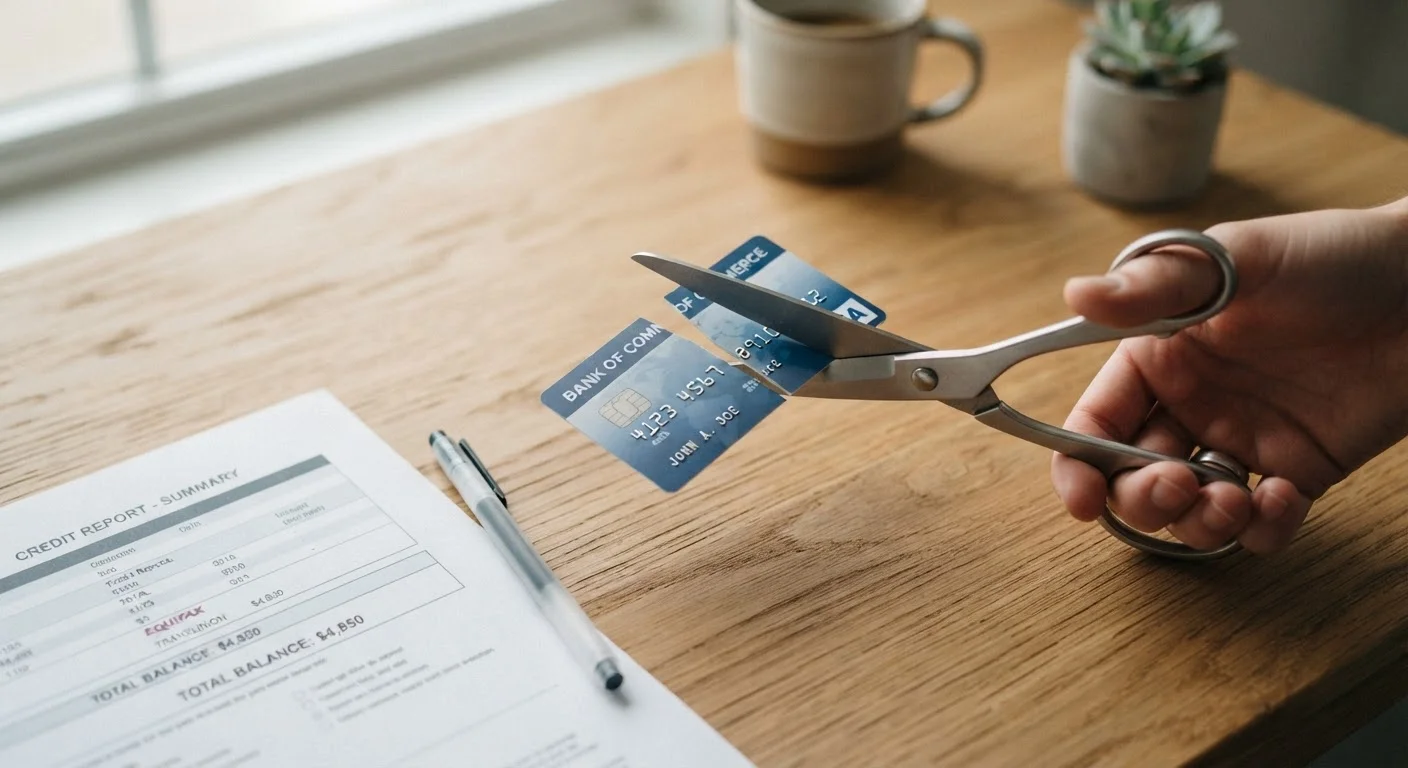
Closing a credit account means formally ending your relationship with a lender or card issuer so that the line of credit is no longer available for use. The account's history doesn't disappear immediately - it stays on your credit report for years. However, the closure can change two key scoring factors: your credit utilization ratio and the length of your credit history.
Under FICO scoring models, closed accounts in good standing typically remain on your report for up to 10 years; accounts closed with negative history generally stay for 7 years from the date of first delinquency.
The Two Mechanisms That Drive Score Changes
When you close a credit account, your score doesn't change for one single reason - it shifts because of how that closure interacts with specific scoring factors. Understanding these two mechanics is the clearest path to making a smart decision.
Credit Utilization
Utilization measures how much of your available revolving credit you're using. If you have $10,000 in total credit limits and carry a $2,000 balance, your utilization is 20%. Close an account with a $3,000 limit - even one you never use - and your available credit drops to $7,000. That same $2,000 balance now represents roughly 29% utilization. Utilization accounts for about 30% of a standard FICO score, so even a modest jump can move your number.
For a deeper look at how balances interact with scoring, see why carrying a small balance doesn't help your score.
Length of Credit History
Scoring models factor in both the age of your oldest account and the average age of all your accounts. Closing a card you've held for 15 years doesn't immediately wipe that history - the account stays on your report for up to a decade - but once it ages off, your average account age can drop noticeably. That's why closing your oldest account tends to carry more long-term risk than closing a newer one.
~30%
FICO score weight for credit utilization
According to FICO's publicly disclosed scoring factor breakdown, amounts owed - which includes utilization - represents approximately 30% of a standard FICO score.
10 years
How long closed positive accounts stay on report
The Consumer Financial Protection Bureau notes that accounts closed in good standing generally remain on a credit report for up to 10 years.
35%
FICO score weight for payment history
Payment history is the single largest scoring factor under FICO models, meaning a strong track record on a closed account continues to benefit your score for years.
What Doesn't Change When You Close an Account
Here's where many people get tripped up: closing an account does not erase its history. If you paid on time for 12 years, those 12 years of positive payment history remain on your report for up to 10 more years after closure. Payment history is the single largest scoring factor - roughly 35% under FICO models - so that track record keeps working in your favor even after you've closed the card.
Similarly, closing an account does not remove negative marks. A late payment from two years ago stays on the report for the full 7-year period regardless of whether the account is still open. This is a common misconception that leads some people to close accounts hoping to clean up their history - it doesn't work that way.
For other actions people mistakenly believe will damage their credit, see what actually doesn't hurt your score.
“The history associated with an account doesn't vanish when you close it. Positive payment records continue to influence your score long after the account is no longer active.”
— Consumer Financial Protection Bureau, U.S. federal agency overseeing consumer financial products and credit reporting
When Closing Still Makes Sense
Despite the potential score impact, closing an account is sometimes the right financial move. A card with a $150 annual fee that you no longer use meaningfully isn't free to keep - you're paying for access you don't need. If closing it would save you money and only temporarily dip your score by a small amount, that trade-off may be worth it.
Security is another legitimate reason. If you've had fraudulent activity on an older card and the issuer won't replace it with a new number, closing the account limits future exposure.
Ask About a Product Change First
Before closing a card with an annual fee, call the issuer and ask whether you can downgrade to a no-fee version of the same product. Many issuers offer this option, which eliminates the cost while preserving your credit limit and account history - the best of both outcomes.
Before closing, consider asking the issuer to downgrade the card to a no-fee version if one exists. That preserves your credit limit and history while eliminating the annual cost. It's also worth calling to confirm whether a product change counts as a new account - some issuers keep the same account number, others don't.
This kind of decision fits into a broader pattern of credit moves that can backfire when made without full context. Credit decisions that seem smart but can quietly backfire covers several similar scenarios worth reviewing.
How to Minimize Score Impact If You Do Close
If you've decided to close an account, there are steps that can soften the effect on your score.
- Pay down balances first. Before closing, reduce balances on your remaining cards so your utilization stays low even after the available credit shrinks.
- Avoid closing multiple accounts at once. Each closure compounds the utilization and history impact. Space decisions out if you're simplifying your wallet.
- Prioritize closing newer accounts. If you have a choice, close a card you've held for two years rather than one you've had for fifteen. The older account contributes more to your average credit age.
- Keep an eye on your report afterward. Confirm the account is reported as "closed by consumer" rather than "closed by issuer" - the latter can signal a negative event to some scoring models.
Life events sometimes force these decisions. Managing credit through major life changes offers a broader framework for protecting your profile during transitions like divorce or job loss, when account closures might feel unavoidable.
This article is for general informational purposes only and does not constitute personalized financial or credit advice. For guidance specific to your situation, consult a qualified financial professional.