

Key Takeaways
Why Debt and Savings Must Be Managed Together
Most personal finance advice treats debt payoff and saving as an either/or choice. That framing is a mistake. Ignoring savings while attacking debt leaves you one unexpected expense away from new high-interest borrowing. Ignoring debt while building savings means the interest you pay likely exceeds the interest you earn.
The reality is that both levers work on the same engine: your monthly cash flow. Managing them together - with intention - lets you make the most of every dollar. Start with a clear budget that tracks your spending so you know exactly how much you have to allocate each month before making any debt-versus-savings decisions.
This article is for general financial education only and does not constitute personalized financial, tax, or investment advice. Consult a licensed financial professional for guidance specific to your situation.
Assess Where You Actually Stand
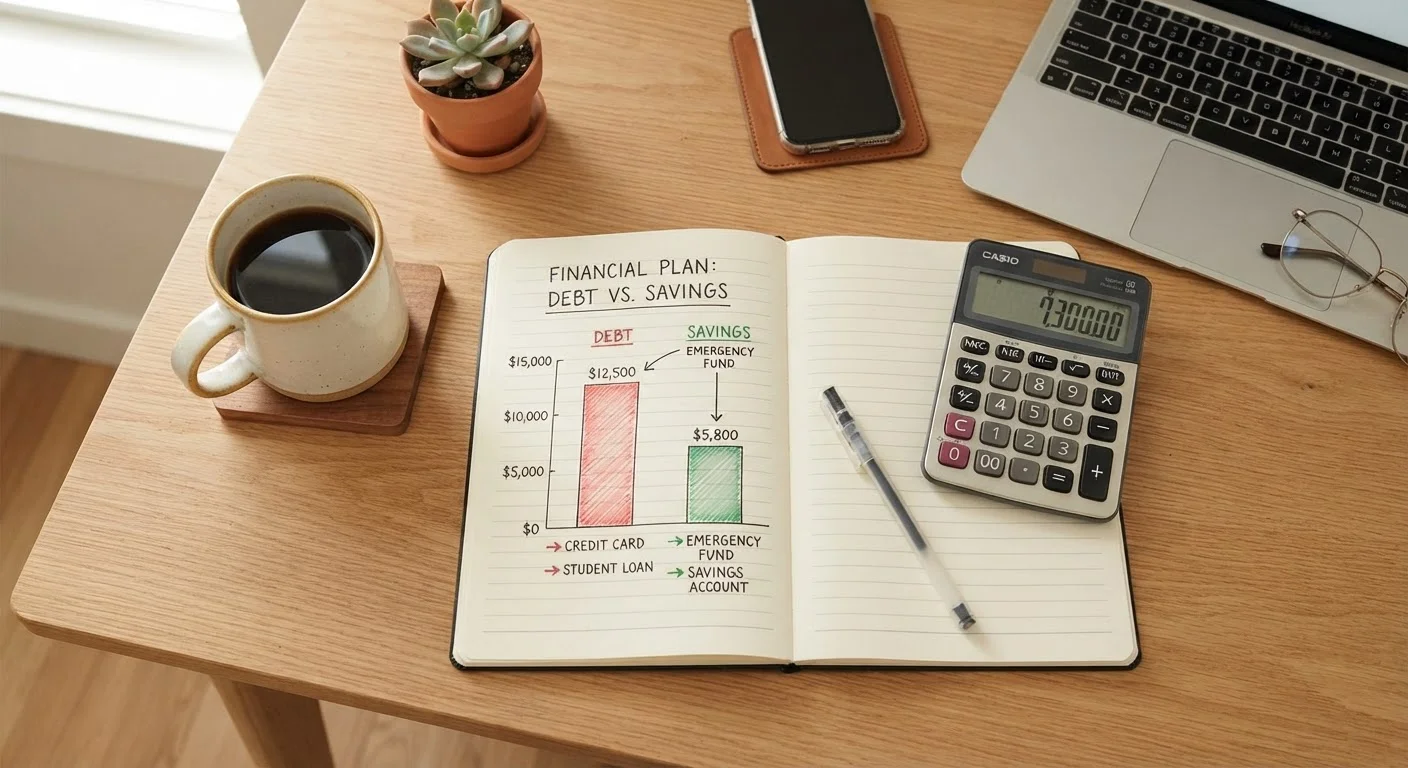
Before you can build a strategy, you need a complete, honest picture of your finances. List every debt balance, its interest rate (APR), and the minimum monthly payment. Then list every savings or investment account and its current balance. This two-column snapshot is the foundation of all decisions that follow.
Key numbers to gather:
- Total outstanding debt by account
- Interest rate on each debt - not just the payment amount
- Current liquid savings (checking, savings, money market)
- Monthly take-home income and committed fixed expenses
Once a year, run this exercise again as a formal review. Our structured annual debt and savings check-in walks you through the process step by step.
Print or export your balances on the same day each month so comparisons are clean and consistent. Inconsistent snapshot dates make trends hard to read and easy to rationalize.
Practitioners who track financial data on a fixed cadence catch drift earlier and make corrections before small gaps become large ones.
When you pay off a debt account, immediately redirect that exact payment amount to the next debt or savings goal - don't let it dissolve into discretionary spending.
This 'payment recycling' technique keeps your total monthly commitment constant while accelerating progress, a method supported by behavioral finance research on habit reinforcement.
The Core Decision: Pay Down Debt or Save First?
The general rule financial educators rely on: compare your debt's interest rate to the expected after-tax return on savings or investments.
- High-interest debt (roughly 7% APR and above): Prioritize payoff. The guaranteed "return" of eliminating 20% credit card interest beats almost any savings vehicle.
- Low-interest debt (below roughly 4-5% APR): Consider carrying it while directing surplus cash toward savings or employer-matched retirement contributions.
- Mid-range debt (5-7% APR): A split approach - partial extra payments plus partial savings - is defensible. This is where personal preference and risk tolerance matter most.
One non-negotiable exception: always contribute enough to a workplace retirement account to capture the full employer match before accelerating debt payoff. A 50% or 100% match is an immediate guaranteed return that virtually no debt rate can beat.
~$6,500
Average US household credit card balance
According to Federal Reserve consumer credit data, average revolving credit balances have remained in the mid-thousands for most US households.
56%
Americans unable to cover a $1,000 emergency
Bankrate's annual Emergency Savings Report has consistently found that more than half of US adults could not cover a $1,000 unexpected expense from savings alone.
3-6 months
Recommended emergency fund target
Major financial education bodies including the CFPB recommend holding three to six months of essential living expenses in liquid savings.
Building Your Emergency Fund Alongside Debt Repayment
An emergency fund is not a luxury - it's a circuit breaker that prevents a car repair or medical bill from becoming new high-interest debt. The conventional wisdom is three to six months of essential expenses, but that target can feel paralyzing when you're carrying debt.
A practical two-phase approach:
- Phase 1 - Starter fund: Save a flat $1,000 as quickly as possible, even while making only minimum debt payments. This handles the majority of common financial surprises without new borrowing.
- Phase 2 - Full fund: Once high-interest debt is eliminated, redirect those freed-up payments toward growing your fund to the three-to-six-month target.
Keep the emergency fund in a federally insured deposit account that is separate from your everyday checking - accessible, but not so convenient that it gets spent casually. Your banking and account choices affect how easily you can access these funds when you actually need them.
Debt Repayment Strategies: Avalanche vs. Snowball
Once your starter emergency fund is in place and you're capturing any employer match, direct extra dollars toward debt using one of two proven frameworks:
Debt Avalanche
List debts by interest rate, highest to lowest. Pay minimums on all accounts; put every extra dollar toward the highest-rate balance first. This approach minimizes total interest paid over time and is mathematically optimal.
Debt Snowball
List debts by balance, smallest to largest. Pay minimums on all accounts; put every extra dollar toward the smallest balance first. Once it's gone, roll that payment into the next. The quick wins deliver psychological momentum that keeps many people on track longer.
Research published in financial behavior journals suggests the snowball method can be more effective in practice for people who have struggled to stay motivated - even though the avalanche saves more in interest. Neither method is universally correct; the best one is the one you'll stick to.
Try a Hybrid Split If You're Undecided
If choosing between avalanche and snowball feels paralyzing, split the difference: put 70% of extra funds toward the highest-rate debt and 30% toward the smallest balance. You capture most of the interest savings while still getting occasional payoff wins. Reassess after three months and shift the ratio if one approach feels more sustainable.
Keeping Progress on Track Long-Term
A one-time plan fades without reinforcement. Treat your debt-and-savings strategy as a living document that gets revisited when circumstances change - a raise, a job loss, a new expense, or a paid-off account all warrant a recalibration.
Practical habits that sustain progress:
- Automate minimum payments on all debts to avoid late fees and credit score damage.
- Automate a savings transfer on payday so the money moves before it can be spent.
- Track your net worth quarterly - total assets minus total liabilities. A rising number confirms the plan is working.
- Understand how your credit score affects borrowing costs. The Credit & Banking hub explains how utilization, payment history, and account age interact.
Earning more can accelerate the timeline significantly. If expanding your income is a goal alongside debt reduction, the frameworks in this end-to-end upskilling guide can help you identify and close skill gaps that lead to higher pay.
Financial stability is not a destination reached once - it's maintained through consistent, informed decisions. Set a recurring calendar reminder each year to run your full debt-and-savings assessment and adjust accordingly.