

Key Takeaways
Why Indoor Air Quality Deserves Attention
The air inside a typical American home can contain a surprisingly wide range of pollutants - from fine particulate matter and volatile organic compounds (VOCs) to mold spores, pet dander, and combustion byproducts. Everyday activities like cooking, cleaning, and even running certain appliances contribute to what accumulates indoors. Because modern homes are built and weather-sealed for energy efficiency, that air has fewer natural escape routes than it once did.
The good news: a full HVAC replacement isn't the only way to address the problem. A targeted set of low-cost, high-leverage actions - applied consistently - can meaningfully reduce pollutant levels without major system work. The strategies below focus on the four core levers of indoor air quality: filtration, ventilation, humidity control, and source reduction.
If you already schedule regular home walk-throughs, the weekend home audit checklist is a natural complement - it helps you catch moisture and system issues early, before they compound into air quality problems.
Upgrade Your HVAC Filter - and Change It on Schedule
The filter in your furnace or air handler is your system's first line of defense against airborne particles. Most homes ship with basic fiberglass filters rated at MERV 1-4, which capture large debris but pass fine particles like pollen, pet dander, and mold spores right through.
Stepping up to a MERV 8-11 pleated filter - widely available at hardware stores - captures a far wider range of particles without significantly restricting airflow in most residential systems. MERV 13 filters offer even finer filtration, comparable to what hospitals use, though you should confirm your system can handle the increased resistance before installing one.
Equally important: replace filters on schedule. A clogged filter doesn't just stop filtering - it restricts airflow, stresses your blower motor, and can push trapped pollutants back into circulation. Most households should replace filters every 60-90 days; homes with pets or allergy sufferers may need monthly changes.
A MERV 8-11 pleated filter costs a few dollars more but captures dramatically more airborne particles than basic fiberglass.
Use Exhaust Fans Consistently - and Keep Them Clean
Bathroom and kitchen exhaust fans are among the most underused ventilation tools in a home. A bathroom fan running during and for 15-20 minutes after a shower removes moisture before it can settle on surfaces and fuel mold growth. A range hood running while cooking captures combustion byproducts, grease particulates, and steam that would otherwise disperse throughout the house.
The catch: exhaust fans that aren't cleaned regularly become clogged with dust and grease, reducing their effectiveness dramatically. Remove and wash the grille cover quarterly, and check that the exterior vent damper opens freely - a stuck damper means the fan is exhausting air into your wall cavity instead of outside.
If your bathroom lacks an exhaust fan entirely, that's worth addressing - it's one of the more practical upgrades a licensed electrician can install, and it protects both air quality and building materials over time.
Running a bathroom exhaust fan for 20 minutes post-shower removes moisture before mold has a chance to establish.
Control Indoor Humidity Between 30% and 50%
Humidity is one of the most overlooked drivers of indoor air quality. Too high - above 60% - and you're creating conditions where dust mites multiply and mold colonizes surfaces. Too low - below 30% - and you get dry mucous membranes that are more susceptible to airborne pathogens, plus static electricity that can damage electronics.
A basic digital hygrometer (an instrument that measures relative humidity) costs very little and tells you where your home actually stands. If rooms consistently read above 50%, a portable dehumidifier in the basement or main living area is typically the most cost-effective intervention. If readings run chronically low in winter, a whole-house humidifier attached to the furnace or a room-level evaporative humidifier can help - just clean humidifiers regularly to prevent microbial growth in the reservoir.
Keeping relative humidity between 30% and 50% cuts the conditions that allow dust mites and mold to thrive.
Ventilate Strategically With Natural Airflow
When outdoor air quality is good - check your local Air Quality Index (AQI) before opening up - cross-ventilating your home by opening windows on opposite sides of the house flushes accumulated indoor pollutants efficiently. Even 10-15 minutes of active cross-ventilation in mild weather can substantially reduce VOC concentrations that build up from paints, adhesives, and cleaning products.
Time ventilation thoughtfully: early morning often offers lower outdoor pollen counts and particulate levels than midday, particularly near busy roads. Avoid ventilating on days with high AQI ratings, high pollen counts, or when neighbors are burning yard waste.
For tighter homes where opening windows isn't always practical, an energy recovery ventilator (ERV) or heat recovery ventilator (HRV) is a more involved solution worth researching - these bring in fresh air without the energy penalty of simply opening a window in winter.
Ten minutes of cross-ventilation on a low-AQI morning can flush accumulated VOCs more effectively than filtration alone.
Reduce Pollutant Sources at the Point of Origin
Filtration and ventilation address what's already airborne. Source reduction - limiting what enters the air in the first place - is often more efficient. Common indoor pollution sources include:
- Cleaning products: Many spray cleaners and aerosols release VOCs. Switching to fragrance-free, lower-VOC alternatives or diluted concentrate formulas reduces off-gassing significantly.
- Scented candles and air fresheners: Combustion-based products release particulates and VOCs. Unscented beeswax candles or simply ventilating after cleaning are lower-impact alternatives.
- New furniture and flooring: Off-gassing from adhesives and synthetic materials is highest in the first weeks after installation. Ventilate aggressively during this window.
- Gas appliances: Unvented gas stoves release nitrogen dioxide and carbon monoxide. Always run the range hood while cooking with gas, and ensure appliances are serviced per manufacturer guidelines.
Tracking down sources takes a walk through your home with fresh eyes - notice what you're spraying, burning, and storing in living spaces.
Switching to lower-VOC cleaning products eliminates a recurring source of indoor air pollution without any equipment purchase.
Add a Portable Air Purifier Where It Counts Most
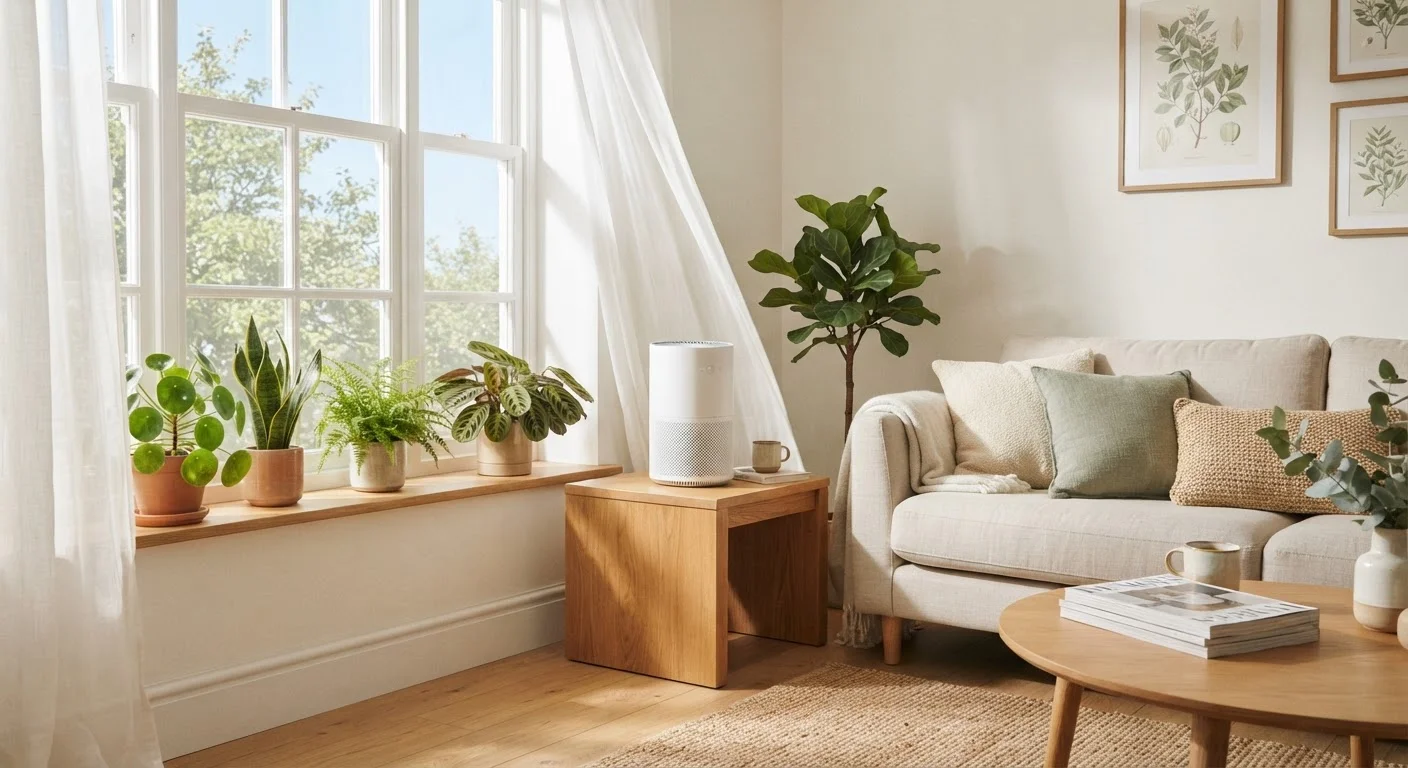
A standalone air purifier with a true HEPA filter can meaningfully reduce fine particulate levels in a single room - particularly useful in bedrooms, where people spend roughly a third of their lives, or in rooms where a family member has respiratory sensitivities.
When evaluating purifiers, focus on two specs: the Clean Air Delivery Rate (CADR), which measures how quickly a unit cleans a given room size, and whether the unit uses a true HEPA filter (capturing 99.97% of particles 0.3 microns and larger) rather than a loosely defined "HEPA-type" filter. Avoid ozone-generating ionizer units - ozone is itself a respiratory irritant.
A portable purifier complements your HVAC filter rather than replacing it; think of it as targeted filtration for spaces that matter most, while your central system handles the whole-house baseline.
A HEPA air purifier in the bedroom targets the space where pollutant exposure has the greatest impact on sleep and recovery.
Putting It All Together
No single fix eliminates all indoor air quality concerns, but layering these approaches creates compounding benefit. Better filtration catches what ventilation misses. Controlled humidity neutralizes the conditions that allow mold and dust mites to thrive. Source reduction means there's less pollutant to filter in the first place. Together, they shift the baseline meaningfully - without requiring you to replace functioning equipment.
Set a simple maintenance calendar: change filters on schedule, clean exhaust fans quarterly, check humidity monthly, and audit cleaning products annually. These habits take minutes each and sidestep the most common air quality pitfalls homeowners face.
Build a Simple Air Quality Maintenance Calendar
Set recurring reminders: filter changes every 60-90 days, exhaust fan cleaning quarterly, and a humidity check monthly during heating and cooling seasons. Pairing these tasks with something you already do - like a monthly bill payment or seasonal home walkthrough - makes them easier to sustain. Consistent small actions prevent the gradual buildup that leads to noticeable problems.
This article provides general home improvement information only. If you or members of your household have asthma, allergies, or other respiratory conditions, consult a qualified healthcare professional and consider having a licensed indoor air quality specialist assess your home.