

Key Takeaways
How Road Warriors Actually Think About Packing
Business travelers who fly multiple times a month don't approach packing the way occasional vacationers do. The goal isn't to bring everything that might be useful - it's to build a system so reliable that packing becomes nearly automatic. That shift from reactive to systematic is what separates a stressed first-timer stuffing a checked bag from someone who boards with a single carry-on and zero anxiety.
The habits below reflect what frequent travelers consistently report as high-value priorities. They're not about deprivation; they're about precision. For a broader foundation on how destination research and itinerary structure shape what you need, see our guide to packing light planning decisions.
Build a neutral capsule wardrobe and never deviate
Road warriors don't re-evaluate their wardrobe before each trip. They maintain a fixed set of neutral-colored, mix-and-match pieces - typically two to three dress shirts, one pair of dress trousers, dark jeans that pass in casual and semi-formal settings, and a versatile blazer. Every item pairs with every other. The result: five days of outfits from seven pieces, with zero decision fatigue the night before departure.
The key discipline is resisting the urge to add "just in case" items. If a piece doesn't combine with at least three others already in the bag, it doesn't go in. See how layering strategies extend this approach in packing for every climate in one suitcase.
A fixed capsule wardrobe eliminates repacking decisions entirely - the system does the thinking.
Prioritize wrinkle-resistant and moisture-wicking fabrics
Fabric choice is one of the highest-leverage decisions a business traveler makes. Wrinkle-resistant wool-blend and synthetic-blend dress shirts can be rolled tightly, pulled from a bag, and worn directly into a client meeting. Natural cotton - despite feeling premium - requires pressing after any compression, adding friction to tight itineraries.
Moisture-wicking properties matter on travel days specifically: long terminal walks, delayed connections, and humid climates all test whether you'll arrive feeling presentable. Merino wool is particularly favored for its temperature regulation and odor resistance, allowing garments to be worn multiple days without laundering - a significant weight reducer on multi-day trips.
Wrinkle-resistant fabrics turn rolled packing from a risk into a reliable strategy.
Keep a pre-packed, TSA-ready toiletry kit permanently ready
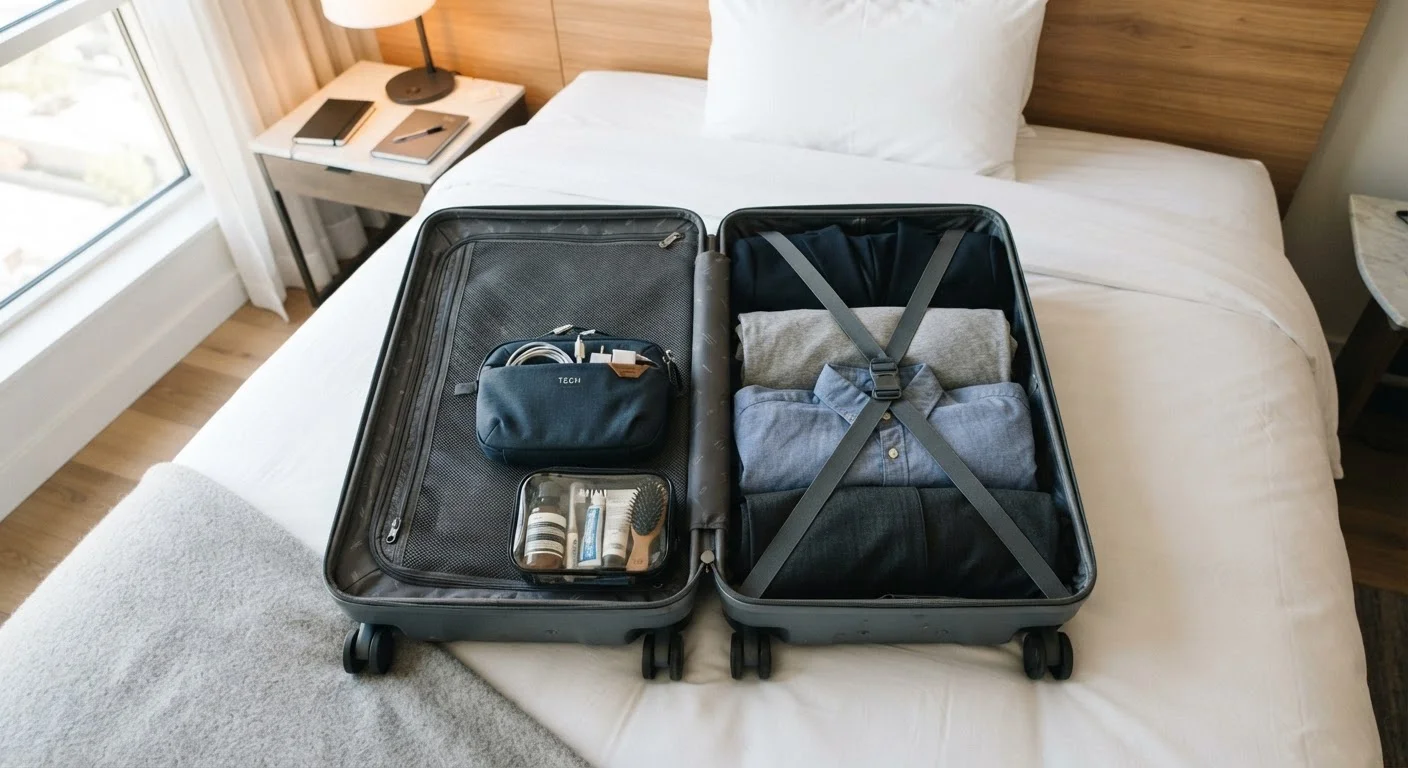
Experienced business travelers maintain a dedicated toiletry bag that lives in their luggage - not in their bathroom. It contains travel-sized duplicates of everything they use daily: a razor, deodorant, toothbrush, toothpaste, face wash, and any skincare essentials. All liquids stay under the TSA 3.4 oz (100 ml) limit and are organized in a clear, quart-sized bag that never leaves the kit.
The practical effect is that packing toiletries takes zero time - the bag is already packed. Replenishing after a trip takes two minutes. This single habit is among the most cited time-savers among frequent travelers, cutting pre-departure prep by a measurable margin on every single trip.
A permanently packed toiletry kit means toiletries are never a packing task - only a grab.
Use a dedicated tech pouch with a fixed loadout
Tech sprawl - adapters, cables, chargers, earbuds, and dongles scattered loose in a bag - costs time at security, in meeting rooms, and at hotel desks. Road warriors consolidate everything into a single tech pouch with a consistent, memorized loadout: laptop charger, USB-C hub or multi-port adapter, phone cable, earbuds, a portable battery pack, and any presentation dongles required.
Nothing is added ad hoc; nothing is removed between trips unless it needs replacing. The pouch goes directly from bag to desk to bag. For a full look at how cubes and pouches can structure an entire packing system, packing cubes explained is a useful companion read.
A fixed tech pouch loadout means you never leave a charger behind or spend time hunting cables.
Default to carry-on only and protect that constraint
The carry-on default isn't just about saving checked bag fees - though on shorter trips those fees add up quickly. It's about controlling your arrival. A carry-on traveler exits the plane and heads directly to ground transport. A checked bag traveler waits 20-40 minutes at baggage claim, multiplied across every trip in a year.
Protecting this constraint means actively resisting pressure to bring more. When the urge to check a bag surfaces, experienced travelers treat it as a signal to re-evaluate the packing list, not to expand the bag. The trade-offs between carry-on and checked bag are worth understanding fully before making that call.
Carry-on-only isn't a constraint to endure - it's a system that saves time on every single trip.
Compress and roll rather than fold flat
Rolling garments instead of folding them flat reduces volume, prevents hard crease lines in wrinkle-resistant fabrics, and makes items immediately visible when the bag is opened - no unpacking required to find something at the bottom. Heavier items like jeans and blazers go at the base of the bag nearest the wheels; lighter rolled items fill remaining space efficiently.
This isn't about compression bags - which add their own bulk and time cost - but about disciplined rolling technique applied consistently. For a step-by-step method covering a full week's clothing in a single carry-on, packing a week into a carry-on walks through the approach in detail.
Rolling clothes reduces volume and keeps wrinkle-resistant fabrics presentation-ready without pressing.
Building a System You Can Repeat Every Trip
The real payoff from these habits isn't any single saved minute - it's the compound effect of removing dozens of small decisions from every departure. A pre-packed toiletry kit, a fixed capsule wardrobe, and a dedicated tech pouch mean you're not starting from scratch each time you travel. If you're still trying to understand why overpacking keeps happening despite your best intentions, the psychology behind overpacking is worth reviewing.
Set a bag weight limit before you start packing
Many frequent business travelers impose a personal weight ceiling - often 15-18 lbs for a carry-on - as a hard constraint before placing a single item in the bag. Weighing the empty bag first, then packing to the ceiling rather than filling the available volume, forces prioritization early. A luggage scale kept near your packing area makes this a two-second check rather than an afterthought at the airport.
For a comprehensive view covering luggage selection, document prep, and toiletry rules, the complete packing and trip prep guide covers every category in one place.