

Key Takeaways
Why Night Driving Is Disproportionately Dangerous
Most drivers know night driving feels different. Fewer appreciate exactly how much the math changes. According to the National Safety Council, roughly half of all traffic fatalities occur in the dark - despite nighttime accounting for far less than half of total miles driven in the US.
Three overlapping problems explain this gap: reduced visibility, degraded depth perception, and driver fatigue. Human eyes don't switch cleanly to night mode. Peripheral vision narrows, color perception fades, and the ability to judge speed and distance at a distance deteriorates. These aren't minor inconveniences - they fundamentally change how much reaction time you have when something unexpected enters your path.
Understanding the specific mechanisms at work is the first step to compensating for them. The practices below address each one directly.
Drive at a speed where you can stop within your headlight range
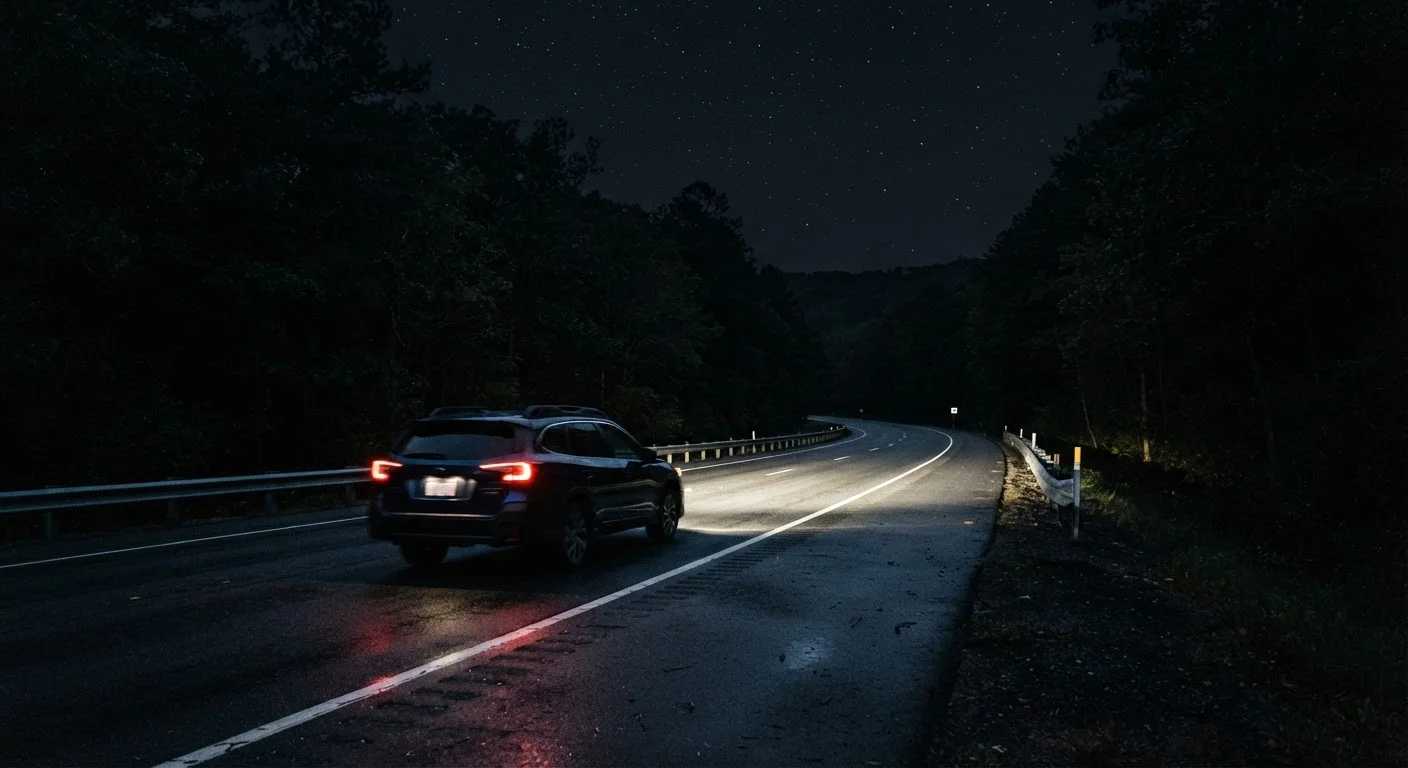
Standard low-beam headlights illuminate roughly 160-250 feet ahead. At 60 mph, total stopping distance - reaction time plus braking - can exceed 300 feet. This gap, sometimes called 'overdriving your headlights,' means you may not be able to stop before hitting something you can only just see. Slowing down is the only reliable fix.
Use high beams on unlit roads - and drop them promptly for oncoming traffic
High beams can extend illumination to 350-500 feet, dramatically increasing your reaction window on dark roads. Many drivers underuse them out of habit. The discipline is switching back to low beams when an oncoming vehicle appears within approximately 500 feet, or when following another vehicle closely - both required by law in most US states.
Protect your night vision by avoiding direct glare
The eye's ability to see in low light - dark adaptation - takes 20-30 minutes to fully develop and can be disrupted in seconds by bright oncoming headlights. Looking slightly right of the lane line rather than directly at oncoming lights helps preserve adaptation. Avoid looking at your phone screen, which has the same disruptive effect.
Increase following distance beyond the standard three-second rule
At night, you have less visual context about what the vehicle ahead is doing and what's in front of them. A four-to-five second gap gives you more time to react to sudden brake lights, and reduces the discomfort of their taillights obscuring the road ahead. See why stopping distances are larger than most drivers expect.
Keep windshield and headlights clean before night trips
Road grime, smears, and dust that are barely noticeable during the day scatter incoming light at night, creating glare and reducing clarity. A dirty windshield can cut effective visibility substantially. Headlights coated in road film emit noticeably less light than clean ones. Both are easy fixes with outsized impact.
Recognize fatigue early and respond before it becomes dangerous
Fatigue and darkness reinforce each other. Darkness suppresses alertness through melatonin production; driving at night is when the body naturally wants to sleep. Drivers often misjudge how impaired they are until performance has already degraded significantly. If you're yawning repeatedly, struggling to maintain lane position, or missing exits, these are actionable warning signs - not signals to push through.
Core Night-Driving Practices That Actually Reduce Risk
Each of the following practices targets a specific vulnerability that darkness creates. Taken together, they close the gap between what the conditions demand and what most drivers instinctively do.
For a deeper look at how fatigue specifically degrades your driving ability at a physiological level, see what happens to your body when you drive tired. Night driving and drowsiness are a particularly dangerous combination - each one amplifies the other.
Situational Awareness After Dark: What Changes and What to Watch
Night driving doesn't just limit what you can see - it changes where the threats come from. Pedestrians and cyclists are far harder to spot, deer and other animals are most active at dusk and dawn, and road hazards like debris or potholes appear with almost no warning under low-beam headlights.
Maintaining full-surround awareness becomes harder at night because reference points disappear. You lose the peripheral cues that help you track adjacent vehicles during the day. Scanning further ahead - not just at the illuminated patch directly in front - gives you more processing time.
Weather compounds night risk significantly. Rain, fog, and snow each interact with headlight beams in ways that can reduce effective visibility well below the already-limited low-beam range. Adverse weather demands its own set of adjustments layered on top of nighttime habits - not instead of them.
Finally, overconfidence is a real factor after dark. Experienced drivers often underestimate how much their nighttime performance has degraded, particularly as fatigue sets in. The cognitive traps that affect experienced drivers are especially active when familiarity with a route creates a false sense of security.
Distraction Compounds Night Risk
Any distraction that pulls visual attention away from the road is more consequential at night because you have less time to process what your headlights reveal. Activities that feel low-stakes during the day - adjusting the radio, glancing at navigation - carry greater consequence after dark. The full range of driver distractions extends well beyond phones, and night amplifies the cost of all of them.