

Key Takeaways
Why Weather Changes the Equation
Most drivers understand, in principle, that bad weather means slower driving. In practice, many underestimate just how dramatically conditions shift the physics of stopping, steering, and seeing. A dry road at 60 mph may require roughly 200 feet to stop; the same vehicle on wet pavement can need 40% more distance, and significantly more on snow or ice.
Critically, posted speed limits are not weather-adjusted. They reflect optimal, dry conditions. US traffic law consistently holds that drivers must operate at a speed that is reasonable and prudent for existing conditions - meaning you can be cited for driving the speed limit if conditions made that speed unsafe. Understanding this shifts the frame: slowing down in bad weather isn't timid, it's legally and physically correct.
Experienced drivers are particularly vulnerable to underestimating these risks - familiarity with a route or vehicle can breed a false sense of security that conditions quickly punish.
Driving in Rain: Traction, Visibility, and Following Distance
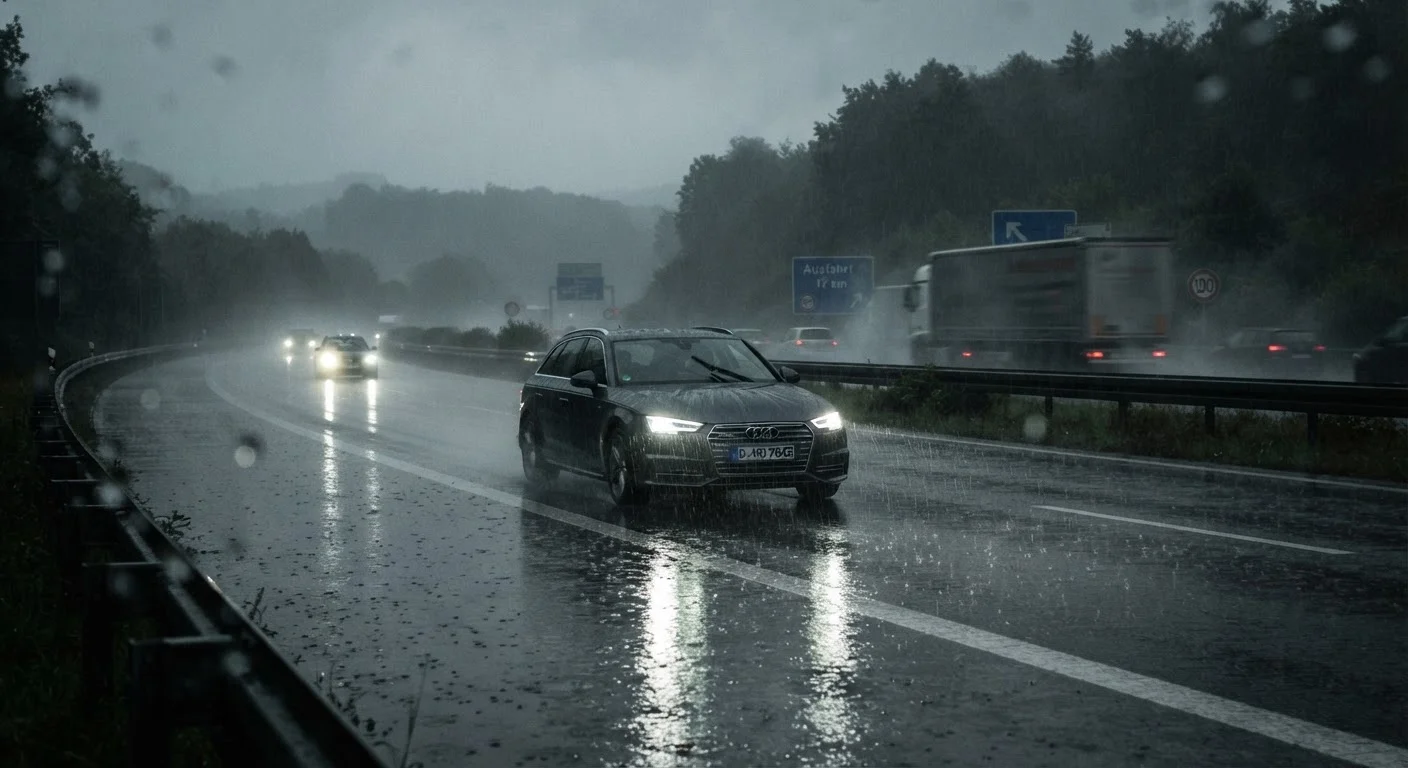
Rain presents two simultaneous problems: reduced tire grip and reduced visibility. The first few minutes of a rainstorm are often the most hazardous - water mixes with accumulated road oils to create a slicker surface than either dry pavement or a thoroughly washed, heavier rain produces.
Increase following distance to at least 4-6 seconds on wet roads, and 8-10 seconds on snow or ice.
Stopping distances increase dramatically on wet or frozen surfaces. The standard 2-3 second gap in dry conditions leaves almost no margin when traction is reduced. More space buys time for both perception and braking.
Turn on headlights as soon as visibility drops, even in daylight rain.
Most US states legally require headlights when wipers are in use. Beyond legality, headlights make your vehicle visible to others - side and rear visibility matters as much as forward visibility in rain.
Reduce speed before entering curves, not while in them.
Braking during a curve transfers weight and reduces traction at precisely the moment the tires are already managing cornering forces. In wet or icy conditions, this combination significantly raises the risk of sliding.
Brake earlier and more gradually than you would in dry conditions.
Hard, late braking is the most common trigger for skids on slippery roads. Longer, gentler pressure on the brake pedal allows ABS to function effectively and keeps the vehicle more stable.
Eliminate distractions entirely when weather conditions are poor.
Bad weather demands more cognitive bandwidth - scanning for hazards, monitoring traction, reading the road surface. Any distraction that's marginal in good conditions becomes genuinely dangerous when conditions degrade.
Hydroplaning - where tires ride on a film of water rather than the road surface - can occur at speeds as low as 35 mph on standing water, depending on tire tread depth and water depth. If you feel the steering go light and unresponsive, ease off the throttle gradually rather than braking sharply. For a full breakdown of what to do when traction disappears, see how to handle skids and hydroplaning.
Keep your vehicle's tires and wipers properly maintained - these are your primary defenses in rain. Worn tread and streaky wiper blades both quietly erode your margin of safety before you notice they're failing.
Snow and Ice: The Invisible Threat
Snow is visible and commands attention. Ice - particularly black ice - is not. Black ice forms when road surfaces drop to freezing while remaining wet, typically on bridges, overpasses, shaded stretches, and intersections where traffic polish has smoothed the pavement. It looks like wet road, not ice.
Recognizing the conditions for black ice matters more than trying to see it: temperatures near or below 32°F combined with recent precipitation or overnight dew are the warning signs. Bridges freeze before roads because cold air circulates beneath the deck from both sides.
AWD and 4WD Don't Shorten Stopping Distance
All-wheel drive and four-wheel drive systems distribute power to improve traction during acceleration, which helps on snow and slippery surfaces. However, braking physics are governed by tire-to-road friction, not drivetrain configuration. An AWD vehicle stops at essentially the same distance as a comparable two-wheel drive vehicle on ice. Overconfidence in AWD capability is a recognized factor in winter weather crashes - adjust your following distance and speed regardless of what your drivetrain is doing.
All-wheel drive and four-wheel drive improve your ability to accelerate on snow - they do not meaningfully shorten your stopping distance. Drivers in AWD or 4WD vehicles who assume they can brake as confidently as on dry roads are a documented source of serious winter crashes. Braking physics apply equally regardless of drivetrain.
In snow, reduce speed well beyond what feels necessary, increase following distance to at least 8-10 seconds, and brake and steer with deliberate smoothness. Abrupt inputs - sharp steering, hard braking - are what triggers loss of control on snow-covered roads.
Fog: When Your Instincts Work Against You
Fog creates a strong psychological pressure to drive faster than visibility allows - partly because speed feels normal and slowing feels uncomfortable, and partly because fog can be difficult to judge. Drivers routinely overestimate how much road they can see ahead.
The correct response to dense fog is counterintuitive in two specific ways. First, use low-beam headlights, not high beams. High beams reflect off the water droplets in fog and scatter light back at you, reducing visibility. Second, do not use hazard lights while moving in most US states - check your state's specific laws, as hazard light rules vary, but in many jurisdictions they are reserved for stationary or very slow vehicles and can confuse following drivers about your intentions.
The Sight Distance Rule for Fog
In dense fog, your speed should never exceed what allows you to stop within the distance you can see ahead. If visibility is 150 feet, you need to be able to stop in 150 feet or less. At 40 mph, most passenger vehicles require roughly 120-130 feet to stop under good conditions - meaning fog may demand speeds well below 40 mph to maintain safe sight distance.
The governing principle in fog is to drive only as fast as your visibility allows you to stop. If you can see 100 feet ahead, your speed should be no more than what lets you stop within that 100 feet. This is sometimes called the sight distance rule and it applies regardless of the posted limit.
Reduced visibility at night compounds fog's danger significantly. Night driving already raises risk before fog enters the picture - combining the two demands even more conservative speeds and greater following distances.
The Habits That Apply Across All Bad Weather
Specific conditions require specific responses, but a core set of adjustments applies universally when weather deteriorates.
Weather-related crashes are disproportionately caused not by the worst conditions - when drivers appropriately slow down - but by moderate conditions that drivers underestimate. Steady rain, patchy fog, and lightly snow-dusted roads all carry significant risk precisely because they don't feel alarming enough to trigger the full caution response.
Building consistent habits around defensive driving principles is what separates drivers who navigate bad weather reliably from those who navigate it safely - until they don't. The habits listed here are not exceptional measures for exceptional storms. They're the baseline for any conditions outside dry, clear, and daylight.
For a broader look at how situational awareness shapes safety, the guide to mirrors and full-surround awareness covers the scanning habits that become even more critical when visibility is compromised.