

Key Takeaways
Option A
Defensive Driving
The data-backed approach that consistently reduces crash risk.
Best for: Drivers who want to arrive safely, keep insurance costs lower, and maintain predictable control in all conditions.
Option B
Aggressive Driving
The high-risk style that feels faster but rarely delivers.
Best for: Understanding what not to do - and recognising these habits in yourself before they cause a crash.
If you drive frequently in urban or high-traffic environments
Defensive Driving
Stop-and-go traffic amplifies the risk of aggressive habits like tailgating and abrupt lane changes. Smooth, anticipatory driving reduces rear-end exposure and stress.
If you regularly drive on highways or interstates
Defensive Driving
High-speed environments leave almost no margin for error. The physics of stopping distance at 70 mph make aggressive manoeuvres disproportionately dangerous.
If you are trying to reduce your insurance premiums
Defensive Driving
Many insurers offer discounts for completing certified defensive driving courses, and a cleaner violation record directly lowers risk tier ratings.
If you want to understand whether your current habits are risky
Defensive Driving
The research consistently shows that drivers who identify and consciously correct aggressive tendencies have measurably better safety outcomes.
Defining the Two Styles
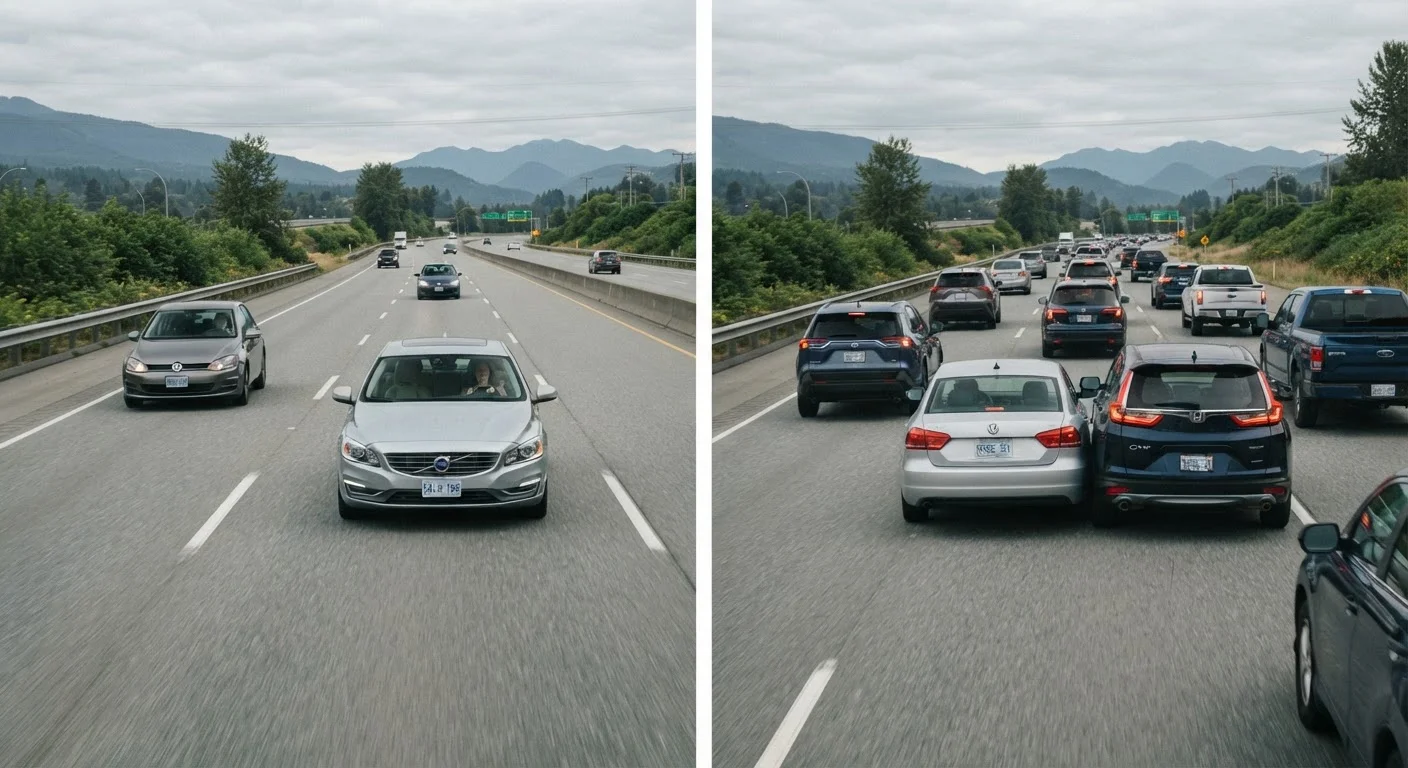
Defensive driving is best understood as anticipation-based driving. It means scanning ahead for hazards, maintaining adequate following distance, adjusting speed to conditions - not just to the posted limit - and assuming other drivers may make mistakes. It is proactive rather than reactive.
Aggressive driving, as defined by the National Highway Traffic Safety Administration (NHTSA), encompasses a cluster of unsafe behaviours: speeding, following too closely, running red lights, unsafe lane changes, and intimidating other drivers. It is not simply assertive or confident driving - it is behaviour that increases crash probability for everyone nearby.
The distinction matters because many aggressive drivers do not self-identify as such. They frame tailgating as "keeping pace" or rapid lane-switching as "efficient." Research on driver self-assessment consistently finds that people rate themselves well above average in skill - a bias that makes it harder to recognise risky habits. See our guide to overconfidence behind the wheel for a deeper look at that cognitive blind spot.
| Criterion | Defensive Driving | Aggressive Driving |
|---|---|---|
| Core approach | Anticipate and manage hazards | React and push through gaps |
| Following distance | 3+ seconds in normal conditions | Often under 1 second |
| Speed management | Matched to conditions and traffic | At or above posted limit regardless |
| Crash involvement risk | Lower - fewer high-risk inputs | Higher - disproportionate in fatal crashes |
| Time savings per trip | Negligible loss vs. aggressive | Seconds to low minutes - overstated |
| Vehicle wear | Lower - smoother inputs | Higher - hard braking and acceleration |
| Insurance impact | Neutral to positive (fewer violations) | Negative - violations raise premiums |
| Performance in adverse conditions | Adapts - increases margins | Deteriorates - margins collapse |
What the Research Actually Shows
NHTSA data attributes aggressive driving as a contributing factor in roughly one-third of all fatal crashes in the United States. Speeding alone - one of the most common aggressive behaviours - was a factor in 29% of all traffic fatalities in a recent reporting year, according to NHTSA crash data.
The time-savings argument for aggressive driving is largely a myth under normal conditions. Traffic engineering studies have shown that speeding between signals or weaving through traffic saves, on average, only a few minutes over a typical commute - while the probability of being involved in a crash rises substantially with each 10 mph above the flow of traffic.
~29%
Of US traffic fatalities linked to speeding
According to NHTSA crash data, speeding is consistently one of the top contributing factors in fatal crashes each year.
~1/3
Of fatal crashes with aggressive driving as a factor
NHTSA research attributes aggressive driving behaviours as a contributing factor in roughly one-third of all fatal US traffic crashes.
3 seconds
Minimum recommended following distance
Traffic safety guidelines recommend at least a three-second gap at normal speeds, increasing to four or more seconds in poor conditions.
Defensive driving does not mean driving slowly or timidly. It means driving at the right speed for the conditions, leaving enough space to brake without panic, and keeping your attention on a wider field of view. Those habits directly reduce the severity of any incident when one does occur. Our article on the physics of stopping distances explains exactly why following distance is so critical at speed.
Adverse conditions magnify the difference between the two styles further. On wet or icy roads, the stopping distances that aggressive drivers ignore become life-threatening gaps. Read more about how road conditions change required habits in our piece on driving in rain, snow, and fog.
The Hidden Costs of Aggressive Driving
Beyond crash risk, aggressive driving carries measurable financial consequences. Frequent hard braking and rapid acceleration accelerate brake pad and tyre wear. Engines and transmissions operated at sustained high load require more frequent servicing. These are real costs that accumulate over months, not just dramatic one-time repair bills after a crash.
Insurance is the other lever. Moving violations - speeding tickets, reckless driving citations - are logged against your driving record and used by insurers to calculate your premium tier. Multiple violations within a three-year window can push premiums significantly higher, and in some states a serious aggressive-driving conviction can trigger licence suspension. The Car Costs & Savings hub covers broader strategies for managing these expenses over time.
Defensive Driving Courses and Insurance Discounts
Many US states allow drivers to complete a certified defensive driving course - either in-person or online - to dismiss a minor traffic violation or qualify for an insurance premium reduction. Eligibility, discount amounts, and approved providers vary by state and insurer. Check directly with your state DMV and insurance carrier for specifics before enrolling.
Highway driving is where aggressive habits carry the highest stakes. At 70 mph, even a one-second lapse in attention translates to roughly 100 feet of uncontrolled travel. Our overview of highway driving skills covers lane discipline and merging technique that many drivers were never formally taught.
Practical Habits That Separate the Two Styles
The difference between defensive and aggressive driving often comes down to a handful of specific, repeatable habits:
- Following distance: Defensive drivers maintain at least a three-second gap in normal conditions - more in adverse weather or at highway speeds. Aggressive drivers routinely close this gap to under one second.
- Speed in context: Defensive drivers read the flow of traffic and conditions, not just the posted limit. Aggressive drivers treat the limit as a floor, not a ceiling.
- Lane changes: Defensive drivers signal early, check mirrors and blind spots, and merge gradually. Aggressive drivers cut across multiple lanes with minimal warning.
- Intersection behaviour: Defensive drivers treat a green light as permission to proceed after confirming the intersection is clear. Aggressive drivers accelerate through yellows and push through red-light timing margins.
- Emotional regulation: Defensive drivers treat conflict with other drivers as a non-event. Aggressive drivers allow frustration to drive decision-making - a documented pathway to escalating risk.
Night driving compounds all of these factors. Reduced visibility means the hazards defensive drivers scan for appear later, leaving less margin. Our guide on night driving risk and compensation techniques details how to adapt these habits after dark.