

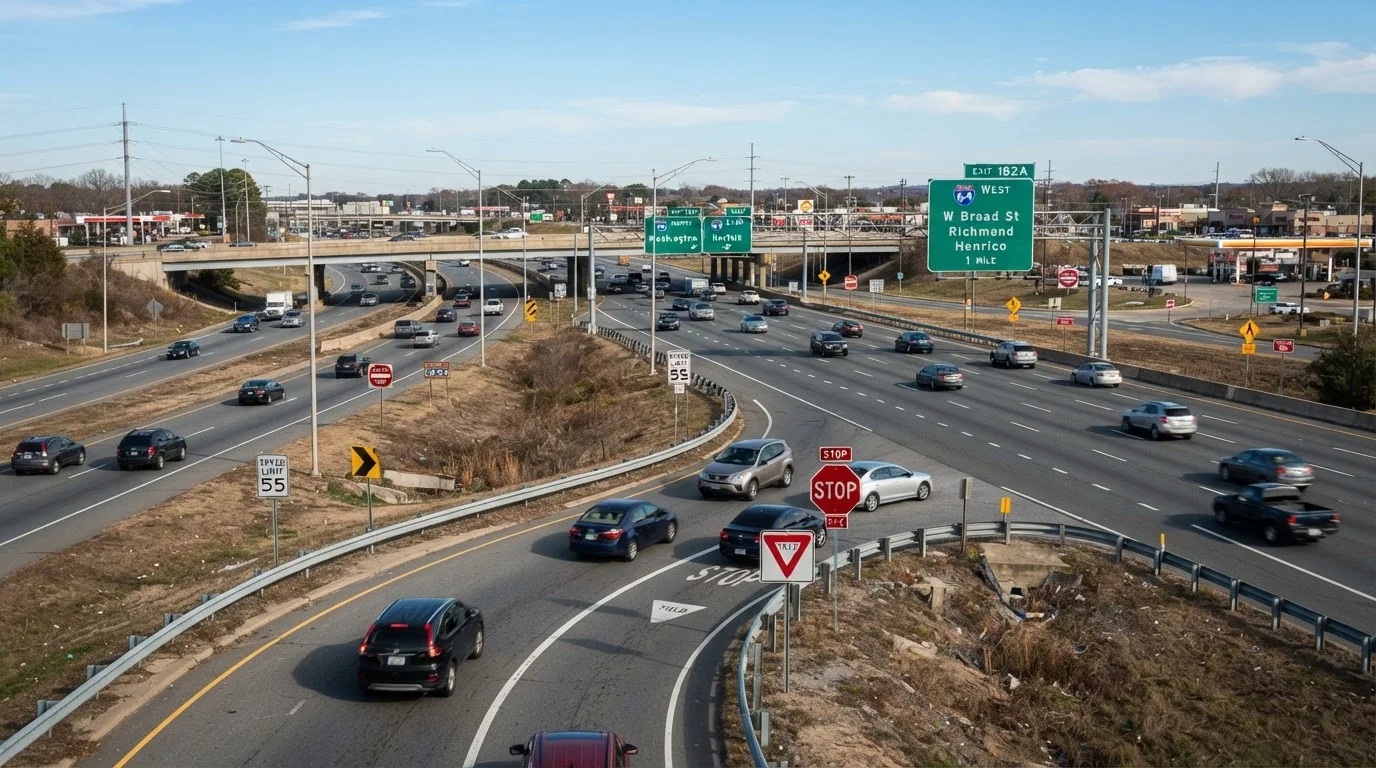
| Governing standard | MUTCD (Manual on Uniform Traffic Control Devices) (Federal Highway Administration) |
| Distinct sign shapes in US system | 8 standardized shapes (MUTCD, current edition) |
| Exclusive shape reserved for one sign | Octagon - STOP sign only (MUTCD) |
| Color for active work zones | Orange (MUTCD) |
| School zone sign color | Fluorescent yellow-green (MUTCD) |
| Three functional sign categories | Regulatory, Warning, Guide (MUTCD) |
Why Shape and Color Come Before Words
The Federal Highway Administration's MUTCD governs every road sign in the US. Its core principle: a driver should be able to react to a sign before they can read it. Shape and color encode the message first - words confirm it. That layered design is not an accident; it exists so that partially obscured, faded, or fast-approaching signs still communicate intent.
Understanding the system doesn't just help on the written driving test. It reduces cognitive load while driving, so you're processing information faster and leaving more mental bandwidth for hazard detection. See our guide to full-surround awareness for how sign-reading fits into broader situational awareness.
| Governing standard | MUTCD (Manual on Uniform Traffic Control Devices) (Federal Highway Administration) |
| Distinct sign shapes in US system | 8 standardized shapes (MUTCD, current edition) |
| Exclusive shape reserved for one sign | Octagon - STOP sign only (MUTCD) |
| Color for active work zones | Orange (MUTCD) |
| School zone sign color | Fluorescent yellow-green (MUTCD) |
| Three functional sign categories | Regulatory, Warning, Guide (MUTCD) |
The Shape Code: Eight Forms, Eight Meanings
Each sign shape is federally assigned to a specific function. Learn these and you'll know a sign's category at a glance, day or night.
- Octagon (8 sides): Stop - exclusively reserved for the STOP sign. No other sign uses this shape.
- Triangle (inverted, pointing down): Yield - give right-of-way to crossing or merging traffic.
- Diamond: Warning - alerts you to a road condition, hazard, or change ahead.
- Rectangle (vertical): Regulatory - communicates rules you must follow (speed limits, turn restrictions, lane controls).
- Rectangle (horizontal): Guide or informational - distances, destinations, services.
- Pentagon (5 sides, pointing up): School zone or school crossing - used together with fluorescent yellow-green color.
- Round circle: Railroad crossing advance warning or no-passing zone.
- Crossbuck (X shape): Railroad crossing at grade - always yield to trains.
Regulatory signs govern legal obligations. Confusing a warning diamond for a regulatory sign is a common mistake - the diamond tells you what's coming; the rectangle tells you what you must do. For how posted limits are interpreted legally, see Speed Limits, Speed Cameras, and the Law.
MUTCD
The Manual on Uniform Traffic Control Devices, published by the Federal Highway Administration. It sets the national standards for all traffic signs, signals, and pavement markings used on US public roads.
Regulatory sign
A sign that communicates a legal requirement drivers must obey, such as a speed limit or turn prohibition. Violating a regulatory sign can result in a traffic citation.
Warning sign
A sign that alerts drivers to a road condition, hazard, or change requiring increased caution ahead. Most US warning signs use a yellow diamond shape.
Work zone (construction zone)
A designated area of active road construction or maintenance, marked with orange signs. Traffic fines are commonly increased in these zones, and reduced speed limits apply even when workers are not present.
Guide sign
A sign that provides navigational, directional, or service information to drivers. Guide signs do not impose legal obligations but help drivers navigate routes and locate services.
Crossbuck
The X-shaped sign placed at railroad grade crossings. Drivers are legally required to yield to any approaching train when a crossbuck is present.
The Color Code: What Each Hue Signals
Color assignments under the MUTCD are standardized nationwide. Here's what each color communicates:
| Color | Meaning / Category | Common Examples |
|---|---|---|
| Red | Stop, prohibition, or do-not-enter | STOP, YIELD border, Wrong Way, Do Not Enter |
| Yellow | General warning | Curve ahead, pedestrian crossing, merge warning |
| Orange | Construction and maintenance zones | Road work, lane shift, flagger ahead |
| Green | Permitted movement, guide information | Highway exits, distance markers, permitted turns |
| Blue | Motorist services | Rest areas, hospitals, gas, food, lodging |
| Brown | Recreation and cultural sites | Parks, campgrounds, historic sites |
| White | Regulatory | Speed limit, one-way, lane-use controls |
| Fluorescent yellow-green | High-visibility warning | School zones, pedestrian and bicycle crossings |
Orange is worth special attention: it applies only in active work zones, where fines are often doubled and speed limits are strictly enforced. Understanding right-of-way rules around work zones is covered in our article on merging, yielding, and right-of-way.
500,000+
Work zone crashes annually in the US
According to the Federal Highway Administration, hundreds of thousands of crashes occur in work zones each year, reinforcing why orange-zone awareness matters.
8
Standardized sign shapes in the US
The MUTCD assigns each shape to a specific functional category, enabling drivers to classify a sign before reading its text.
The Three Functional Categories
Beyond shape and color, every US road sign falls into one of three operational categories defined by the MUTCD:
- Regulatory signs state legal requirements. Ignoring them is a traffic violation - speed limits, stop signs, lane restrictions, and turn prohibitions all fall here. They're typically white or red with vertical rectangular or distinctive shapes.
- Warning signs alert drivers to conditions requiring extra caution. They don't create legal obligations by themselves, but failing to respond appropriately can contribute to liability in a crash. Most are yellow diamonds.
- Guide signs provide navigational and informational support - exits, mileage, services, and points of interest. They carry no legal obligation but are critical for route decision-making.
A practical habit: every time you see a sign, quickly classify it. Regulatory? Adjust behavior. Warning? Scan the road ahead. Guide? File it for navigation. This three-step mental sort keeps sign-reading automatic rather than effortful.
This article provides general educational information about US road sign standards. Always consult your state's driver handbook and official MUTCD resources for the most current and jurisdiction-specific guidance.