

Key Takeaways
Why Speed Law Trips Up Even Experienced Drivers
Most drivers passed a written test once and haven't revisited traffic law since. Speed regulations, however, are more layered than a single posted number suggests. They shift by location, time of day, weather conditions, and even the type of road - and enforcement technology has evolved faster than public understanding of it.
The result: drivers operating on assumptions that are partly or entirely wrong. That's not a minor inconvenience. Misreading speed law can mean an unexpected ticket, a spike in insurance premiums, or worse, a collision. The myths below represent the most common and consequential misunderstandings the editorial team encounters. Each one is correctable with a clearer reading of how speed law actually works.
For a broader look at how road conditions interact with your legal obligations, see our guide on driving in rain, snow, and fog.
Myth
The posted speed limit is the speed you're supposed to drive - staying at or just under it means you're always legal.
Fact
Posted limits are legal maximums under ideal conditions. State law in every US jurisdiction requires drivers to adjust speed for actual conditions - rain, fog, heavy traffic, or road hazards can make the posted limit unsafe and legally insufficient.
This is sometimes called the basic speed law, and it exists in every state's vehicle code. It holds that no driver may operate a vehicle at a speed greater than is reasonable and prudent given current conditions - regardless of what the sign says. A driver traveling 55 mph on a rain-slicked highway in near-zero visibility can be cited even if 55 is the posted limit. The sign sets the ceiling; conditions set the floor.
Myth
If you're driving the same speed as everyone around you, you can't be singled out for a speeding ticket.
Fact
Keeping pace with surrounding traffic provides no legal protection. Every vehicle in that flow is individually subject to the speed limit, and an officer can cite any one of them - including you.
The "everyone else is doing it" defense has no standing in traffic law. Officers routinely select individual vehicles from a speeding cluster based on radar lock, pacing, or laser targeting. Being part of a faster-moving group does not distribute liability - it just means multiple people are violating the law simultaneously. Courts do not accept flow of traffic as a mitigating argument for exceeding posted limits.
Myth
School zone speed limits only apply when children are visibly present or crossing.
Fact
School zone limits typically apply during designated hours posted on the sign - not based on whether you can see children. In many states, the reduced limit applies on school days during arrival and dismissal windows, regardless of visible foot traffic.
Signs in school zones usually specify the hours during which the reduced speed applies - for example, 7-8 a.m. and 2:30-3:30 p.m. on school days. Some jurisdictions use flashing beacons to signal when the limit is active. If the beacon is flashing or the time window applies, the limit is in force whether or not children are visible. Assuming the absence of students means the regular limit applies is one of the most common - and expensive - school zone mistakes.
Myth
Speed camera tickets don't affect your driving record because no officer witnessed the violation.
Fact
Whether a camera ticket affects your driving record or insurance depends entirely on your state. In some states, camera tickets are civil penalties with no record impact; in others, they function like standard moving violations.
There is no federal standard governing how automated speed enforcement citations are classified. States vary significantly: some issue camera tickets to the registered owner as a civil fine (similar to a parking ticket), with no points assessed; others treat them as moving violations that appear on your record and can influence insurance rates. If you receive a camera citation, check your state DMV's rules before assuming it's consequence-free. Ignoring it in either case typically results in escalating penalties.
Myth
Minimum speed limits are rarely enforced and can be ignored safely.
Fact
Driving significantly below a posted minimum speed on controlled-access highways is a citable offense and a genuine safety hazard. Enforcement is uncommon but legal and real.
Minimum speed limits exist on many interstate and expressway segments for a reason: slow vehicles create dangerous speed differentials with surrounding traffic, increasing rear-end collision risk. Driving 40 mph on a 65 mph highway - even if you feel safer - disrupts traffic flow and can result in a citation. If you're uncomfortable with highway speeds, highway driving fundamentals can help build the confidence and technique to operate safely at posted speeds.
Myth
Speed cameras must always be announced with a warning sign before the enforcement zone.
Fact
Warning sign requirements for speed cameras vary by state and municipality. Some jurisdictions mandate advance signage; many do not. Assuming a warning is required in your area may be incorrect.
This belief likely stems from the fact that some localities do post warning signs as a matter of policy or legal requirement. But it is far from universal. Drivers should not rely on the presence or absence of a warning sign to gauge whether a camera is operating. The safest and legally correct approach is to observe the posted speed limit consistently - warning sign or not.
Speed Cameras, Variable Limits, and What Enforcement Actually Means
Beyond the basics of posted limits, drivers frequently misunderstand how speed is enforced and what certain sign types legally require. These misunderstandings matter because acting on them can result in citations even when a driver believes they're in compliance.
~12,000
Annual US speeding-related fatalities
According to the National Highway Traffic Safety Administration, speeding is a contributing factor in roughly 29% of all traffic fatalities in recent reporting years.
~140
Speed camera programs in the US
The Insurance Institute for Highway Safety tracks automated speed enforcement programs; use and legal status vary widely by state, with some states banning the practice outright.
Variable speed limit signs - the electronic overhead signs common on managed highways - are a growing source of confusion. Many drivers treat them as advisory. In states like Washington, Oregon, and Virginia, where these systems are deployed, the displayed limit carries the same legal force as a fixed sign. Ignoring a reduced variable limit during congestion or poor weather is a citable offense, not a suggestion to consider.
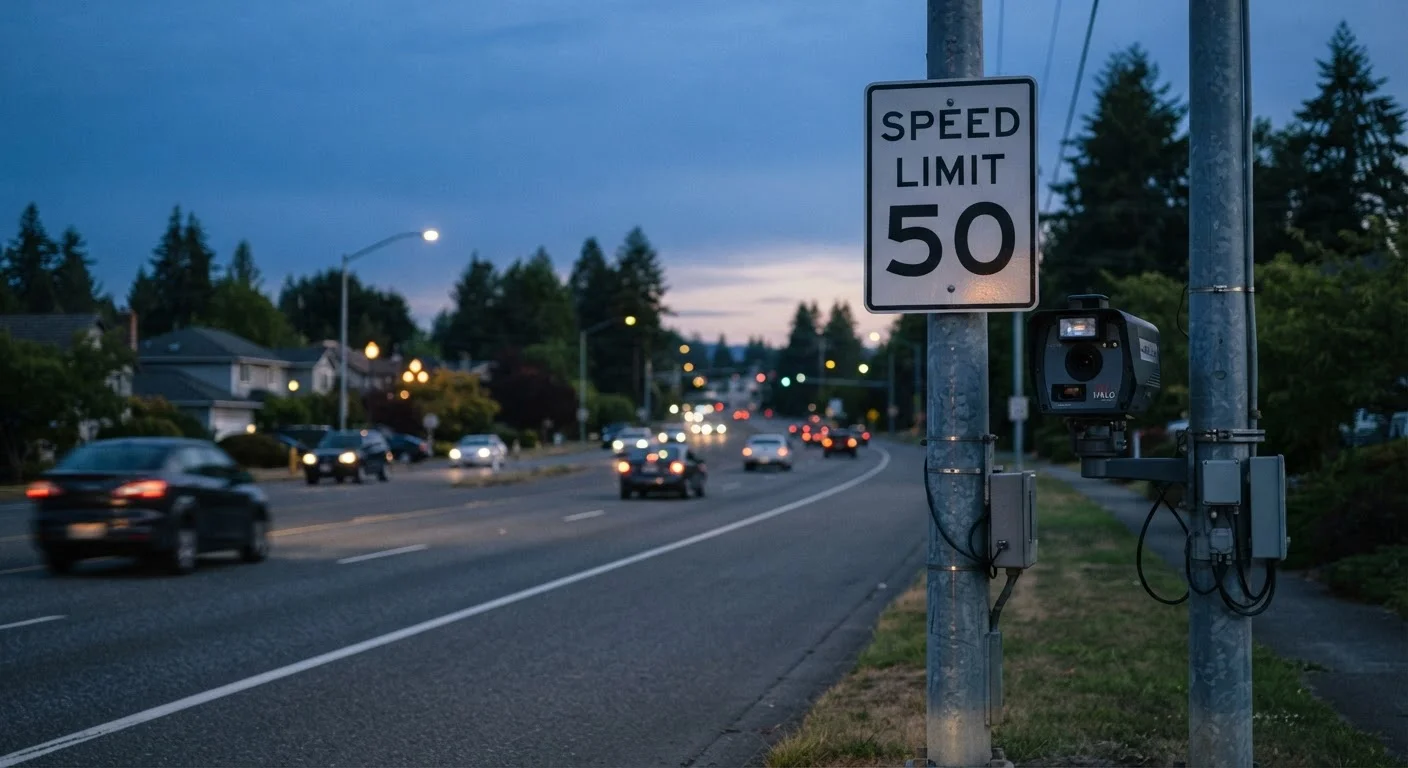
Speed cameras are another area where folklore outpaces fact. A common belief is that cameras must be preceded by a warning sign, or that tickets issued by cameras are legally unenforceable. Neither is universally true - both depend entirely on state and local statute. Some states, including Texas and Wisconsin, ban or heavily restrict automated speed enforcement; others, like Maryland and Colorado, deploy it actively. You cannot assume your state's rules based on what you've heard from another driver.
Understanding sign types more broadly helps here. Our article on reading road signs explains how regulatory signs (including speed limit placards) differ from warning and guide signs - a distinction that affects how legally binding each type is.
Variable Speed Limit Signs Are Legally Binding
In states that deploy variable speed limit systems on managed highways, the electronically displayed speed carries the same legal force as a fixed posted sign. Treating a lowered variable limit as advisory - rather than mandatory - can result in a citation. Always observe the current displayed limit, not the fixed sign you passed a mile earlier.
Right-of-way confusion causes similar enforcement blind spots. For a parallel look at traffic rules drivers routinely misread, see merging, yielding, and right-of-way rules.