

Key Takeaways
Handwriting deepens initial encoding of material
Physically writing a card forces you to process and condense information rather than copy it verbatim, engaging motor and semantic memory simultaneously.
Zero digital distractions during review sessions
Paper removes the risk of notifications, app-switching, or browser rabbit holes, making focused review sessions easier to sustain.
No technology dependency or battery concerns
Paper cards work anywhere, anytime, without charging, syncing, or software updates - a meaningful advantage in low-tech or exam environments.
Freedom to draw diagrams and spatial layouts
Freehand drawing on paper cards is faster and more flexible than inserting images into digital platforms, benefiting subjects like anatomy, chemistry, or geometry.
Difficult to scale beyond a few hundred cards
Large paper decks become physically unwieldy to carry, sort, and maintain - a practical barrier for subjects with extensive terminology.
Manual spaced repetition scheduling is error-prone
Without algorithmic support, most learners fall back on reviewing all cards equally, which wastes time on well-known material and under-reviews difficult items.
No multimedia support for audio or visual content
Subjects requiring pronunciation audio, detailed images, or video context cannot be effectively captured on a paper card.
Cards can be lost, damaged, or disorganized
There's no backup for a lost deck, and reorganizing cards by topic or difficulty requires manual sorting that digital platforms handle automatically.
Our Verdict
Paper flashcards offer a meaningful encoding advantage for learners who benefit from the physical act of writing, and they work particularly well for visual or spatial subjects. Digital flashcards win on scale, algorithmic scheduling, and portability - especially for large vocabulary sets or content requiring audio and images. For most learners, the format that gets used consistently will outperform the theoretically superior one that sits unused.
Digital flashcards suit learners managing large or growing decks who want automated spaced repetition; paper cards suit those studying focused, handwriting-friendly material who prefer a distraction-free, tactile process.
Why Format Matters More Than You Might Think
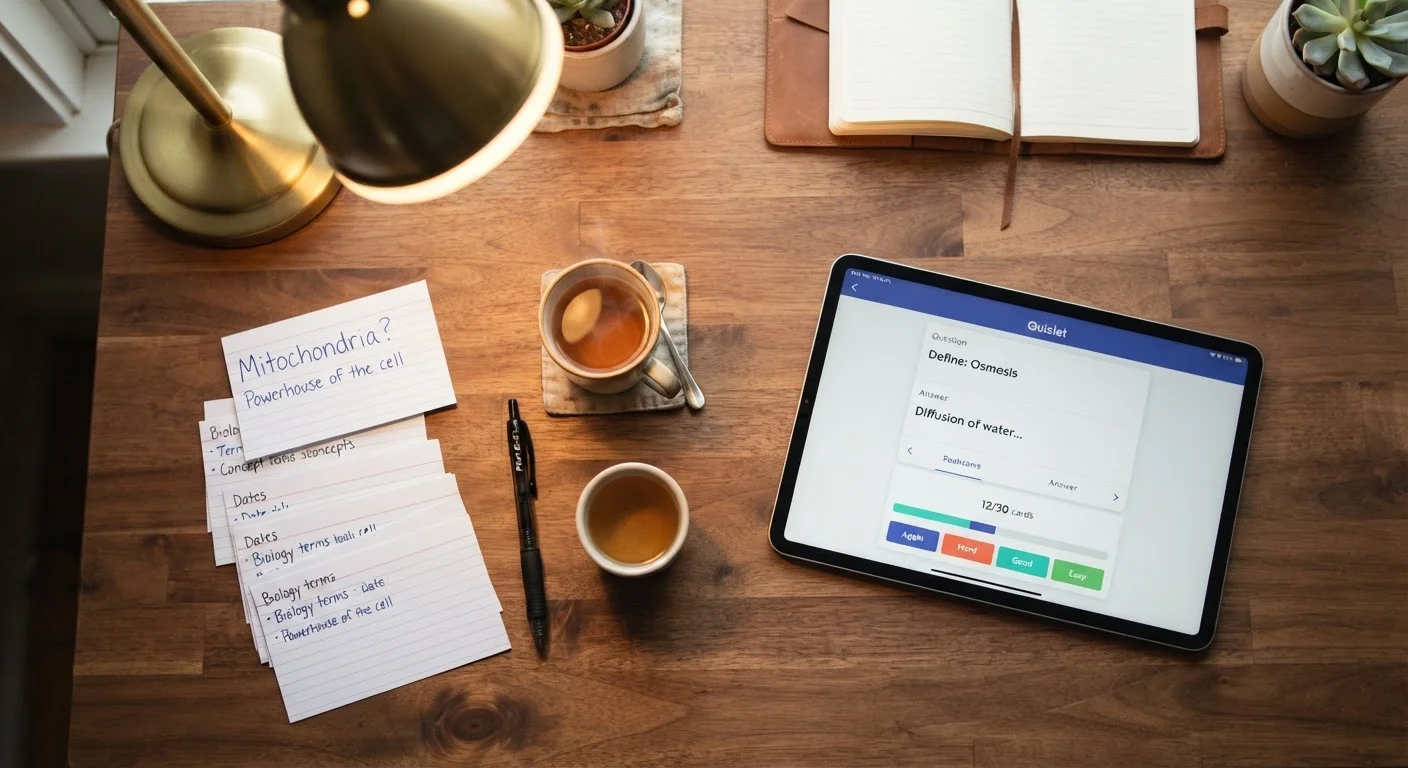
Flashcards work because they operationalize two of the most evidence-backed study principles: active recall and spaced repetition. The format you use - paper or digital - doesn't change those underlying mechanisms, but it does influence how easily you apply them, how often you reach for your cards, and how deeply your brain processes the material during creation.
Understanding how memory actually encodes information helps clarify what each format does and doesn't offer. Encoding happens at multiple levels: semantic (meaning), visual (imagery), and motor (physical movement). Paper and digital cards engage these channels differently, which is why the research doesn't produce a single clear winner.
Advantages and Disadvantages of Paper Flashcards
Paper flashcards have been a study staple for generations, and the cognitive science behind them remains relevant.
Handwriting deepens initial encoding of material
Physically writing a card forces you to process and condense information rather than copy it verbatim, engaging motor and semantic memory simultaneously.
Zero digital distractions during review sessions
Paper removes the risk of notifications, app-switching, or browser rabbit holes, making focused review sessions easier to sustain.
No technology dependency or battery concerns
Paper cards work anywhere, anytime, without charging, syncing, or software updates - a meaningful advantage in low-tech or exam environments.
Freedom to draw diagrams and spatial layouts
Freehand drawing on paper cards is faster and more flexible than inserting images into digital platforms, benefiting subjects like anatomy, chemistry, or geometry.
The handwriting advantage is probably the most robust finding in this space. Research on note-taking consistently shows that writing by hand encourages deeper processing than typing - you can't transcribe fast enough by hand, so you're forced to paraphrase and prioritize. That same effect applies when you're making flashcards: the act of deciding what to write and physically writing it is itself a form of encoding.
Paper cards also eliminate the distraction problem entirely. There's no notification, no temptation to switch apps, no battery to manage.
Difficult to scale beyond a few hundred cards
Large paper decks become physically unwieldy to carry, sort, and maintain - a practical barrier for subjects with extensive terminology.
Manual spaced repetition scheduling is error-prone
Without algorithmic support, most learners fall back on reviewing all cards equally, which wastes time on well-known material and under-reviews difficult items.
No multimedia support for audio or visual content
Subjects requiring pronunciation audio, detailed images, or video context cannot be effectively captured on a paper card.
Cards can be lost, damaged, or disorganized
There's no backup for a lost deck, and reorganizing cards by topic or difficulty requires manual sorting that digital platforms handle automatically.
The practical ceiling for paper is low, though. Managing a 500-card deck is cumbersome, reorganizing by topic requires physical sorting, and lost or damaged cards are gone. Scheduling your own spaced repetition manually - deciding which cards to review and when - requires discipline that most learners underestimate.
Advantages and Disadvantages of Digital Flashcards
Digital flashcard platforms address the operational weaknesses of paper while introducing a few of their own.
~20%
Typical forgetting within 24 hours without review
Research on the forgetting curve, originally described by Hermann Ebbinghaus, suggests a substantial portion of new information is lost within a day without reinforcement.
2x
Recall improvement with active retrieval vs. rereading
Multiple studies in cognitive psychology have found that retrieval practice - the mechanism flashcards exploit - roughly doubles retention compared to passive review strategies.
The algorithmic spaced repetition built into most digital platforms is the format's defining advantage. Rather than guessing which cards to review, the software tracks your performance on each card and schedules reviews at intervals calibrated to the forgetting curve. This is difficult to replicate manually with paper. For subjects with large, growing decks - medical terminology, a new language, professional certifications - this scheduling capability alone can justify the digital approach.
Digital cards also support multimedia: images, audio pronunciations, and diagrams can be embedded directly into a card, which matters for subjects where visual or auditory context is part of what you're learning.
The Pre-Made Deck Shortcut Has a Cost
Downloading a shared deck skips the card-creation step, which is where a significant portion of the learning happens. If you do use pre-made decks, supplement them by adding your own cards for concepts you find genuinely difficult. The effort of producing a card - deciding what's worth capturing and how to phrase it - is an encoding event in its own right.
The trade-off is creation friction and distraction risk. Typing a card is faster than writing one, but that speed can work against encoding - you're less likely to think carefully about what you're entering. Pre-made shared decks are a tempting shortcut, but passive importing of someone else's cards skips the encoding benefit of building your own.
How to Choose the Right Format for Your Situation
Rather than picking a format for all your studying, consider matching format to context. A few practical guidelines:
- Large vocabulary or terminology sets: Digital wins on sheer manageability and automated scheduling.
- Conceptual or diagram-heavy material: Paper lets you draw freely; digital requires you to find or create image files.
- Limited screen time or distraction-prone environments: Paper removes the problem at the source.
- Studying on a commute or between locations: Digital is more portable at scale.
- Budget constraints: Index cards are inexpensive; many capable digital platforms offer free tiers, though feature-rich options may carry costs.
Whichever format you choose, making your own cards from source material - rather than downloading pre-built decks - preserves the encoding benefit that makes flashcards effective in the first place. The habits that make learning stick apply across formats: active engagement during creation is non-negotiable.