

Key Takeaways
Credit Score
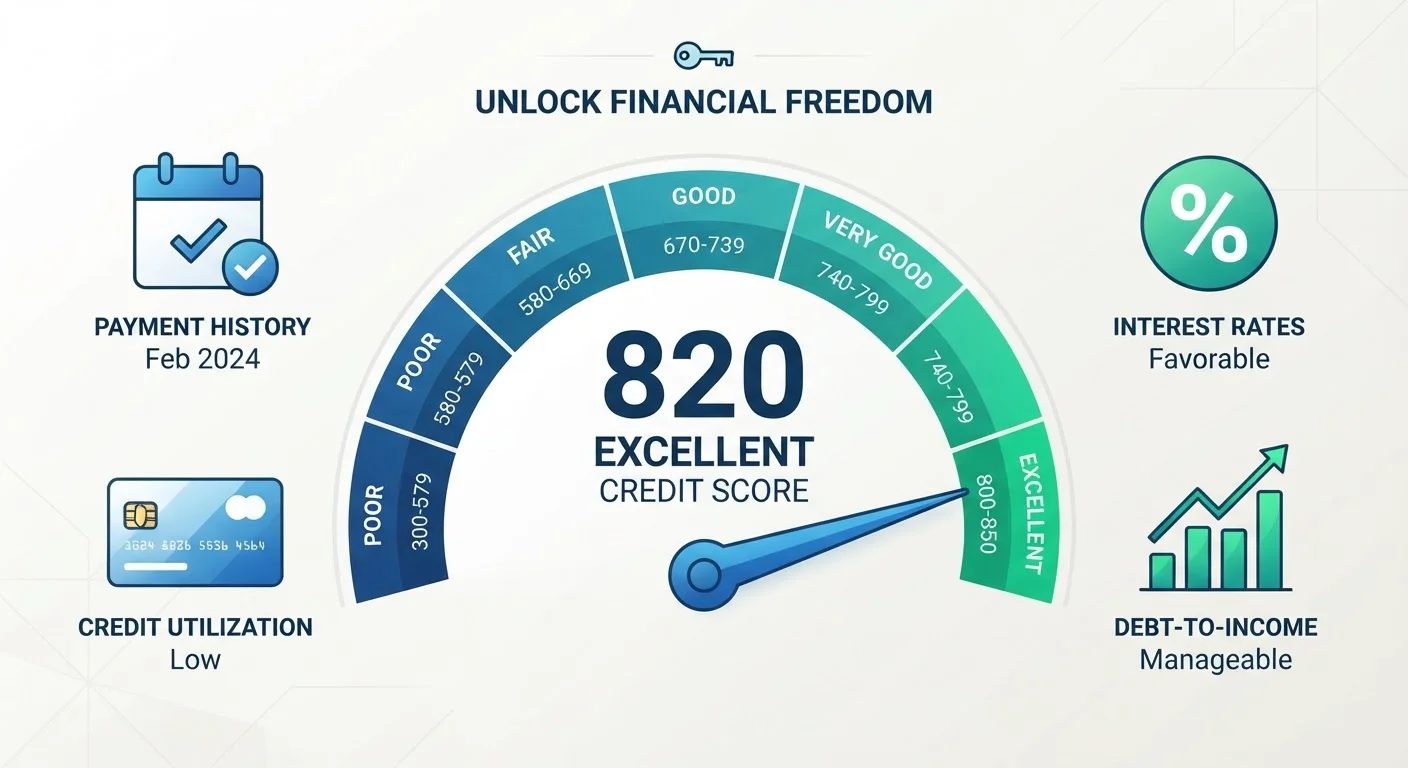
A credit score is a three-digit number - typically ranging from 300 to 850 - that summarizes how reliably you've managed borrowed money. Lenders use it to quickly assess the risk of lending to you. The higher the number, the lower the perceived risk.
The most widely used model is the FICO Score, developed by Fair Isaac Corporation. VantageScore, a competing model created by the three major credit bureaus, uses the same 300-850 range but weights factors differently.
The Five Factors Behind Every Score
Credit scores don't appear out of thin air. Every major scoring model - including FICO and VantageScore - calculates your number from the same basic categories of information found in your credit report. Understanding those categories is the fastest way to understand your score.
Under the FICO model, the five factors and their approximate weights are:
- Payment history (35%): Whether you've paid bills on time. A single missed payment - especially one 30+ days late - can drop your score significantly.
- Credit utilization (30%): The percentage of your revolving credit limits you're currently using. Using less than 30% of available credit is generally favorable; under 10% tends to score even better.
- Length of credit history (15%): How long your accounts have been open, including the age of your oldest account, newest account, and average age across all accounts.
- Credit mix (10%): Having a variety of account types - credit cards, installment loans, mortgage - can benefit your score, though this factor carries less weight than the top two.
- New credit inquiries (10%): Applying for new credit generates a hard inquiry, which can cause a small, temporary dip. Multiple applications in a short window for the same loan type (like mortgage shopping) are often treated as a single inquiry. Learn more in our guide on hard vs. soft inquiries.
35%
Payment history weight in FICO Score
According to myFICO.com, payment history is the single largest factor in a standard FICO Score calculation.
800+
Score range considered 'exceptional' by FICO
FICO classifies scores of 800-850 as exceptional, a range associated with the most favorable lending terms from most lenders.
3
Major US credit bureaus reporting independently
Equifax, Experian, and TransUnion each maintain separate credit files, which is why scores can differ across bureaus.
Why Your Score Differs Across Bureaus
Many people are surprised to find that their credit score varies depending on where they check it. This isn't a glitch - it reflects how the credit reporting system actually works.
There are three major credit bureaus in the US: Equifax, Experian, and TransUnion. Lenders are not required to report account data to all three, so each bureau may have a slightly different picture of your credit history at any given moment. A credit card that reports to Experian and TransUnion but not Equifax will influence two of your bureau scores but not the third.
On top of that, different scoring models (FICO Score 8, FICO Score 9, VantageScore 3.0, VantageScore 4.0) weight factors differently and may treat certain items - like medical debt or paid-off collections - distinctly. A lender who pulls your FICO Score 8 from Experian may see a different number than one pulling your VantageScore 3.0 from TransUnion.
It helps to understand the relationship between your credit report and your credit score - they're related but not the same thing. Our explainer on the credit report vs. credit score distinction walks through exactly what each contains and who generates them.
Scoring Models Treat Some Items Differently
Newer scoring models like FICO Score 9 and VantageScore 4.0 treat paid-off collection accounts and medical debt more favorably than older models. Because many lenders still use older models (particularly FICO Score 8 for credit cards), your score for a mortgage application may differ from what you see on a free monitoring app. This doesn't mean anything is wrong - it reflects that multiple models are in active use.
Where Credit Scores Actually Get Used
Credit scores influence more than loan approvals. Lenders use them to set interest rates on mortgages, auto loans, and credit cards - meaning a higher score can translate directly into lower borrowing costs over time. A difference of 50-100 points can shift the interest rate on a 30-year mortgage by half a percentage point or more, which adds up to thousands of dollars.
Beyond lending, landlords often run credit checks before approving rental applications. Some employers in certain industries check credit as part of background screening (with your consent and subject to state laws). And in most states, auto insurers can use a credit-based insurance score - related to but distinct from a traditional credit score - as one factor in rate-setting. Our piece on what drives auto insurance rates covers how that works in practice.
None of this means your credit score defines your financial life. But it does mean the number has real-world consequences worth paying attention to. The most reliable path to a strong score is consistent: pay on time, keep balances low relative to your limits, and avoid unnecessary credit applications. These aren't secrets - they're just mechanics, and now you know how they work.
This article is for general informational purposes only and does not constitute personalized financial or legal advice. Consider consulting a qualified financial professional for guidance specific to your situation.