

Key Takeaways
Option A
Credit Report
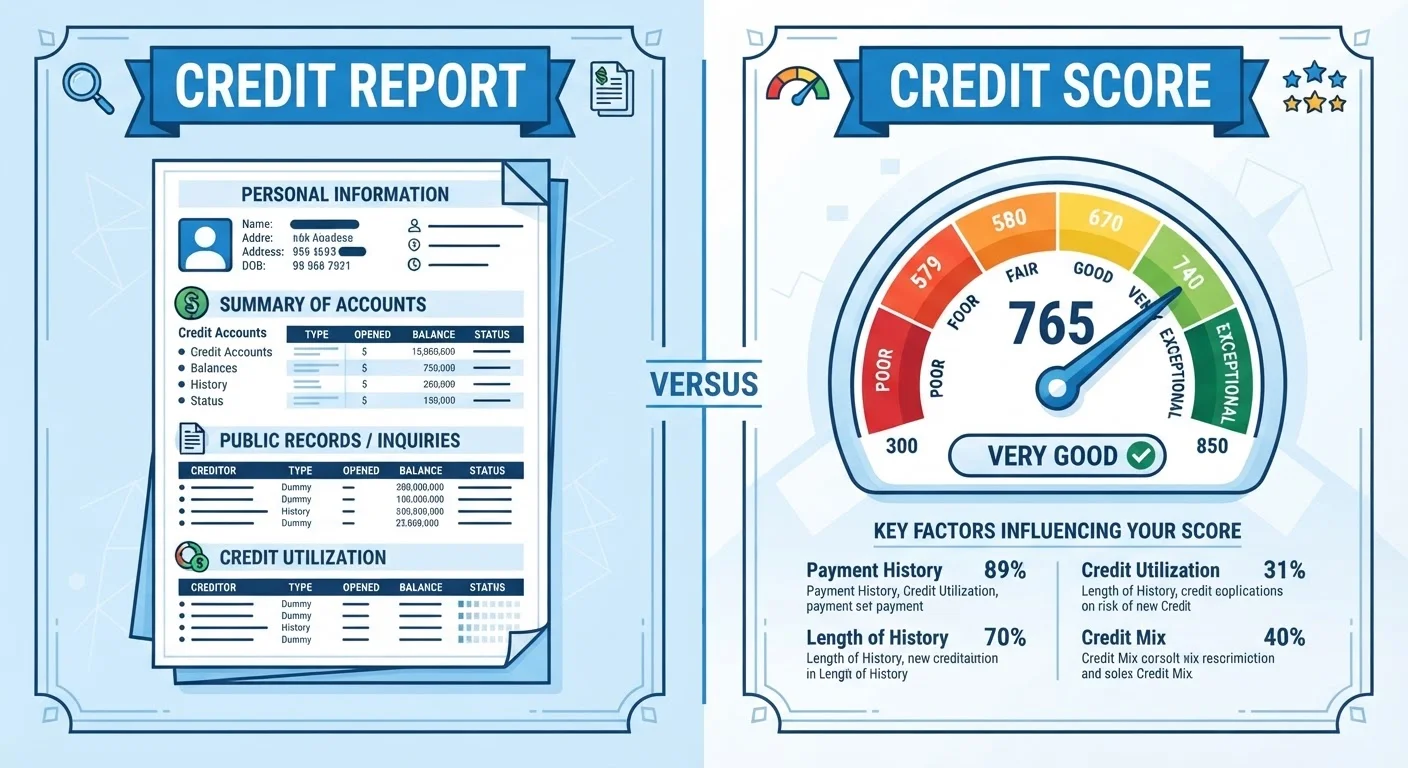
The full financial history - raw data from your credit life.
Best for: Identifying errors, understanding your credit history in detail, and disputing inaccuracies with lenders or bureaus.
Option B
Credit Score
The three-digit summary calculated from your report data.
Best for: Quick risk assessments by lenders, landlords, and insurers - a snapshot of your creditworthiness at a point in time.
If you want to understand what's driving your creditworthiness
Credit Report
The report contains the underlying data - payment history, account ages, balances, inquiries - that scoring models actually use. Start here to diagnose any problem.
If you're preparing to apply for a loan or apartment
Credit Score
Lenders and landlords typically pull a score for fast risk screening. Knowing your score range before applying helps you anticipate their decision and negotiate terms.
If you suspect identity theft or reporting errors
Credit Report
Only your report shows the specific accounts, addresses, and inquiries that may signal fraud. A score alone cannot reveal what's wrong or where.
If you want to track your credit health month to month
Credit Score
Score monitoring is faster and more frequent than combing through full reports. Use it as a gauge, then investigate the report if the number moves unexpectedly.
What Each One Actually Is
A credit report is a detailed ledger of your borrowing history compiled by each of the three major credit bureaus: Equifax, Experian, and TransUnion. It lists every credit account you've opened, your payment history on each, your current balances, any collections or public records, and every inquiry made against your file. Think of it as raw source data - the full record, not a judgment.
A credit score is a number - typically ranging from 300 to 850 under common scoring models - that a mathematical algorithm calculates by weighing the data inside your report. The two most widely used scoring models are FICO and VantageScore. Critically, the bureaus do not create your score; they supply the data that scoring models use to generate it.
This distinction matters in practice. You can have three different credit reports (one per bureau) and multiple different scores depending on which model and which bureau's data is used. See how credit scores are actually calculated for a deeper breakdown of what each factor contributes.
| Criterion | Credit Report | Credit Score |
|---|---|---|
| What it is | Detailed record of credit history | Three-digit numerical summary |
| Who creates it | Equifax, Experian, TransUnion | FICO, VantageScore (via bureau data) |
| How many you have | Three (one per bureau) | Many (varies by model and bureau) |
| Free access | Federally mandated via AnnualCreditReport.com | Often available via card issuers; not federally mandated |
| Primary use | Identifying errors, understanding history | Lender risk screening, quick health check |
| Can be disputed | Yes - directly with bureaus | No - fix the report data instead |
| Update frequency | As lenders report (typically monthly) | Recalculated whenever a lender or service requests it |
Who Creates Them and How
Credit bureaus are private data companies. Lenders - banks, credit unions, card issuers - voluntarily report your account activity to one or more bureaus, usually monthly. The bureaus aggregate this data into your report. They do not independently verify every entry, which is why errors occur and why reviewing your report matters.
Scoring models are developed by separate companies (Fair Isaac Corporation for FICO, VantageScore Solutions for VantageScore). They license their algorithms to bureaus and lenders. A lender might pull your Experian data and run it through FICO Score 8, or pull your TransUnion data and run it through a mortgage-specific FICO model - the score you see elsewhere may differ. Neither the bureau nor the scoring company communicates directly with you about decisions; lenders interpret the output.
1 in 5
Consumers with a credit report error
A Federal Trade Commission study found approximately one in five consumers had a verified error on at least one of their three credit reports.
40+
FICO score versions in use
Fair Isaac Corporation has released numerous FICO score versions; different lenders use different versions depending on loan type, meaning your score can vary by context.
Because your report is the input and your score is the output, fixing an error on your report is the only way to sustainably change a score that's being dragged down by bad data. Auditing your own credit report walks through exactly how to request, read, and formally dispute errors.
Access, Rights, and Practical Use
Federal law (the Fair Credit Reporting Act) entitles every US consumer to one free credit report per bureau per year through AnnualCreditReport.com - the only federally mandated source. Credit score access is not federally guaranteed in the same way; many credit card issuers and banks now provide free score access as a feature, but the score model shown may differ from what a lender uses.
Use your report proactively: check all three bureaus at least annually, since not all lenders report to all three. Look for accounts you don't recognize, incorrect payment statuses, or outdated negative items. Checking your own report is a soft inquiry and has no effect on your score - a common misconception worth clearing up.
Use your score reactively: monitor it as a quick health indicator. If it drops unexpectedly, pull your reports to find the cause. Be aware that hard inquiries from lenders appear on your report and can modestly lower your score temporarily.
Your Score Can Differ by Dozens of Points
Because each bureau holds slightly different data and different scoring models weight factors differently, the score a mortgage lender sees may not match what your credit card app shows. Neither is wrong - they're using different inputs or algorithms. When you apply for a significant loan, ask which bureau and which scoring model the lender uses so you're comparing the right number.
This article is for general informational and educational purposes only and does not constitute personalised financial or legal advice. Consult a qualified financial professional for guidance specific to your situation.