

Key Takeaways
Option A
Debt Avalanche
The mathematically optimal, interest-minimizing approach.
Best for: People motivated by long-term savings who can stay disciplined without frequent early wins.
Option B
Debt Snowball
The psychologically reinforcing, momentum-building method.
Best for: People who need regular progress milestones to stay engaged and on track.
If you carry high-interest credit card debt and are disciplined about long-term goals
Debt Avalanche
Attacking the highest-rate debt first reduces the total interest you'll pay, potentially saving hundreds or thousands of dollars depending on your balances.
If you've struggled to stick with a payoff plan in the past
Debt Snowball
Eliminating smaller balances quickly generates visible wins, which behavioral research links to stronger follow-through over time.
If your debts are similar in interest rate but vary widely in balance size
Debt Snowball
When rates are roughly equal, the math difference narrows significantly, making the motivational advantage of the snowball more valuable.
If your debts are similar in balance but vary widely in interest rate
Debt Avalanche
Targeting the highest rate first has an outsized impact when balances are comparable, directly reducing how quickly interest compounds.
How Each Method Works
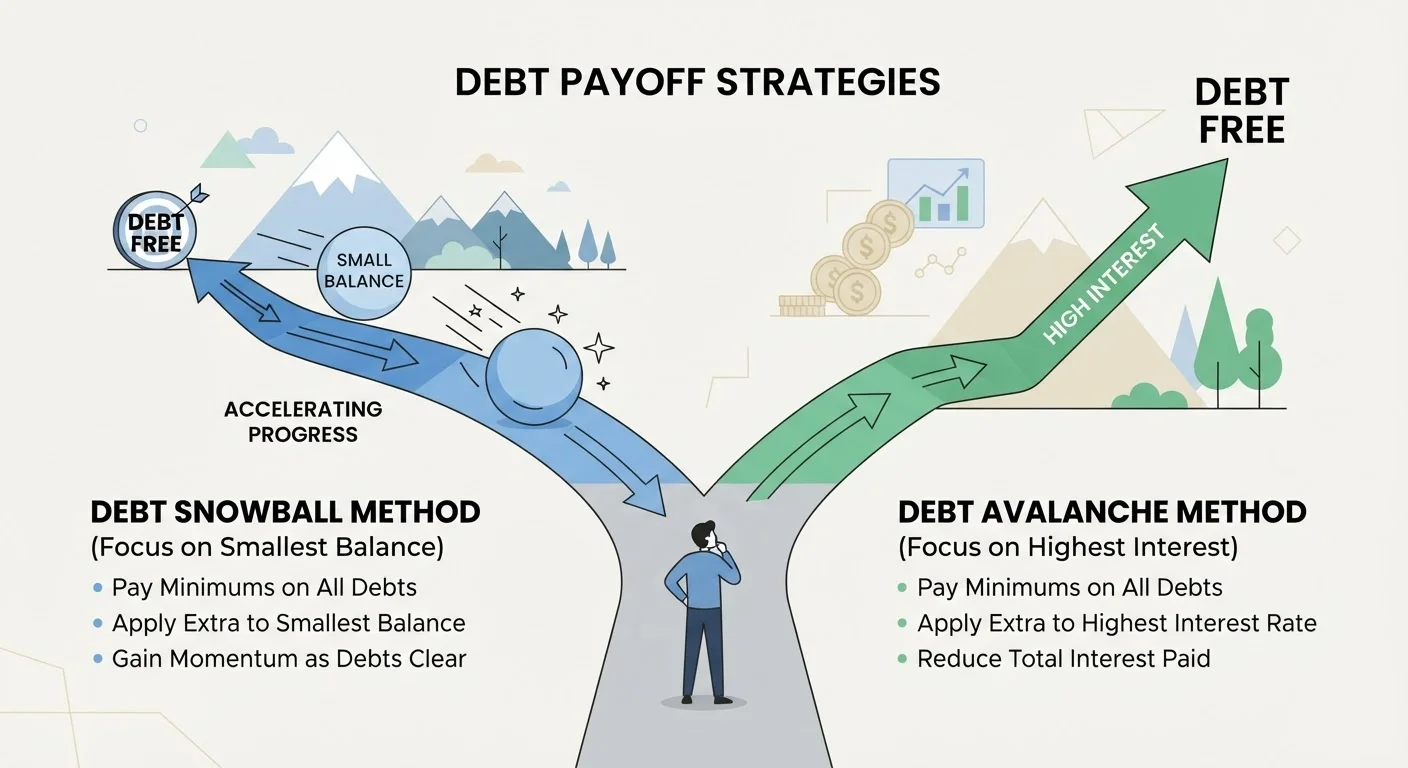
Both strategies share the same foundation: you make minimum payments on every debt, then direct any extra money toward one target account. The difference is how you choose that target.
Debt Avalanche: Rank your debts by annual percentage rate (APR), highest to lowest. Put every extra dollar toward the highest-rate debt until it's gone, then move to the next. Because high-rate debt grows fastest, eliminating it first reduces the total interest that accumulates across all your accounts.
Debt Snowball: Rank your debts by outstanding balance, smallest to largest. Attack the smallest balance first regardless of its rate. When it's paid off, roll that freed-up payment into the next-smallest debt - the "snowball" grows as each account closes.
If you're still deciding whether to pay down debt or build savings simultaneously, the savings vs. debt payoff trade-off guide covers that foundational question first.
| Criterion | Debt Avalanche | Debt Snowball |
|---|---|---|
| Payoff order | Highest APR first | Smallest balance first |
| Total interest paid | Generally lower | Generally higher |
| Time to first payoff | Potentially longer | Usually faster |
| Motivational structure | Requires sustained discipline | Frequent early milestones |
| Best when rates vary widely | Strong advantage | Advantage narrows |
| Best when balances vary widely | Advantage narrows | Strong advantage |
| Complexity | Low - sort by APR | Low - sort by balance |
The Math Gap - and Why It Isn't the Whole Story
In most scenarios, the avalanche method results in less total interest paid. The gap depends on how different your APRs are and how large the balances are. In extreme cases - say, a 24% APR credit card versus a 5% personal loan - the avalanche could save a meaningful amount over several years.
But research on debt payoff behavior complicates the purely mathematical view. A widely cited 2012 study published in the Journal of Marketing Research found that consumers who focused on eliminating individual accounts (snowball-style) were more likely to reduce total debt than those spreading payments across accounts. The mechanism is psychological: closing an account creates a concrete sense of progress that sustains the behavior.
~$1,000+
Potential interest saved via avalanche vs. snowball
The exact figure varies by balance size and rate spread; NerdWallet scenario modeling shows four-figure differences are common on mixed high-rate debt portfolios.
77%
US adults carrying some form of debt
According to a 2023 Bankrate survey, the vast majority of American adults hold at least one type of debt, from credit cards to auto loans.
20.68%
Average credit card APR (2024)
Federal Reserve data for 2024 shows average credit card interest rates at historically elevated levels, making payoff method choice especially consequential.
This means the "best" method is the one you'll actually finish. A plan abandoned six months in saves nothing. For a broader orientation on managing multiple debt types at once, see this beginner's overview.
Choosing the Right Fit for Your Situation
Ask yourself two questions before committing:
- Do I have any high-rate debt above 15-20% APR? If yes, the avalanche's interest savings become hard to ignore. A 20%+ rate means balances can grow quickly, and the cost of delay is measurable.
- Have I started and stopped debt payoff plans before? If the answer is yes, the snowball's early wins may be more valuable than marginal interest savings. Behavioral follow-through is a real constraint, not a character flaw.
A hybrid approach is also possible: start with the snowball to eliminate one or two small balances, build confidence, then switch to avalanche ordering. This isn't a failure to commit - it's a realistic response to how motivation works.
Whichever path you choose, building consistent monthly habits is what turns a strategy into results. The monthly habits that support debt reduction article outlines the routines that keep either method on track. And if your debt picture is complex - multiple account types, collectors involved, or a credit score already affected - consider speaking with a nonprofit credit counseling agency (look for NFCC-member organizations) before deciding. For a full framework covering both debt and savings management, The Complete Picture is a useful next read.
This article is for general informational purposes only and does not constitute personalized financial, legal, or tax advice. Consult a qualified financial professional for guidance specific to your circumstances.