

Key Takeaways
Option A
Caulk
The permanent, rigid solution for stationary gaps.
Best for: Sealing fixed cracks and gaps around window frames, door casings, baseboards, and wall penetrations where surfaces don't move.
Option B
Weatherstripping
The flexible, compressible solution for moving joints.
Best for: Sealing the dynamic gaps created by operable doors and windows that open, close, and flex with seasonal changes.
If you're sealing cracks around a window frame or door casing
Caulk
These joints are stationary and benefit from a rigid, paintable seal that bonds permanently to both surfaces.
If you're stopping drafts along the edges of an operable door or window sash
Weatherstripping
Compressible weatherstripping flexes with every open-and-close cycle without tearing or losing its seal.
If you want to tackle an entire window or exterior door from scratch
Both - used together
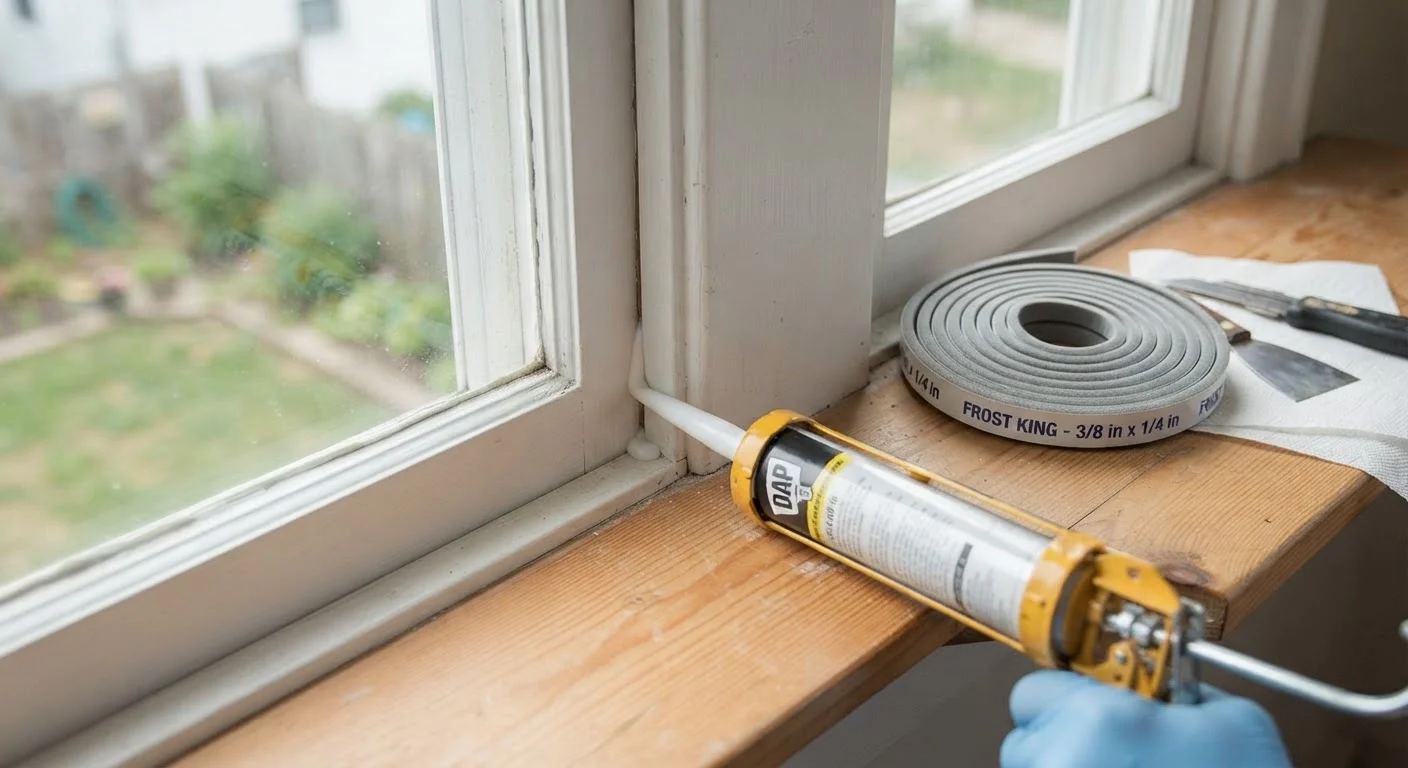
Caulk the fixed frame perimeter while applying weatherstripping to the movable sash or door stop for complete coverage.
If you're dealing with a gap at the bottom of an exterior door
Weatherstripping
A door sweep or threshold seal handles the underside gap that a caulk bead can't bridge without blocking door movement.
Why the Gap's Behavior Determines the Fix
Before reaching for a product, ask one question: does this gap move? That single distinction separates every caulk job from every weatherstripping job.
A gap along the corner where a window frame meets interior drywall is stationary - it was formed during installation and stays put. A gap between a door panel and its stop molding, by contrast, opens and closes hundreds of times a year. Apply a rigid sealant to a moving joint and it will crack under repeated stress, often within a single heating season. Apply a compressible foam seal to a fixed crack in masonry and it won't bond properly, leaving the gap only partially covered.
This is also why a thorough air-sealing project almost always uses both products. As part of any home audit checklist, checking both fixed joints and operable openings separately will help you identify which fix belongs where before you buy anything.
| Criterion | Caulk | Weatherstripping |
|---|---|---|
| Best gap type | Stationary, fixed cracks | Moving joints (operable doors/windows) |
| Typical locations | Window frames, casings, baseboards, pipe penetrations | Door stops, sashes, door bottoms, thresholds |
| Flexibility after cure | Rigid (some silicone types have limited flex) | Compressible and spring-back by design |
| DIY skill level | Beginner - requires prep and smooth tooling | Beginner - peel-and-stick or simple screw installation |
| Durability | 5-20 years depending on product and location | 1-10 years depending on material and traffic |
| Paintable | Latex/acrylic types yes; silicone generally no | Most types are not painted after install |
| Failure mode | Cracking or peeling away from substrate | Compression set (strip no longer springs back) |
How and Where to Apply Caulk
Caulk is best suited for narrow, stationary gaps - generally those under half an inch wide. Common locations include the perimeter of window frames where they meet siding or interior trim, gaps around door casings, cracks where baseboards meet flooring, and penetrations for pipes or cables through exterior walls.
Silicone caulk offers superior flexibility and moisture resistance for exterior and wet-area applications, while latex or acrylic caulk is easier to tool, cleans up with water, and accepts paint - making it the typical choice for interior trim work. For best results, clean and dry the surface thoroughly, cut the tube tip at a shallow angle to produce a consistent bead, and tool the bead smooth with a dampened finger or plastic tool before it skins over.
Up to 30%
Heating and cooling energy lost to air leaks
The U.S. Department of Energy estimates that air infiltration through gaps and cracks can account for up to 30% of a home's heating and cooling energy use.
$5-$20
Typical cost to weatherstrip one exterior door
Materials for a single exterior door - including side strips and a door sweep - generally fall in this range, making it one of the higher-return DIY projects by cost.
Avoid applying caulk over old, crumbling caulk. Remove the old material with a utility knife or caulk remover tool first - fresh caulk bonded to failed caulk will lift away just as fast.
Choosing and Installing Weatherstripping
Weatherstripping comes in four main types, and the right choice depends on location and the amount of friction it will experience.
- Foam tape (open- or closed-cell): Inexpensive and easy to apply, but wears quickly under high-friction conditions like the sides of a frequently used exterior door. Best for low-traffic windows and rarely-used doors.
- EPDM rubber or vinyl bulb strips: More durable and better at compressing against irregular surfaces. A good choice for the door stop on exterior entry doors.
- V-strip (tension seal): A folded strip of plastic or metal that springs open to fill gaps along the sides of doors and double-hung window channels. Durable and nearly invisible once installed.
- Door sweeps and threshold seals: Address the gap at the bottom of exterior doors - the single largest source of door-related air infiltration. Sweeps attach to the door face; threshold seals mount on the floor.
Surface prep matters here too. Clean the door stop or channel, peel the adhesive backing, and press firmly. For screwed-on products, make sure fasteners are snug but not so tight they distort the strip's shape.
If moisture is traveling alongside those drafts - particularly around basement-level windows - it's worth reading about basement waterproofing approaches to understand whether sealing alone is sufficient or if drainage solutions are also needed.
Common Mistakes That Undo the Work
Even correctly chosen materials fail when installed carelessly. A few patterns account for most of the callbacks:
- Caulking over a painted or dirty surface - adhesion drops sharply on anything other than a clean, dry substrate. Sand glossy paint and wipe with a dry cloth before applying.
- Over-compressing foam weatherstripping - if the door or window requires extra force to close, the strip is too thick. The seal should compress roughly 30-50% when closed, not flatten completely.
- Skipping the door bottom - gaps at the top and sides of a door account for far less air leakage than the bottom, yet homeowners often skip the sweep. It's the highest-return installation on any exterior door.
- Using interior caulk outdoors - latex caulk without an exterior rating will fail quickly when exposed to rain and UV. Check the label before purchasing.
For other small-but-consequential maintenance details - like catching moisture intrusion early - a structured seasonal inspection routine can help you spot deteriorating seals before they become expensive problems.