

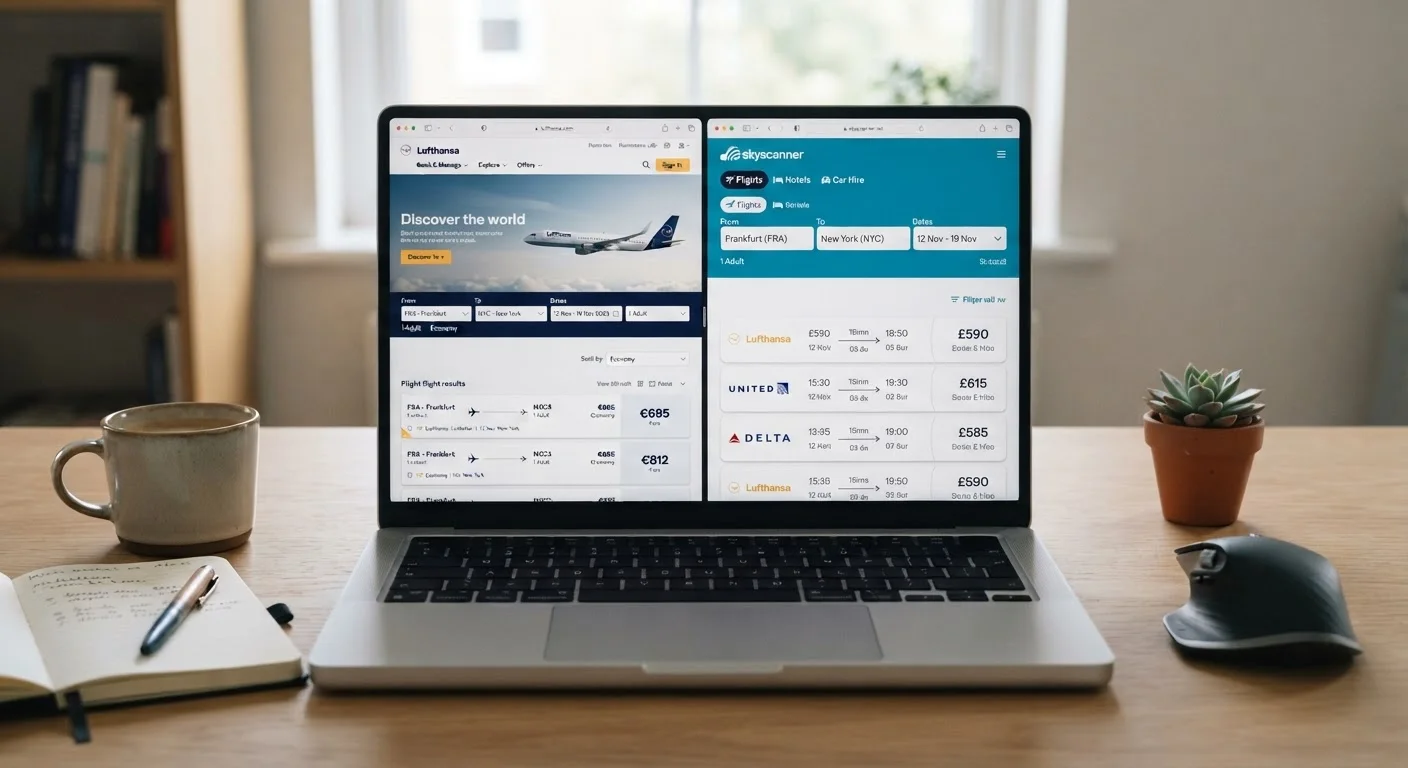
Key Takeaways
Option A
Booking Directly with the Airline
The source-of-record channel with the fewest intermediaries.
Best for: Travelers who value flexibility, reliable customer service access, and loyalty point accrual over the convenience of comparison shopping.
Option B
Booking Through an Online Travel Agency (OTA)
The multi-airline marketplace built for price comparison.
Best for: Travelers prioritizing price discovery across carriers, especially for international or multi-airline itineraries where comparing options side-by-side matters most.
If you're a frequent flyer managing elite status or miles
Booking Directly with the Airline
Direct bookings eliminate any ambiguity about mileage credit and give you the cleanest record should a dispute arise with your loyalty account.
If you're comparing prices across multiple airlines for a complex international itinerary
Booking Through an Online Travel Agency (OTA)
OTAs aggregate inventory across carriers in one view, making it practical to evaluate dozens of routing and pricing combinations quickly.
If your plans are uncertain and you may need to change or cancel
Booking Directly with the Airline
Changes and cancellations are faster and simpler without a third-party intermediary in the loop - especially during irregular operations like weather delays.
If you're booking a leisure trip on a tight budget and flexibility isn't a priority
Booking Through an Online Travel Agency (OTA)
OTAs occasionally surface promotional or bundled fares not visible on airline sites, and the comparison interface helps confirm you're not overpaying.
If you're booking a basic domestic flight with a straightforward itinerary
Booking Directly with the Airline
For simple point-to-point trips, direct booking provides the same fare with fewer potential friction points and no OTA service fees to watch for.
Why the Booking Channel Matters More Than Most Travelers Realize
Most travelers assume the price is the price - that a seat on a given flight costs the same regardless of where you buy it. That assumption is largely correct under price parity agreements (contractual arrangements where airlines require OTAs to display the same base fares), but it's not the whole picture. The booking channel shapes what you pay in fees, how much control you retain over your reservation, and how quickly you get help when something goes wrong.
Understanding the real trade-offs requires looking beyond the ticket price to the total cost of ownership for that booking: service fees, change flexibility, loyalty credit, and support access. To understand what makes a given airfare cheap or expensive in the first place, see our breakdown of flight deal mechanics.
| Criterion | Direct Booking | OTA Booking |
|---|---|---|
| Base fare price | Same as OTA in most cases | Same as direct; exceptions exist |
| Service fees | Typically none | Varies; some OTAs charge fees |
| Change & cancellation | Handled directly by airline | Must go through OTA first |
| Disruption rebooking | Immediate airline agent access | OTA queue; slower resolution |
| Loyalty mile accrual | Straightforward, well-documented | Generally works; disputes harder to resolve |
| Multi-carrier comparison | Single airline only | Multiple carriers in one view |
| Exclusive fares | Airline web-only sales possible | Consolidator rates occasionally available |
Price: Where Each Channel Has the Edge
Airlines periodically offer fares exclusively on their own websites - think web-only sales or discounts tied to their co-branded credit cards. OTAs, on the other hand, can occasionally surface rates from consolidators or promotional inventory not widely advertised. In practice, for most domestic routes, the base fare is identical.
Where divergence appears is in fees. Some OTAs charge a service fee on top of the fare. Others earn revenue through the booking process itself, which may affect which options are displayed first. Always verify the final price at checkout on both channels before committing. For a broader view of how timing affects what you'll pay, see why booking early isn't always cheaper.
~80%
Flights with identical fares across channels
Industry analysts estimate the majority of domestic fares are matched between airline sites and major OTAs due to price parity agreements, though exceptions occur.
2-3x
Longer OTA resolution times during disruptions
Traveler experience surveys and consumer advocacy reports consistently note that OTA customers wait significantly longer for rebooking during weather events or cancellations.
$0-$35
Typical OTA service fee range per booking
Fee structures vary widely by OTA and fare type; some charge nothing while others add per-ticket fees that can meaningfully narrow any price advantage.
Flexibility and Customer Service: The Real Differentiator
This is where direct booking holds its clearest advantage. When a flight is cancelled or significantly delayed, the airline controls the rebooking inventory. If your ticket was purchased directly, the airline's agents can rebook you immediately, apply waivers, and process refunds without waiting on a third party.
With an OTA booking, the airline may direct you back to the OTA for any changes - even during a weather event. OTA customer service queues during irregular operations can be long, and the OTA must coordinate with the airline before making certain changes. Travelers who have navigated a major disruption through an OTA report this friction as a significant cost - one that doesn't show up in the original ticket price.
Before booking any non-refundable fare, regardless of channel, it's worth understanding the fine print. Our guide on reading non-refundable fare terms walks through what to check.
Loyalty Programs, Bundling, and the Decision Framework
Frequent flyer miles generally accrue based on the fare class purchased, not the booking channel - but complications arise. Some airlines have historically been slower to credit miles for OTA bookings, and disputes about missing mileage are harder to resolve when the booking record sits with a third party. Elite status members, in particular, should verify mileage crediting terms before booking through an OTA.
OTAs do offer one genuine structural advantage: side-by-side comparison across carriers. For complex itineraries - international trips with multiple legs, or routes served by several airlines - this comparison function saves meaningful research time and can surface routing combinations a single airline's site wouldn't show. If you're evaluating whether to bundle your flight with a hotel, see when bundling actually saves money before assuming the package is the better deal.
A practical pre-booking habit: use an OTA to identify the fare and routing you want, then check the airline's site directly to see if the price matches. If it does, book direct. If the OTA is measurably cheaper after accounting for any service fees, weigh that saving against the reduced flexibility. Our pre-purchase savings checklist can help you run that comparison systematically before you pay.
Price Alerts Work Across Both Channels
Airfare price alert tools monitor fare changes regardless of which booking channel you ultimately use. They're useful for identifying when a target price is reached - but they have gaps worth understanding. See our guide on how price alerts work and where they fall short before relying on them as your sole research method.