

Key Takeaways
Our Verdict
Package deals deliver real savings in specific, predictable conditions - mainly peak-season leisure destinations where hotels inflate room-only rates. Outside those conditions, booking separately typically offers lower total cost, better cancellation terms, and the ability to use loyalty points. Run the numbers before you commit to either approach.
| Best for | Recommended |
|---|---|
| Travelers heading to high-demand leisure destinations in peak season | Package deal |
| Travelers with hotel or airline loyalty points to redeem | Booking separately |
| Those who need maximum cancellation flexibility | Booking separately |
| First-time international travelers prioritizing simplicity over cost optimization | Package deal |
Why Packages Exist - and Who They Actually Benefit
Travel packages exist because suppliers - airlines, hotels, and intermediaries - benefit from guaranteed volume. A hotel in a resort market would rather sell a room at a modest discount bundled inside a flight package than leave it empty. That underlying logic is real, and it's the engine behind genuine package savings.
But that benefit flows to travelers only when the hotel component is the one driving the price gap. When an OTA bundles a flight that's already available at the same fare plus a hotel with ordinary pricing, the "package price" often just repackages the same cost with less transparency. Understanding how airfare is actually priced helps you spot when a flight in a bundle is genuinely discounted versus simply obscured.
Packages tend to benefit leisure travelers heading to destinations with concentrated hotel supply - think Caribbean resorts, European city-break hotels, or Las Vegas - during high-demand periods. In those markets, hotel room-only rates spike, while the same rooms sold through volume package agreements stay more stable.
When Bundling Genuinely Cuts Costs
The clearest case for a package deal meets all three of these conditions simultaneously:
- High hotel demand at the destination: Room-only rates are elevated, but wholesale-contracted rooms in the package stay below market.
- You have no points or loyalty status to apply: If you're paying full cash either way, the bundle's negotiated hotel rate can undercut a direct booking.
- Your dates are fixed: Packages penalize changes; if you know exactly when you're traveling, the inflexibility costs you nothing.
Package deals also tend to perform well on routes where a single carrier or OTA has negotiated preferential hotel inventory - common in sun-and-beach markets. For a balanced look at how all-inclusive planning compares, see the case for and against all-inclusive trips.
| Package Deal | Booking Separately | |
|---|---|---|
| Best pricing scenario | Peak-season, high-demand hotel markets | Off-peak or when loyalty points apply |
| Cancellation flexibility | Limited; all components often voided together | Independent terms per booking |
| Loyalty points / status use | Rarely permitted | Fully available |
| Price transparency | Components not always itemized | Each cost visible and comparable |
| Activity add-ons | Typically marked up significantly | Direct pricing often lower |
| Ease of booking | Single transaction, simpler | Multiple bookings required |
When Booking Separately Wins
Separate booking outperforms in more situations than most travelers expect:
- You hold loyalty points or status: Applying hotel points or airline miles to a package booking is rarely permitted. Redeeming points for even one component - especially a high-value hotel night - frequently outperforms the bundle's cash discount.
- Off-peak travel: When hotel occupancy is low, room-only rates often drop below what a package can match, because there's no artificial floor from wholesale contracts.
- Non-standard routing: Packages are designed around popular origin-destination pairs. If your itinerary involves a less-traveled route or a budget carrier, the package won't include it.
- You need flexible cancellation: Separate bookings - particularly refundable hotel rates - give you independent cancellation windows. A package cancellation typically voids all components at once, often with steeper penalties.
The math also shifts when activities are added. Bundled tours and excursions inside packages carry significant markups; pricing the same experience through local operators directly is almost always cheaper. Before finalizing any booking approach, the pre-purchase savings checklist is a useful final filter.
Check the Hotel's Direct Rate First
Hotels are required by many OTA contracts to show their lowest rates on their own sites, but exceptions exist. Always pull up the property's direct booking page before accepting a package's hotel component as a deal. Even a $10-per-night difference compounds across a multi-night stay and can reverse the apparent package advantage.
How to Compare Fairly Before You Commit
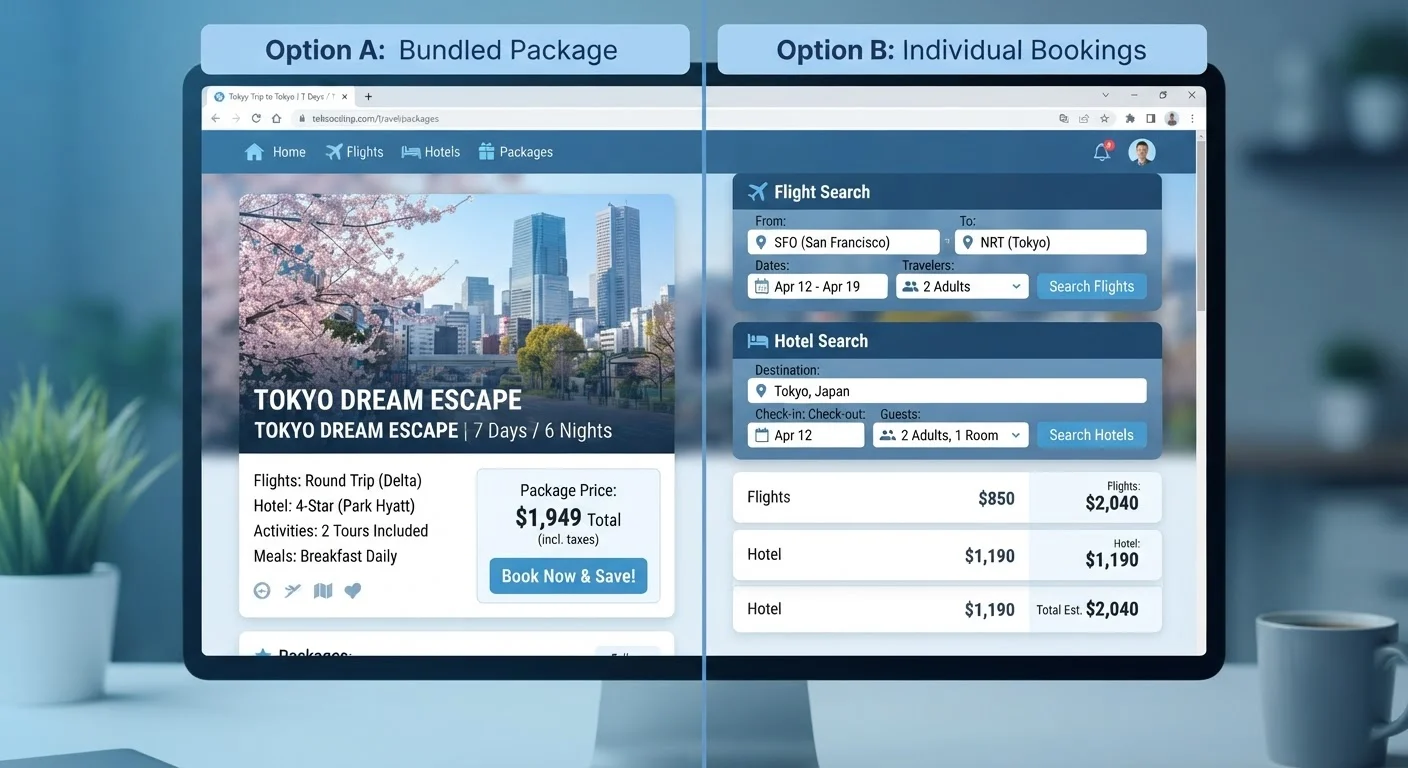
The only reliable test is a side-by-side price build. Before accepting any package quote:
- Price the flight independently - check the airline directly and through an OTA. See what each booking channel actually costs for a detailed breakdown of where prices diverge.
- Price the hotel room-only rate for the same dates through the hotel's own site and at least one OTA.
- Add those two numbers. If the package is within a few dollars, the package offers no real savings - and costs you flexibility.
- Check whether your loyalty status at the hotel chain changes the calculus. Hotel loyalty program math can tip the decision even for occasional travelers.
Timing also matters. Booking far in advance versus last minute each carry distinct trade-offs that interact with package availability - packages often disappear as departure nears, while room-only rates sometimes drop.
This article provides general travel planning information only. Prices, availability, and terms vary by provider and change frequently; always verify current rates and cancellation policies directly with suppliers before booking.