

Key Takeaways
Our Verdict
Neither budget nor full-service carriers are universally cheaper - the winning choice depends on what you're bringing and how flexible you need to be. Budget carriers deliver genuine savings only for light packers flying short hauls with no need for seat selection or itinerary changes. Once a checked bag enters the equation, the gap narrows sharply, and two bags often make a full-service ticket the more economical option.
| Best for | Recommended |
|---|---|
| Carry-on-only travelers on short or domestic routes | Budget carriers |
| Travelers checking one or two bags on longer routes | Full-service carriers |
| Frequent flyers with elite status or co-branded credit cards | Full-service carriers |
| Families traveling with gear, car seats, or sports equipment | Full-service carriers |
Why the Base Fare Is Rarely the Whole Story
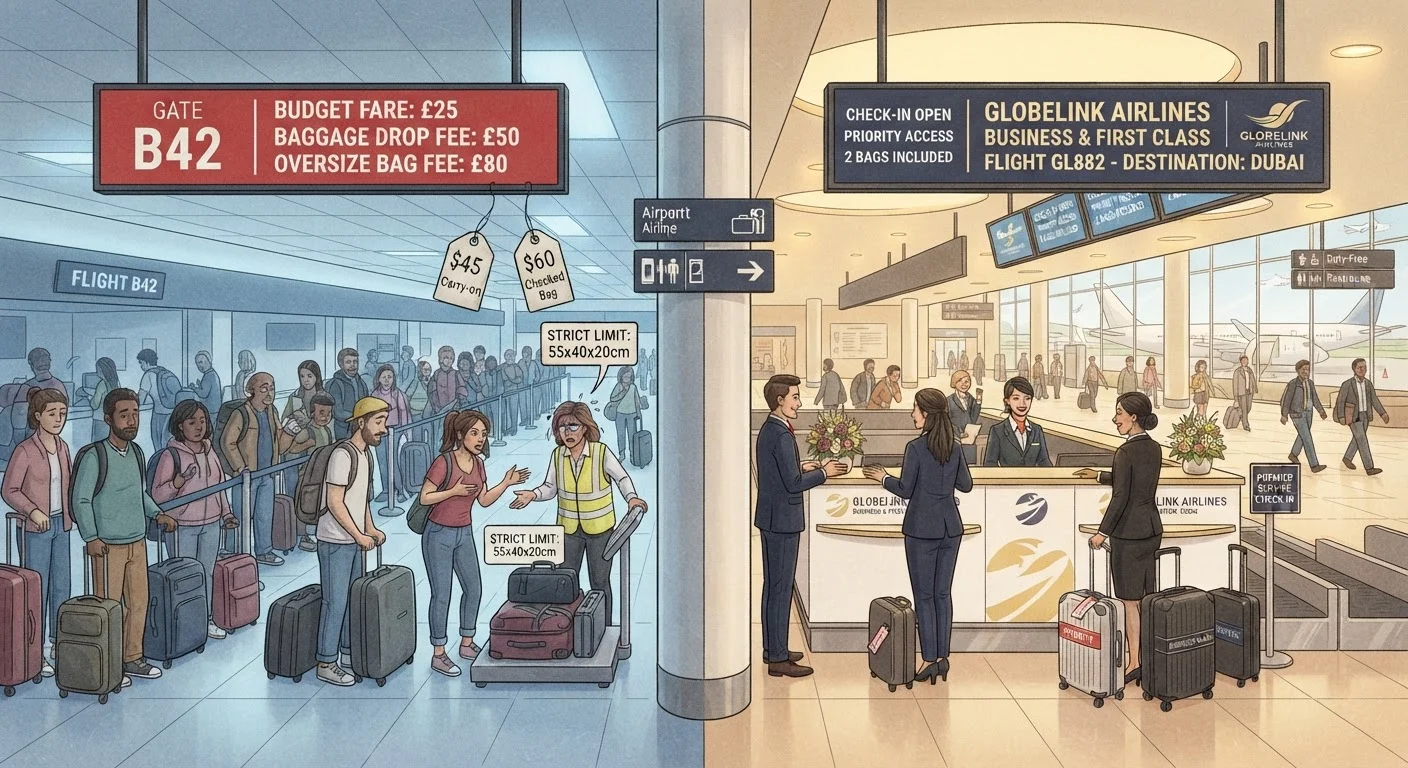
Budget airlines build their pricing model on a simple premise: strip the ticket down to its bare minimum and charge separately for everything else. The advertised fare covers a seat and - in some cases - a small personal item. Everything beyond that is an add-on with its own price tag.
Full-service carriers use a bundled model. A main-cabin fare typically includes a carry-on bag, at least one checked bag on many international routes, seat assignment options, and in-flight service. The sticker price looks higher upfront, but that number covers more.
This structural difference is exactly why fare comparisons made at the search-results level so often mislead travelers. As explored in how airfare pricing actually works, what looks like a deal is often a product of what's been removed from the price, not what's been discounted.
| Budget Carrier | Full-Service Carrier | |
|---|---|---|
| Base fare (domestic, economy) | Lower - often $50-$150 less | Higher upfront but bundled |
| Carry-on bag | Often charged ($25-$65) | Generally included |
| First checked bag (each way) | $35-$75 booked online | $35-$40, waived with status/card |
| Second checked bag (each way) | $45-$100 | $45-$65 |
| Seat selection | $10-$60 per seat per segment | Often free or lower cost |
| Change/cancellation fee | High or non-refundable base fare | More flexible policies common |
| Total cost: carry-on only traveler | Often lowest total | Competitive but typically higher |
| Total cost: two checked bags, round trip | Can exceed full-service by $100-$250 | Frequently lower total cost |
Breaking Down the Fee Structure on Budget vs. Full-Service Flights
Budget carriers typically charge for checked bags based on when you pay (at booking vs. at the gate), the bag's weight, and the route length. Paying at the gate is almost always the most expensive option - often 50-100% more than the online rate booked in advance.
A single checked bag on a domestic budget carrier commonly runs $35-$75 each way when booked in advance. A second bag adds another $45-$100. Those fees apply in both directions, meaning a round trip with two checked bags can add $160-$350 on top of the base fare.
Full-service domestic carriers often charge $35-$40 for a first checked bag and $45-$65 for a second, though elite status, co-branded credit cards, or specific fare classes can eliminate the first bag fee entirely. On many international routes, one checked bag is still included in standard economy fares.
Calculate Fees Before You Search
Before opening a flight search tool, decide how many bags you'll check and whether you need a specific seat. That decision should shape which carriers you compare - not the other way around. Locking in your packing strategy first prevents the budget carrier's low base fare from anchoring your perception of what the trip will actually cost.
Seat selection is a secondary cost that catches travelers off guard. Budget carriers may charge $10-$60 per seat per segment for anything beyond a randomly assigned middle seat. On a round-trip flight for two, that alone can add $80-$240 to the total. For a fuller picture of how these extras add up across a trip, see the hidden costs travelers forget to plan for.
When Budget Airlines Actually Win on Total Cost
Budget carriers offer real savings in a specific scenario: a traveler flying with only a personal item (a small backpack or bag that fits under the seat), who doesn't need to select a seat, is flexible on timing, and is unlikely to change or cancel. In that case, the base fare advantage is largely preserved.
Short-haul domestic routes - typically under two hours - are where this calculus most often favors budget carriers. The discomfort of tighter seating and no free beverages is a smaller trade-off on a 90-minute flight than on a cross-country leg.
The math also shifts for solo travelers. A family of four, by contrast, almost always needs seat assignments to sit together, may be traveling with checked luggage, and is more exposed to cancellation risk. Choosing between carry-on and checked luggage is itself a decision worth making before you book, since it directly determines which carrier type will cost less.
How to Build an Apples-to-Apples Fare Comparison
The only reliable way to compare budget and full-service options is to price out the complete itinerary - not just the base fare. That means adding: the checked bag fee (both directions), seat selection if applicable, carry-on fees if relevant, and any change or cancellation fee if your plans carry any uncertainty.
A useful framework: start with the budget carrier's base fare, then add every fee you realistically expect to pay. Do the same for the full-service option. The resulting total-cost number is the only figure that should drive your decision.
For travelers who check bags consistently, stretching your travel budget without premium seats often comes down to loyalty status and co-branded card benefits - tools that can eliminate checked bag fees on full-service carriers entirely, making them structurally cheaper for frequent travelers. Similarly, don't let ancillary travel costs catch you off guard; nominally free experiences also carry hidden costs that compound when your flight budget is already stretched.
This article provides general travel information for educational purposes. Prices and fee structures vary by carrier, route, and booking date - always verify current fees directly with the airline before booking.