

Key Takeaways
Start here
Why Knowing Your Car Saves You Money
Next
The Checks Any Driver Can Do Without Tools
Then
Your Owner's Manual: The Most Underused Resource in Your Glovebox
Apply it
Jobs Worth Learning vs. Jobs to Hand Off
Make it stick
Building Habits That Prevent Expensive Surprises
Why Knowing Your Car Saves You Money
You don't need to be a mechanic to maintain your car responsibly. A working understanding of routine upkeep is one of the most practical money skills a driver can develop. According to AAA, drivers who follow their vehicle's maintenance schedule consistently face fewer unexpected breakdowns and lower average repair costs over time.
The real cost of neglect isn't just a single repair bill - it's the cascade. A missed oil change accelerates engine wear. Ignored tire pressure affects braking distance. Small failures compound. Understanding which maintenance tasks drivers most commonly defer is the first step toward not making those same mistakes.
This guide is built for drivers who are starting from zero. No prior mechanical experience is assumed. By the end, you'll know what you can reasonably do yourself, what to hand off to a shop, and how to read your car's own signals before they become expensive problems.
Owner's manual
The booklet provided with your vehicle that contains manufacturer-specified maintenance schedules, fluid types, and operating instructions specific to your model and trim.
Maintenance interval
The recommended mileage or time period between specific service tasks, such as oil changes or tire rotations, as set by the vehicle manufacturer.
Dipstick
A metal rod inserted into the engine that lets you check the level and general condition of your engine oil without tools.
PSI (pounds per square inch)
The unit used to measure tire pressure. Keeping tires inflated to the correct PSI improves safety, handling, and fuel efficiency.
Cabin air filter
A filter that cleans the air coming into your vehicle's interior through the HVAC system. It's typically located behind the glovebox and is one of the easier DIY replacements.
Coolant (antifreeze)
A fluid that regulates engine temperature by absorbing heat. Running low on coolant can cause an engine to overheat, leading to serious damage.
The Checks Any Driver Can Do Without Tools
Several maintenance checks require nothing more than your eyes, a few minutes, and a basic understanding of what normal looks like. Build these into a monthly routine:
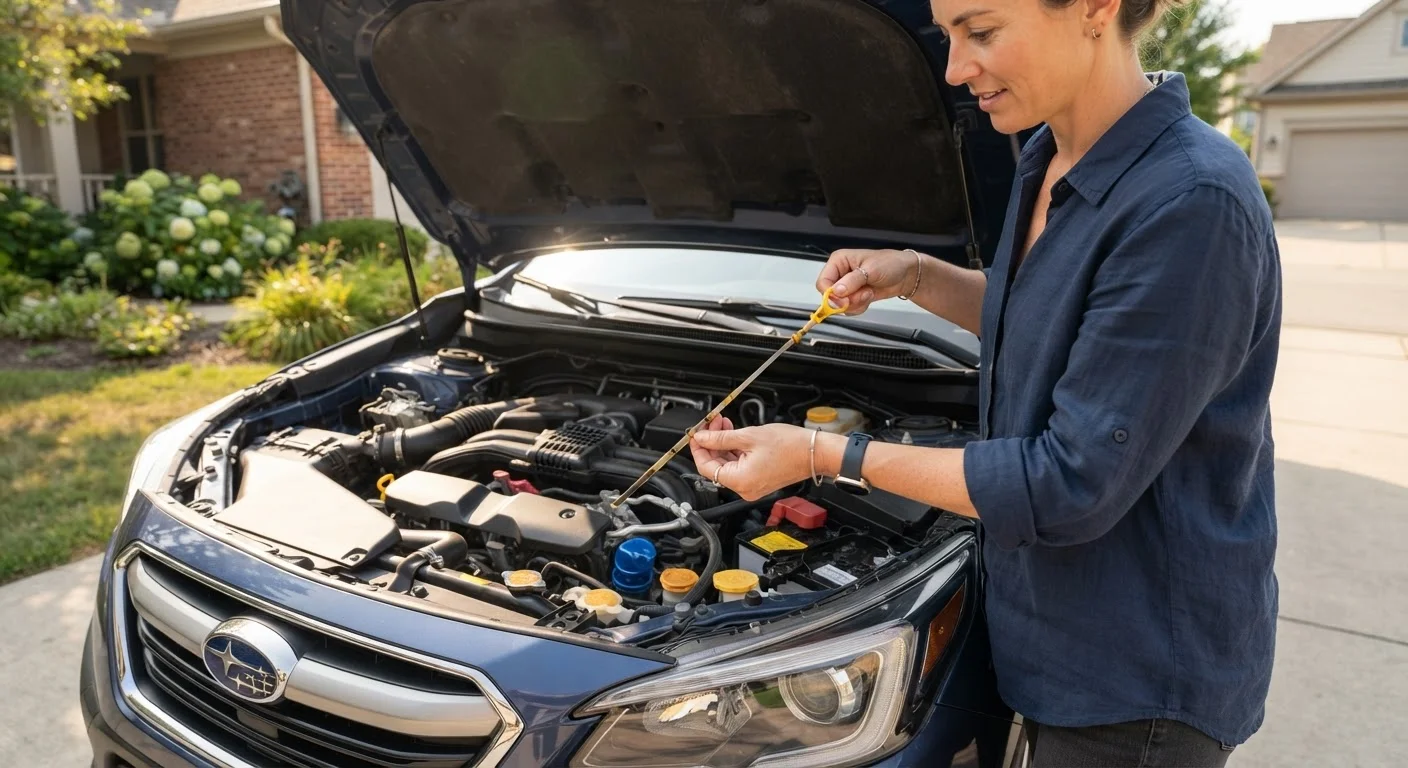
- Engine oil: Pull the dipstick (usually a brightly colored handle near the engine), wipe it clean, reinsert fully, pull again. Oil should sit between the two marks and appear a light amber color. Dark, gritty oil is overdue for a change.
- Tire pressure: Check when tires are cold, before driving. The correct pressure (in PSI) is on a sticker inside the driver's door jamb - not on the tire sidewall, which lists the maximum. A basic pressure gauge costs a few dollars.
- Coolant level: Check the translucent reservoir near the radiator with the engine cold. The level should fall between the MIN and MAX lines.
- Windshield washer fluid: The only fluid you can safely top up with no mechanical knowledge. Use rated washer fluid - not water alone, which can freeze and grow bacteria.
- Wiper blades: Run them; if they streak or chatter, they need replacing. Most blades clip off without tools and take under five minutes.
- Lights: Walk around your car periodically with lights on. A burned-out brake light or headlight is a safety issue and a ticketable offense in most states.
These checks don't fix problems - they surface them early, when they're still inexpensive to address.
Check Tires When They're Cold
Tire pressure rises as tires heat up from driving, which can give you a falsely high reading. Always check pressure before your first trip of the day or after the car has sat for at least three hours. This gives you an accurate baseline to compare against the recommended PSI on your door sticker.
Your Owner's Manual: The Most Underused Resource in Your Glovebox
Most drivers never open it. That's a mistake. Your owner's manual contains the manufacturer-specified maintenance intervals for your exact vehicle - oil type, filter specs, tire rotation schedule, brake fluid intervals, and more. It's the authoritative source, not the generic recommendations posted at a quick-lube counter.
Key things to locate in your manual:
- Maintenance schedule
- Usually a table by mileage or time intervals. Follow whichever comes first.
- Fluid specifications
- Your engine may require a specific oil viscosity (e.g., 5W-30 vs. 0W-20). Using the wrong weight can reduce protection.
- Tire information
- Correct tire size and inflation range for your load and driving conditions.
- Warning lights guide
- A visual reference for every dashboard indicator and what action it warrants.
If your manual is missing, most manufacturers post digital versions on their websites by model year and trim. Our deeper look at what each maintenance milestone actually means can help you interpret what you find there.
Jobs Worth Learning vs. Jobs to Hand Off
Not every maintenance task belongs in the DIY column. The honest breakdown:
Reasonable for beginners
- Replacing wiper blades
- Swapping cabin air filters (usually behind the glovebox, no tools needed)
- Checking and topping up fluids
- Replacing a burned-out bulb (on many vehicles - check your manual first)
- Monitoring tire pressure and adding air
Require more confidence and research
- Changing your own oil (possible, but involves safe disposal of used oil and correct filter installation - see our full trade-off breakdown)
- Replacing an air filter (engine side)
- Battery replacement (straightforward on most vehicles, but requires resetting some systems)
Leave to a qualified mechanic
- Brake pad or rotor replacement
- Timing belt or chain service
- Suspension and steering components
- Any fuel system work
- Electrical diagnostics beyond a simple fuse swap
For a detailed breakdown of where the DIY line really sits, this guide on DIY tasks worth learning covers each category with practical detail.
Brake Work Is Not a Beginner DIY Task
Brake systems are safety-critical. Incorrectly installed brake pads, improperly torqued caliper bolts, or a disturbed brake line can cause brake failure. Even if video tutorials make it look straightforward, this is one area where the consequences of an error are severe. Have brake work done by a qualified mechanic who can inspect the full system.
Building Habits That Prevent Expensive Surprises
Knowledge without routine doesn't prevent breakdowns. The drivers who avoid surprise repair bills aren't necessarily the most mechanically skilled - they're consistent. A few habits make a significant difference:
- Set a monthly reminder to run through the basic checks above. Five minutes once a month catches most developing issues.
- Log your service history. A simple notes app or glove-box log listing date, mileage, and what was done gives you (and any future mechanic) a clear picture.
- Pay attention to changes. New sounds, smells, or handling quirks are your car communicating. Investigate before ignoring.
- Understand your full ownership costs. Maintenance is one line item among several - this overview of car ownership costs puts the full picture in context.
Building these habits early - especially if you're a new driver - pays dividends over the life of any vehicle. Routine care keeps you safer, extends what your car is worth, and keeps money in your pocket rather than at the repair counter.