

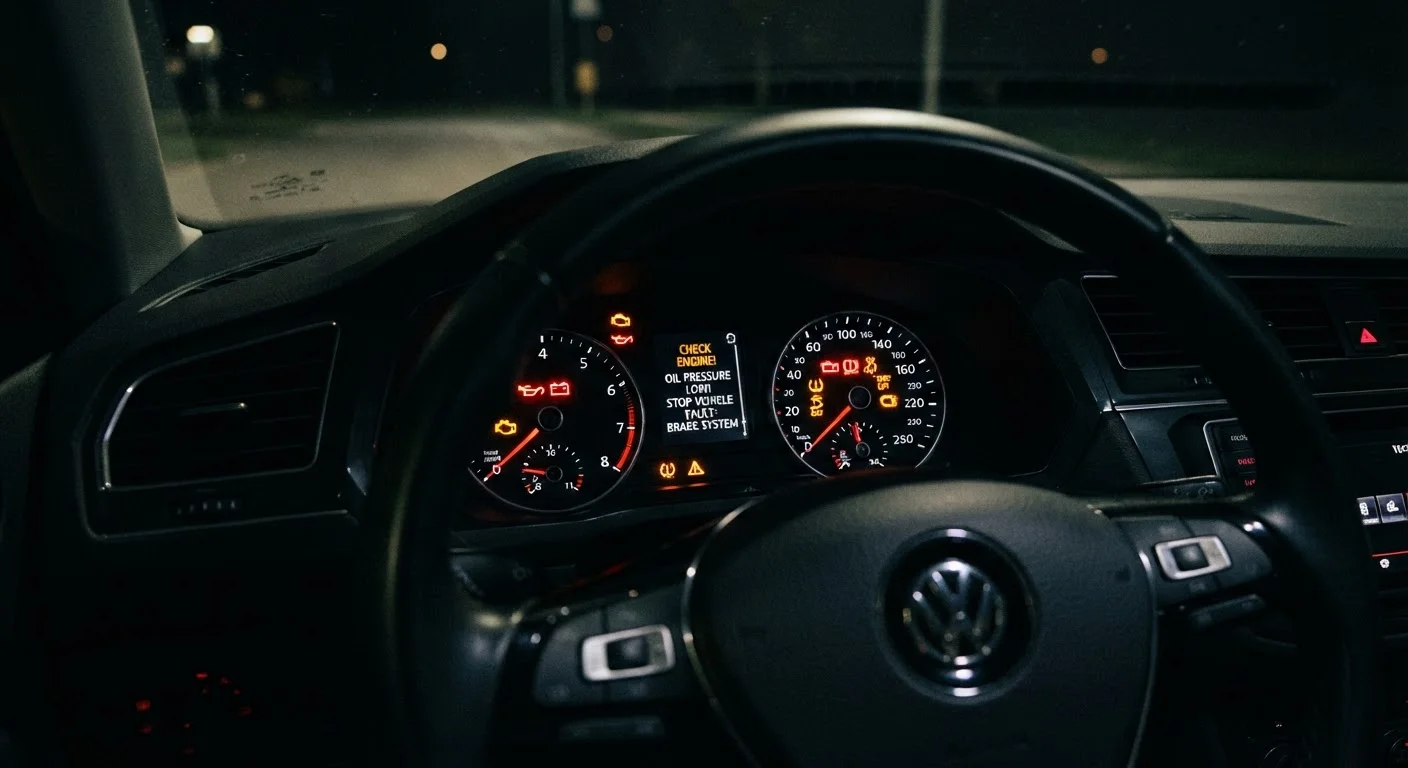
Why Warning Lights Exist - and Why Color Matters
Your dashboard warning lights are outputs from your vehicle's onboard diagnostic system (OBD), which continuously monitors dozens of sensors. When something falls outside normal parameters, a light triggers. The color of that light is your first clue about urgency.
Red means stop or act immediately - continued driving risks serious damage or a safety hazard. Yellow/amber means investigate soon - the system has detected something abnormal, but you typically have time to address it without pulling over right now. Green or blue lights are informational - they confirm a system is active (high beams, turn signals). Ignoring a red light is one of the most expensive mistakes a driver can make. For a broader view of keeping your vehicle in shape, see your car's maintenance schedule explained.
The Most Common Warning Lights, Decoded
These are the lights drivers encounter most often, ranked roughly by how urgently each demands attention.
OBD-II (On-Board Diagnostics)
A standardized vehicle self-diagnostic system required on all US cars sold after 1996. It monitors engine, transmission, and emissions sensors and stores fault codes when a problem is detected.
Fault Code (P-code)
A standardized alphanumeric code stored by the OBD-II system when a sensor reading falls outside acceptable limits. A mechanic or scan tool reads these codes to identify the specific system at fault.
TPMS
Tire Pressure Monitoring System - a federally mandated sensor system that alerts drivers when tire pressure drops 25% or more below the vehicle manufacturer's recommended level.
Catalytic Converter
An emissions-control device in the exhaust system that converts harmful pollutants into less harmful gases. A misfiring engine can overheat and permanently damage this component, making repairs costly.
ABS (Anti-lock Braking System)
A safety system that prevents wheels from locking during hard braking, allowing the driver to maintain steering control. An ABS warning light indicates a fault in this system, though base braking still functions.
Charging System
The combination of the alternator, battery, and voltage regulator that keeps a vehicle's electrical system powered while the engine runs. A fault here means the battery is draining and the vehicle may stall.
Red Lights - Act Immediately
- Oil Pressure Warning (oil can icon): Oil pressure has dropped dangerously low. Pull over safely, turn off the engine, and check the oil level before driving another foot. Low oil pressure can destroy an engine in minutes.
- Engine Temperature (thermometer in liquid): The engine is overheating. Pull over, shut off the engine, and let it cool. Do not open the radiator cap while hot. Check coolant level once cool - see how to check your fluids at home for guidance.
- Battery/Charging System (battery icon): The charging system isn't maintaining battery voltage. Your car is running on battery reserves alone. Drive directly to a shop - you may have 30 minutes or less before the vehicle stalls.
- Brake Warning (exclamation mark in circle): If your parking brake is off and this light is on, brake fluid may be low or a brake component has failed. Do not ignore this - braking ability may be compromised.
Yellow/Amber Lights - Address Within Days
- Check Engine (engine outline): The most common and most misunderstood light. It signals a fault in the engine or emissions system, ranging from a loose gas cap to a failing catalytic converter. A steady light means schedule a diagnostic soon; a flashing light means pull over and stop driving - a misfire is occurring that can damage the catalytic converter.
- Tire Pressure (TPMS - tire cross-section with exclamation): One or more tires is significantly under- or over-inflated. Check pressures at a gas station and inflate to the specification on the driver's door jamb sticker, not the number on the tire sidewall.
- Traction Control / Stability Control (car with wavy lines): The system is actively working, or has been disabled. A light that stays on while driving normally may indicate a wheel-speed sensor fault.
- ABS Warning (ABS in circle): The anti-lock braking system has a fault. Normal braking still works, but ABS - which prevents wheel lock-up during hard braking - may not function. Schedule a diagnostic promptly.
What to Do When a Light Comes On
Your Owner's Manual Is the Definitive Source
Dashboard symbols are not fully standardized across manufacturers - the same icon can mean different things in different vehicles. Your printed or digital owner's manual includes a complete, model-specific guide to every light on your dash. Keep it in the glove box or bookmark the digital version for quick access when a light appears unexpectedly.
Follow this sequence regardless of which light appears:
- Note the color. Red = immediate action; yellow = schedule service; blue/green = informational.
- Check for symptoms. Is the car driving differently? Smells, sounds, or handling changes elevate urgency.
- Consult your owner's manual. Every vehicle's symbols are listed there with model-specific guidance - it's the most accurate reference for your exact car.
- Use an OBD-II scanner. For check engine lights, a scan tool reads the stored fault code (P-code), giving you or a mechanic a precise starting point. Many auto parts stores will read codes for free.
- Don't just clear the code. Erasing the light without fixing the underlying problem means it will return - and you'll have lost the original code data.
For everything related to safe, confident driving decisions, the Driver Know-How hub covers licensing, road rules, and vehicle operation essentials.