

Key Takeaways
Our Verdict
Manual and automatic transmissions each impose distinct demands on the driver. Manuals reward attentive, engaged drivers with finer control over power and braking; automatics reduce task load and suit stop-and-go or high-distraction environments. The transmission that supports safer driving is the one the driver has fully mastered and applies thoughtfully to the conditions at hand.
| Best for | Recommended |
|---|---|
| Drivers seeking maximum control on mountain roads or slippery surfaces | Manual transmission |
| Drivers navigating dense urban traffic or long highway commutes | Automatic transmission |
| Drivers who want to minimise cognitive load and focus entirely on hazard scanning | Automatic transmission |
| Drivers who prioritise engine braking and direct powertrain feedback | Manual transmission |
What Actually Changes Between the Two
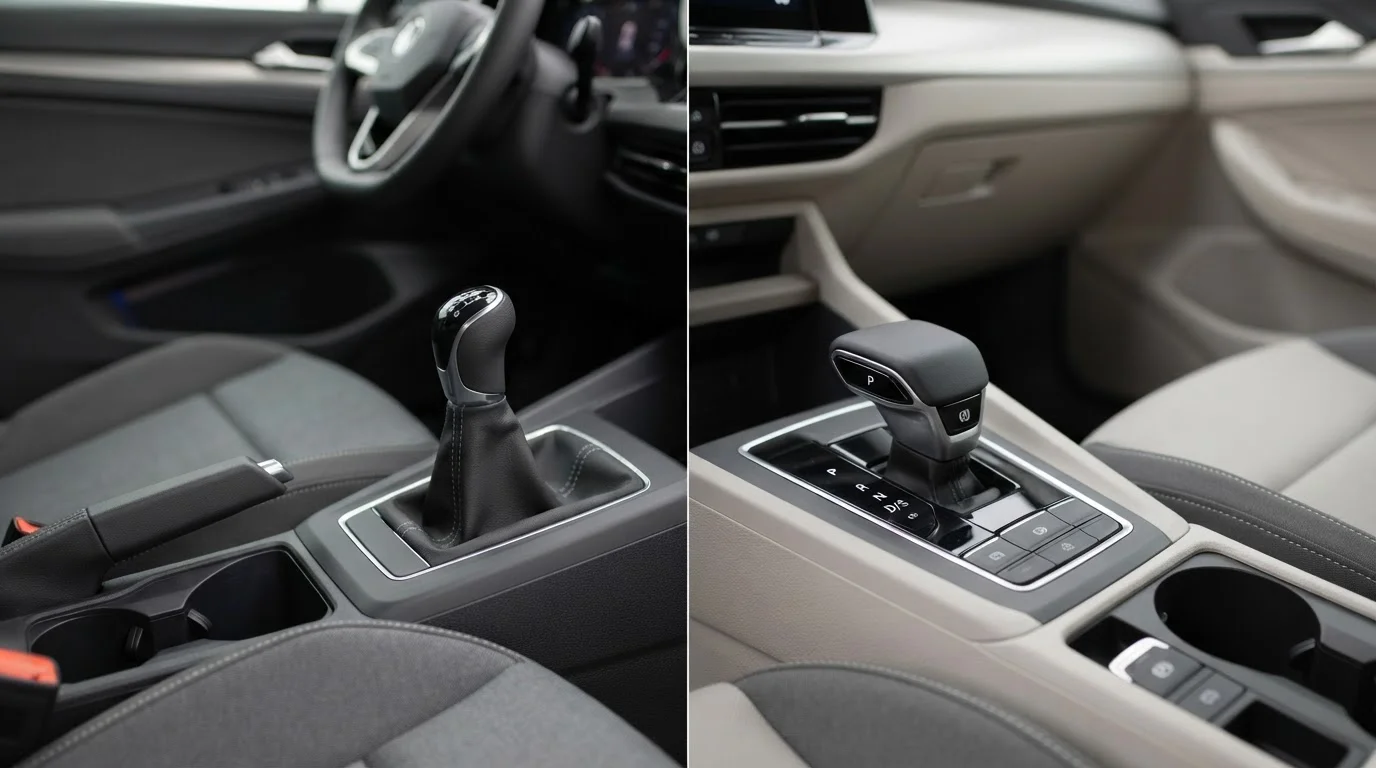
The fundamental difference is who manages the gear ratio - you or the vehicle. In a manual (stick shift), the driver selects each gear using a clutch pedal and a gear lever, physically connecting and disconnecting the engine from the drivetrain. In an automatic, a torque converter and control electronics manage that process continuously, selecting ratios based on speed, throttle input, and load.
That mechanical distinction cascades into very different driving experiences. Manual drivers carry a continuous mental checklist: current gear, engine RPM, clutch engagement point, and road gradient. Automatic drivers offload that checklist to the transmission, which frees working memory for other tasks - reading traffic, monitoring mirrors, managing speed.
Neither setup is a shortcut to better driving. Each just allocates the driver's attention differently.
Control, Engine Braking, and Situational Awareness
One of the most practical differences involves engine braking - the resistance created when you lift off the throttle and the drivetrain slows the vehicle without touching the brake pedal. In a manual, downshifting amplifies this effect dramatically. On a long descent or a slippery surface, experienced manual drivers use sequential downshifts to regulate speed while keeping the brakes cooler and the vehicle more stable.
Automatic transmissions do provide some engine braking, and most modern units include a manual-override mode (paddle shifters or a sequential gate) that lets drivers hold a lower gear. But the reflex to reach for a paddle is learned behaviour - it doesn't come as naturally as the clutch-and-lever routine a manual driver has practiced thousands of times.
In adverse conditions, this distinction matters. Driving in rain, snow, and fog already demands extra cognitive bandwidth. A manual driver who can engine-brake smoothly has an additional tool; a manual driver still building clutch confidence may find the extra task overwhelming.
| Manual Transmission | Automatic Transmission | |
|---|---|---|
| Gear control | Driver selects all gears manually | Electronics select gears automatically |
| Engine braking | Strong; easy to modulate via downshift | Moderate; requires manual override mode |
| Cognitive load | Higher - clutch, RPM, gear selection | Lower - offloads drivetrain management |
| Urban stop-and-go suitability | More demanding; clutch fatigue possible | Well-suited; minimal driver intervention |
| Driver engagement | Active participation required | Risk of passive disengagement on long routes |
| Skill floor | Steeper learning curve initially | Faster to basic competency |
Cognitive Load and Driving Focus
Research on driver workload consistently shows that gear-management tasks in a manual transmission consume measurable mental resources, particularly in urban stop-and-go traffic. Frequent clutch use in slow-moving lanes increases left-leg fatigue and keeps part of the driver's attention tied to the drivetrain rather than the road ahead.
For automatics, the freed bandwidth theoretically supports better hazard detection - more capacity to scan intersections, track pedestrians, and maintain following distance. In practice, that freed attention is only useful if the driver consciously reinvests it in situational awareness. Passive automation can also dull engagement; some automatic drivers report lower alertness on long monotonous routes compared with manual drivers who must actively participate in the drive.
This connects directly to the habits explored in defensive vs. aggressive driving research - attentiveness and anticipation reduce risk regardless of what the transmission does.
Use Your Transmission Intentionally
Whether you drive a manual or automatic, active engagement with the drivetrain improves safety. In an automatic, practice using engine braking by selecting a lower range on descents rather than riding the brakes. In a manual, work on smooth, confident shifts so gear management becomes automatic - freeing your mind for the road ahead.
Practical Implications for Everyday Drivers
If you drive primarily in dense city traffic, a manual transmission adds friction - literally and figuratively. The repetitive clutch work in bumper-to-bumper conditions accelerates left-knee fatigue and increases the chance of a stall at an inopportune moment. Automatics handle that environment with less driver effort.
On winding rural roads or grades, a confident manual driver has more nuanced control over power delivery through corners and more intuitive engine braking on descents. The transmission becomes an active tool rather than background infrastructure.
Regardless of which you drive, the maintenance demands differ too - clutch components on a manual wear over time and must be inspected, while automatics have their own fluid and filter service intervals. Understanding your drivetrain's upkeep is part of driving smart; the same discipline that leads you to track synthetic vs. conventional oil differences for your engine applies equally to transmission care.
The bottom line: choose the transmission you can operate confidently and completely, and then invest in mastering the habits - scanning, spacing, smooth inputs - that reduce risk on every road.