

Key Takeaways
Calorie (dietary)
A calorie is a unit of energy. On food labels, it measures the amount of energy your body can potentially extract from a given serving. When you eat, your body breaks down carbohydrates, fats, and proteins and converts that chemical energy into fuel for everything from breathing to exercise.
The "calorie" on nutrition labels is technically a kilocalorie (kcal) - 1,000 times larger than the calorie used in physics. Food scientists adopted this convention for practicality; the terms are used interchangeably in everyday nutrition contexts.
Where the Calorie Number Comes From
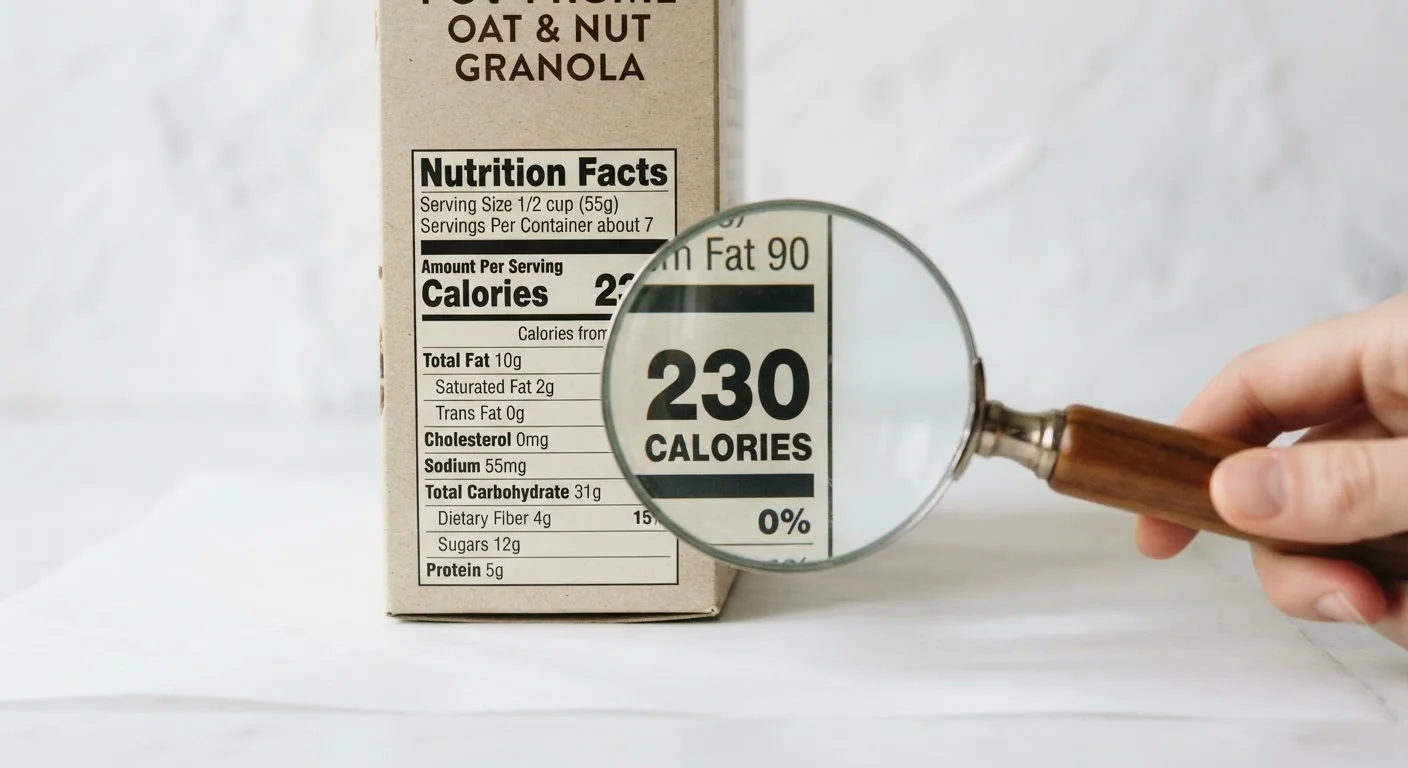
Flip any packaged food over and you'll see a bold number under "Calories." That figure wasn't measured in a lab flame - it was calculated using a system developed in the late 19th century by chemist Wilbur Atwater. The Atwater system assigns fixed energy values to each macronutrient: 4 kcal per gram of carbohydrate, 4 kcal per gram of protein, and 9 kcal per gram of fat. Manufacturers analyze the macronutrient content of a food and multiply each by its Atwater factor to arrive at the total calorie count.
This means the calorie figure is a calculation, not a direct measurement. The FDA permits a tolerance of up to 20% above the declared value on nutrition labels - meaning a food listed at 200 calories could legally contain up to 240. That's not a loophole; it reflects genuine difficulty in achieving perfect uniformity across manufacturing batches. For a deeper look at how the rest of the label is structured, see Reading a Nutrition Label Without Getting Lost.
±20%
Allowed margin of error on US food labels
The FDA permits calorie declarations on nutrition labels to exceed the stated value by up to 20%, reflecting real-world manufacturing variability.
9 kcal/g
Energy density of dietary fat
Under the Atwater system, fat provides more than twice the calories per gram compared to carbohydrates or protein, which each contribute 4 kcal per gram.
20-30%+
Potential error in wearable calorie-burn estimates
Published validation studies have found that consumer fitness wearables can deviate substantially from measured calorie expenditure, depending on the activity type and device.
Energy In vs. Energy Actually Absorbed
The number on the label represents potential energy - what your body could extract under ideal conditions. What your body actually absorbs is a different, and more complicated, question.
Several factors affect real-world energy extraction:
- Food structure and processing: Whole almonds yield fewer absorbed calories than almond butter made from the same nuts, because intact cell walls slow digestion and limit absorption. Cooking generally increases calorie availability by breaking down cell walls and denaturing proteins, making nutrients more accessible.
- Fiber content: Dietary fiber contributes roughly 2 kcal per gram on average - less than the 4 kcal assigned to other carbohydrates - because humans lack the enzymes to fully digest it.
- Gut microbiome: Emerging research suggests individual differences in gut bacteria influence how much energy is extracted from identical foods, though this science is still developing.
- Thermic effect of food: Digestion itself burns energy. Protein requires significantly more energy to process than fat, which partially offsets its calorie contribution.
None of this means calorie labels are useless - they provide a reasonable ballpark. But the arithmetic is rarely as clean as the label implies.
“The calorie is a useful unit of measurement, but it was never designed to capture the full complexity of human nutrition. Food is a biological system, not a combustion equation.”
— Marion Nestle, Professor Emerita of Nutrition, Food Studies, and Public Health, New York University
Calories Out: Why Exercise Numbers Are Rough Estimates
Just as calorie-in figures carry uncertainty, so do calorie-out estimates. Fitness trackers, treadmill displays, and calorie-burn apps use formulas built from population averages. Your actual energy expenditure depends on body composition, cardiovascular fitness, movement efficiency, and genetics - variables no wristband can fully capture.
Published research has found that wearable devices can deviate substantially from actual calorie burn, sometimes by more than 20-30%. These tools can still be motivating and useful for tracking trends, but treating the specific number as precise is a mistake. Fitness Metrics Worth Tracking (and a Few That Mislead You) explores which movement data points hold up under scrutiny.
What Calories Don't Tell You
A calorie count communicates nothing about the vitamins, minerals, fiber, or phytonutrients in a food. Two foods with identical calorie counts can have dramatically different effects on hunger, blood sugar, and long-term health. A 200-calorie serving of lentils and a 200-calorie serving of a processed snack are not nutritional equivalents, even though the label number matches.
This is where the concept of nutrient density becomes relevant - the idea that foods should be evaluated not just by their energy load but by the nutritional value they deliver per calorie. For a practical framework on this, Nutrient Density vs. Calorie Density: Choosing Foods That Do More breaks down how to apply both lenses when making everyday food choices.
This article provides general nutrition information for educational purposes only and is not a substitute for personalized medical or dietary advice. Consult a qualified healthcare professional or registered dietitian for guidance specific to your health needs.