

Key Takeaways
Option A
Clicker Training
The precision tool for shaping new behaviors fast.
Best for: Pet owners who want to teach specific, measurable behaviors with minimal ambiguity in the feedback signal.
Option B
Verbal Praise
The always-available, relationship-building reinforcer.
Best for: Everyday reinforcement, maintaining learned behaviors, and moments when a clicker simply isn't on hand.
If you're teaching a brand-new behavior from scratch
Clicker Training
The clicker's consistent, neutral sound marks the exact moment of correct behavior, reducing confusion and accelerating the learning curve during early training sessions.
If you want to reinforce a behavior your pet already knows
Verbal Praise
Once a behavior is learned, warm verbal feedback maintains it effectively and doesn't require you to carry equipment or interrupt natural interaction.
If you're training a noise-sensitive or anxious pet
Verbal Praise
Some animals find sudden clicking sounds startling. A calm, consistent verbal marker is gentler and can be adjusted in tone to suit your pet's comfort level.
If you're working on complex, multi-step behaviors
Clicker Training
Precision feedback is essential when breaking down behavior chains; the clicker allows you to pinpoint the exact step your pet performed correctly.
If you want a method that works hands-free and anywhere
Verbal Praise
Your voice is always available - on walks, at the vet, or in public spaces - making verbal praise the most accessible form of reinforcement across all environments.
What Each Method Actually Does
Both clicker training and verbal praise are forms of marker training - they signal to your pet the precise moment a desired behavior occurred. Neither is a reward in itself. The real reward (usually a treat or play) follows the marker. Understanding this distinction is foundational. For a deeper look at the science behind this approach, see why positive reinforcement works for pets.
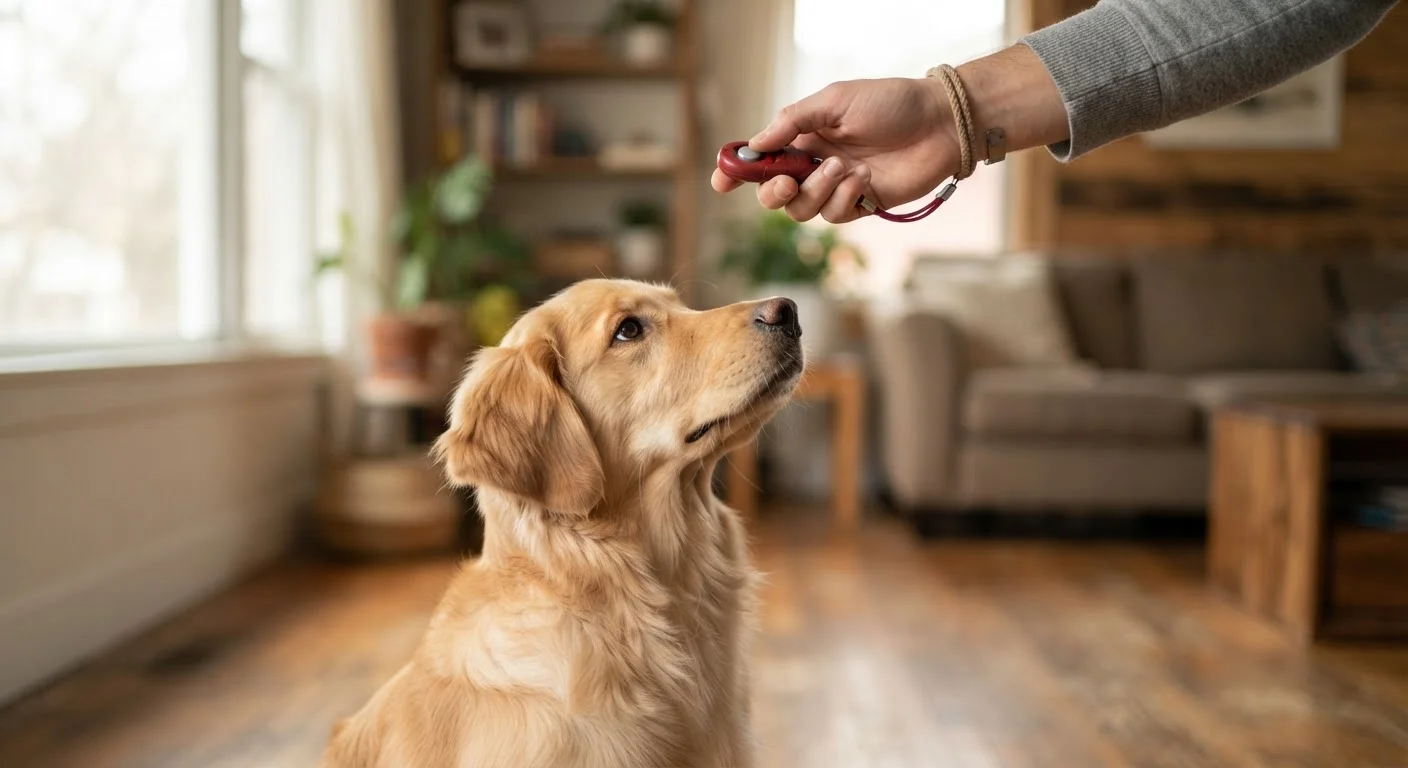
Clicker training uses a small handheld device that produces a short, consistent clicking sound. Because the sound never changes - unlike a human voice - it delivers the same signal every time. Your pet learns that the click means "that exact behavior earned a reward."
Verbal praise uses spoken words ("yes," "good," "nice") as the marker. It's naturally available and deepens the relational bond, but it varies in tone, volume, and timing depending on your mood or the situation - which can introduce ambiguity, especially early in training.
| Criterion | Clicker Training | Verbal Praise |
|---|---|---|
| Signal consistency | Identical every time | Varies by tone and mood |
| Timing precision | Fraction-of-a-second accuracy | Slightly slower, context-dependent |
| Equipment needed | Requires a clicker device | No equipment needed |
| Best phase of training | Acquisition (new behaviors) | Maintenance (known behaviors) |
| Bond-building value | Moderate | High |
| Noise-sensitive pets | May cause startle response | Generally well-tolerated |
| Usable in public | Yes, though less discreet | Yes, seamlessly |
Speed of Learning: Where Each Method Shines
Research in animal learning consistently shows that timing and consistency are the two variables most responsible for how quickly a pet acquires a new behavior. This is where the clicker has a measurable edge during the initial learning phase.
Because the click is uniform and can be delivered within a fraction of a second, pets receive unambiguous feedback about exactly what they did right. Verbal praise, while warm and meaningful, often arrives slightly later - and a delay of even one to two seconds can cause a pet to associate the reward with whatever they happened to be doing at that moment, not the behavior you intended to reinforce.
That said, verbal praise accelerates learning for behaviors a pet already partially understands. If your dog already knows "sit" and you're simply reinforcing fluency and reliability, a confident "yes!" works just as well as a click - and keeps the session feeling natural rather than mechanical.
~0.5 sec
Maximum effective reward delay
Animal learning studies broadly indicate that reinforcement delivered within half a second of the behavior produces the clearest association for most domestic animals.
3-5 sec
Typical verbal praise delivery lag
Trainers often note that spontaneous verbal praise arrives several seconds after the behavior, which can reduce its precision as a teaching marker.
For a practical walkthrough of applying these timing principles, teaching sit, stay, and come demonstrates both markers in action.
Practical Considerations and How to Combine Both
Most experienced trainers don't treat this as an either/or choice. A well-structured training plan often follows a clear progression:
- Teach with the clicker. Use the clicker during the acquisition phase - when your pet is first learning what a cue means. The precision reduces frustration for both of you.
- Pair praise alongside the click. Say "yes" or "good" in the same moment you click so that your voice gradually takes on the same meaning as the sound.
- Phase out the clicker. Once the behavior is reliable, the clicker can step back and verbal praise becomes your primary marker for day-to-day reinforcement.
One practical note: if your pet is noise-sensitive, startled by sudden sounds, or simply doesn't respond positively to the click, verbal praise alone is a fully valid approach - especially if you work hard on delivery consistency. Using a single, distinct word as your marker (rather than general encouragement) helps close the precision gap.
The Marker Is Not the Reward
A common early mistake is assuming the click or the word "yes" is the reward itself. Both are promises of a reward - they tell your pet a treat or play is coming. If you click or praise without following through with the actual reward, the marker loses its meaning quickly. Always back up your marker with something your pet genuinely values.
New pet owners unsure where to begin can find a structured starting framework in Pet Training From Day One, which covers realistic expectations and core method selection.
If you're training a cat specifically, the balance often shifts - felines respond differently to auditory cues and session length. Training Cats: What Actually Works explores what the research says about feline-specific methods.
This article provides general pet care and training information. It is not a substitute for guidance from a certified professional animal trainer or veterinary behaviorist, particularly for pets with fear, anxiety, or aggression concerns.