

Key Takeaways
Cats can learn reliable cued behaviors
With consistent positive reinforcement, most cats can learn sit, come, target-touch, and carrier entry - behaviors that meaningfully improve daily care and veterinary visits.
Training strengthens the human-cat bond
Short, positive training sessions build trust and give cats predictable, structured interaction - which many cats find enriching rather than stressful.
No special equipment required to start
A handful of small, high-value treats and a consistent cue (verbal or clicker) are enough to begin; formal tools help but are not prerequisites.
Reduces problem behaviors indirectly
Teaching alternative, rewarded behaviors - like sitting for attention instead of scratching - can redirect undesirable actions without confrontation or punishment.
Punishment causes fear, not compliance
Scolding, spray bottles, or physical correction do not teach cats what to do instead - they associate the unpleasant experience with the owner's presence, eroding trust over time.
Motivation varies widely between individuals
Food-motivated cats train more easily; cats with low treat drive or high anxiety may require significant patience and experimentation to find effective reinforcers.
Progress is slower than with dogs
Cats typically require more repetitions per session to form reliable associations, and session length must remain short, which means skill development unfolds over weeks rather than days.
Repetitive drilling causes disengagement
Asking a cat to repeat a behavior many times in a row in a single session usually results in the cat walking away - variety and brevity are essential to maintaining engagement.
Our Verdict
Cat training works - but only when owners respect feline psychology rather than trying to impose dog-centric methods. Reward-based approaches, especially clicker training paired with food treats, have solid behavioral science behind them and can produce genuinely reliable results. The process requires patience, short sessions, and willingness to read your cat's signals accurately.
Best suited to owners who are willing to invest consistent daily effort, accept that progress is incremental, and prioritize their cat's comfort and autonomy throughout the process.
Why Cats Aren't Just Difficult Dogs
The most common mistake cat owners make is assuming that training principles borrowed from dog training translate directly to felines. They don't - not because cats are untrainable, but because their behavioral architecture is different. Dogs evolved alongside humans over thousands of years as cooperative working animals; cats domesticated themselves largely on their own terms, optimizing for independence rather than social hierarchy.
This means cats are not naturally motivated by approval or social praise in the way many dogs are. They don't have an ingrained drive to please. What they do have is curiosity, strong sensory preferences, and clear patterns around food and comfort - and these are exactly the levers that effective training uses. Understanding this distinction is the foundation of reward-based training for cats.
What Actually Works: Proven Techniques
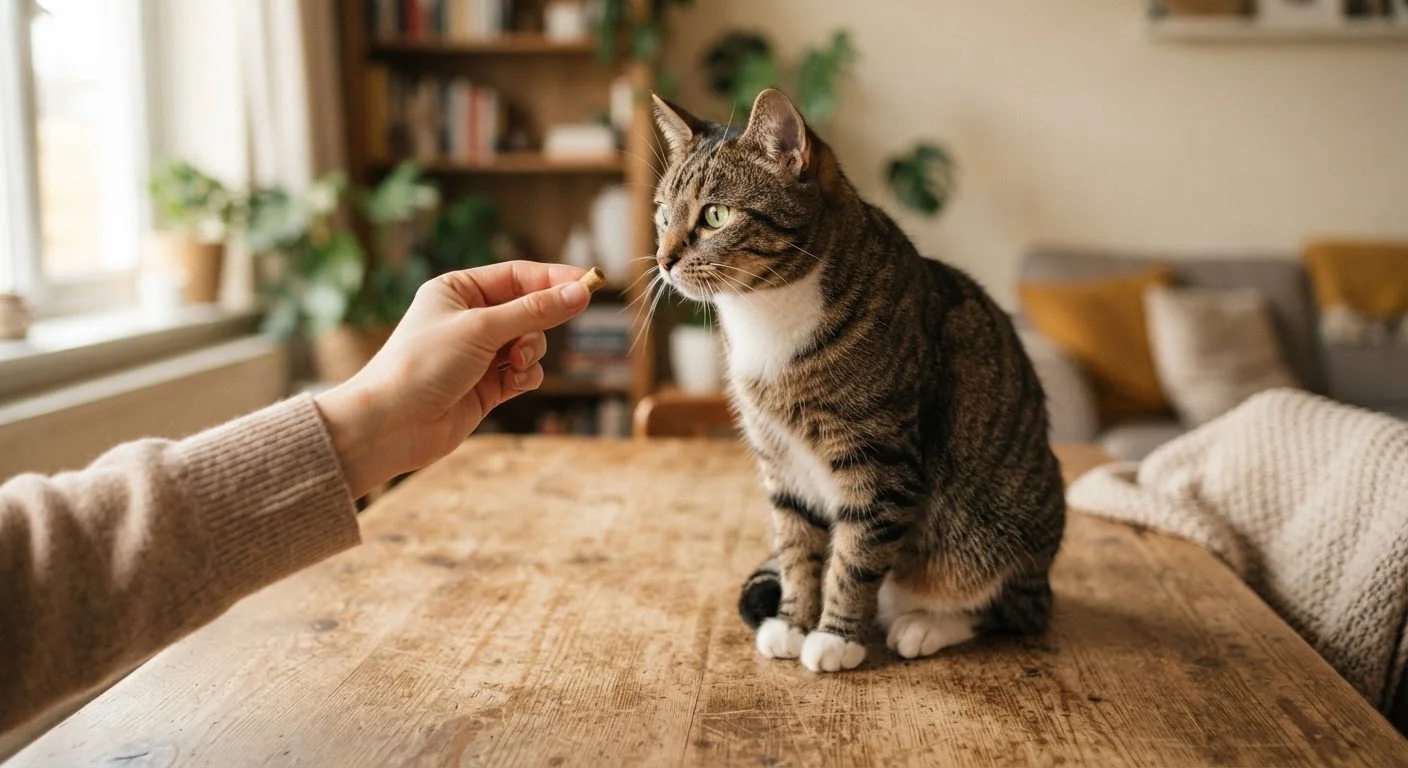
Behavioral research consistently points to positive reinforcement as the most effective training method for cats. The basic principle: immediately reward the behavior you want to see repeated. Timing is everything - a treat delivered even three seconds after the target behavior can confuse a cat about what exactly earned the reward.
Cats can learn reliable cued behaviors
With consistent positive reinforcement, most cats can learn sit, come, target-touch, and carrier entry - behaviors that meaningfully improve daily care and veterinary visits.
Training strengthens the human-cat bond
Short, positive training sessions build trust and give cats predictable, structured interaction - which many cats find enriching rather than stressful.
No special equipment required to start
A handful of small, high-value treats and a consistent cue (verbal or clicker) are enough to begin; formal tools help but are not prerequisites.
Reduces problem behaviors indirectly
Teaching alternative, rewarded behaviors - like sitting for attention instead of scratching - can redirect undesirable actions without confrontation or punishment.
Clicker Training
A clicker (a small handheld device that makes a sharp, consistent sound) acts as a bridge signal - it marks the precise moment the cat performs the correct behavior, before the treat arrives. Cats learn to associate the click with a reward, which sharpens the feedback loop considerably. Clicker training versus verbal praise is a useful comparison if you're deciding which method fits your routine.
Target Training
Teaching a cat to touch its nose to a stick or finger on cue is one of the easiest entry-point behaviors. From there, the target can guide more complex movements - turning, jumping, or entering a carrier. Most cats achieve basic targeting within a few short sessions.
Session Length and Frequency
Keep sessions to two to five minutes, ending while the cat is still engaged and before it disengages on its own. Once daily is sufficient for most cats; twice daily can accelerate progress. New pet owners often underestimate how quickly cats disengage - stopping early is always better than pushing too long.
What Doesn't Work: Common Mistakes
Equally important to knowing what works is recognizing what reliably fails - or actively backfires - with cats.
Punishment causes fear, not compliance
Scolding, spray bottles, or physical correction do not teach cats what to do instead - they associate the unpleasant experience with the owner's presence, eroding trust over time.
Motivation varies widely between individuals
Food-motivated cats train more easily; cats with low treat drive or high anxiety may require significant patience and experimentation to find effective reinforcers.
Progress is slower than with dogs
Cats typically require more repetitions per session to form reliable associations, and session length must remain short, which means skill development unfolds over weeks rather than days.
Repetitive drilling causes disengagement
Asking a cat to repeat a behavior many times in a row in a single session usually results in the cat walking away - variety and brevity are essential to maintaining engagement.
When Behavior Changes Signal a Health Issue
Sudden shifts in a cat's behavior - including new aggression, hiding, or litter box avoidance - can indicate an underlying medical condition rather than a training problem. Before attributing a new behavior to stubbornness or a gap in training, consult your veterinarian to rule out pain, illness, or sensory changes. Training interventions are most effective once any health factors have been addressed.
Ignoring the Environment
A cat that is stressed, overstimulated, or unwell will not train effectively regardless of method. If your cat is consistently avoiding the litter box or displaying sudden behavioral changes, these may signal something beyond training scope. See litter box problems in cats for guidance on distinguishing learned habits from environmental or health causes.
Setting Realistic Expectations
Cats are capable of learning a surprising range of behaviors - from simple sits and high-fives to more complex sequences like running an agility course. What they are not: infinitely patient, consistently motivated regardless of mood, or responsive to repetitive drilling. Their interest in training is context-dependent and can shift day to day.
For most households, the most practical training goals are behaviors that improve daily life: coming when called, tolerating grooming, entering a carrier calmly, and staying off restricted surfaces. Building lasting pet behavior requires consistency over weeks and months, not dramatic breakthroughs in single sessions.
2-5 min
Ideal training session length for cats
Animal behaviorists generally recommend keeping feline training sessions brief to maintain engagement and avoid frustration-related disengagement.
~0.5 sec
Optimal treat delivery window after behavior
Behavioral research on operant conditioning indicates that reinforcement delivered within half a second of the target behavior produces the clearest learning signal for animals.
This article is for general informational purposes only and does not constitute veterinary or behavioral advice. Consult a qualified veterinary behaviorist or certified animal trainer for guidance specific to your cat's needs.