

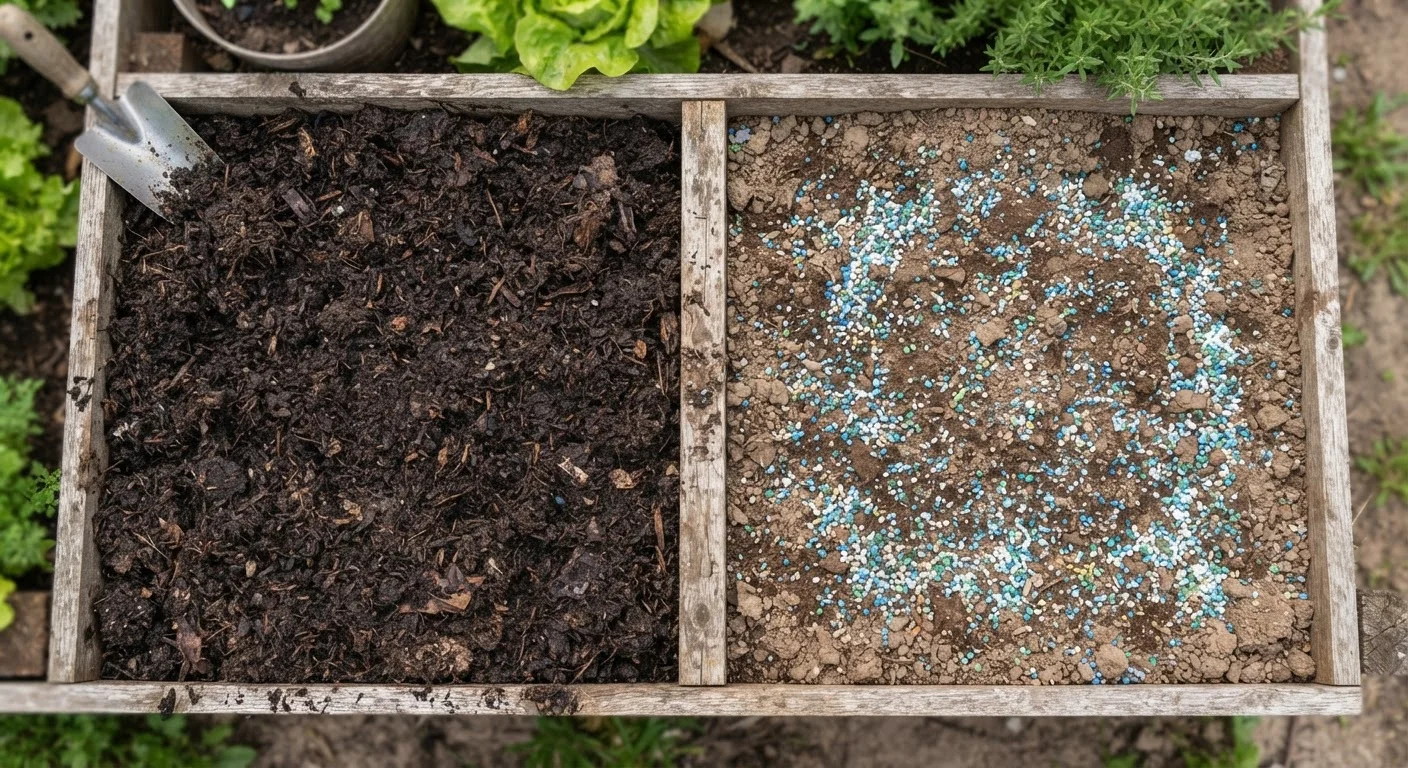
Key Takeaways
Option A
Organic Fertilizers
The slow-build, soil-first approach.
Best for: Gardeners focused on long-term soil health, microbial activity, and reducing synthetic chemical inputs.
Option B
Synthetic Fertilizers
The precise, fast-acting nutrient delivery system.
Best for: Situations requiring rapid nutrient correction or high-yield results in a defined growing window.
If you're building a new garden bed from scratch
Organic Fertilizers
Establishing soil biology from the start sets the foundation for healthier, lower-maintenance growing over many seasons.
If you need to correct a specific nutrient deficiency quickly
Synthetic Fertilizers
Synthetic formulations deliver targeted nutrients in a form plants can absorb within days, helping prevent short-term crop loss.
If you're maintaining an established vegetable or flower garden long-term
Organic Fertilizers
Regular organic inputs sustain microbial diversity and soil structure, reducing your dependence on repeated fertilizer applications.
If you're growing container plants with limited soil volume
Synthetic Fertilizers
Containers flush nutrients quickly; synthetic fertilizers allow precise dosing to match the plant's actual needs in a confined medium.
If you want a balanced, sustainable approach across your whole yard
Organic Fertilizers
Combining compost, aged manure, and slow-release organic amendments builds resilience while minimizing runoff and input costs over time.
How Each Type Feeds Your Plants
The fundamental difference between organic and synthetic fertilizers isn't the nutrients themselves - it's the delivery mechanism.
Organic fertilizers (compost, blood meal, bone meal, fish emulsion, aged manure) are derived from plant or animal matter. They don't feed plants directly. Instead, they feed the soil's microbial community - bacteria, fungi, and other organisms that break organic material down into mineral forms plants can actually absorb. This process takes time, which is why organic fertilizers are described as slow-release.
Synthetic fertilizers are manufactured compounds - typically containing nitrogen (N), phosphorus (P), and potassium (K) in precise ratios shown on the label (e.g., 10-10-10). These nutrients are already in soluble, plant-available form, so roots can absorb them almost immediately after application. You'll often see a visible growth response within days.
Understanding this distinction matters because it shapes every other tradeoff between the two approaches. To better understand your soil's starting condition before choosing either approach, see our guide to reading your soil.
| Criterion | Organic Fertilizers | Synthetic Fertilizers |
|---|---|---|
| Nutrient availability | Slow-release via microbial breakdown | Immediate, water-soluble uptake |
| Soil biology impact | Feeds and supports microbial life | Neutral to negative with overuse |
| Soil structure improvement | Yes - adds organic matter | No direct structural benefit |
| Nutrient precision | Variable; depends on source | Exact ratios on label |
| Runoff and leaching risk | Lower due to slow release | Higher, especially nitrogen |
| Typical cost per application | Higher upfront | Generally lower upfront |
| Best time horizon | Seasons and years | Weeks to one growing season |
What Happens to Your Soil Over Time
This is where the long-term calculus really diverges.
Organic amendments do more than supply nutrients. As they decompose, they add organic matter - the material that binds soil particles into aggregates, creating the pore space roots need to breathe, and that water needs to drain or be retained effectively. Healthy soil structure supports earthworms, beneficial nematodes, and fungal networks that further extend a plant's reach for nutrients and moisture.
Heavy reliance on synthetic fertilizers, without adding organic matter, can gradually erode this biological activity. Salt-based synthetic compounds can accumulate in soil, raising electrical conductivity to levels that stress roots and suppress microbial populations. Over multiple growing seasons, the result is often a compacted, biologically thin soil that requires increasing fertilizer inputs to produce the same yields - a cycle worth being aware of.
That said, synthetic fertilizers don't inherently damage soil if used carefully and in rotation with organic practices. The problem arises from chronic over-application or exclusive reliance without replenishing organic matter.
~5%
Ideal soil organic matter content for most gardens
Most university extension services cite 3-5% organic matter as a target for productive garden soil, yet many urban and suburban soils fall well below this range.
2-6 weeks
Typical release window for organic fertilizers
Decomposition rate depends on soil temperature and moisture; cold or dry soils slow microbial activity and extend the release timeline considerably.
Up to 50%
Nitrogen loss rate from synthetic over-application
Research from land-grant universities has found that significant portions of applied synthetic nitrogen can be lost to leaching or volatilization before plant uptake under poor conditions.
Pairing fertilizer choices with complementary practices - like mulching - can help maintain soil biology between applications. Our mulching guide covers depth, timing, and materials worth considering alongside your fertilizer strategy.
Practical Tradeoffs Every Gardener Should Know
Neither approach is universally superior. Here's what shapes the decision in practice:
- Speed: Synthetic fertilizers act within days; organic options may take weeks to show results as microbial activity processes the material.
- Cost per application: Synthetic fertilizers are generally less expensive per bag and require smaller quantities. Organic products - especially bagged compost or specialty meals - can cost more upfront, though the soil-building benefit compounds over seasons.
- Runoff risk: Soluble synthetic nutrients, especially nitrogen, can leach into groundwater or run off into waterways if over-applied or applied before heavy rain. Organic fertilizers release nutrients more slowly, reducing this risk - though they're not entirely exempt.
- Ease of application: Synthetics are easy to measure precisely. Organics vary considerably in nutrient content, making exact dosing harder without a soil test as your baseline.
- Smell and handling: Some organic materials (fish emulsion, fresh manure) have strong odors. Synthetic granules are odorless and typically cleaner to handle.
Many experienced gardeners use both: organic amendments to build long-term soil health, and targeted synthetic applications to address specific deficiencies during the growing season. Companion planting strategies - outlined in our companion planting guide - can also reduce how much you need to fertilize by creating mutually beneficial plant relationships.
Always Start with a Soil Test
Before applying any fertilizer - organic or synthetic - a basic soil test tells you what nutrients are already present and what's actually lacking. Applying nutrients your soil already has in excess can cause imbalances as harmful as deficiencies. Most US cooperative extension offices offer low-cost soil testing, and results typically include specific amendment recommendations for your region and intended crop.