

Key Takeaways
Our Verdict
Hard-shell luggage earns its place when you're checking fragile gear or navigating high-theft environments, while soft-sided bags reward travelers who need flexibility, lighter carry-ons, or irregular packing shapes. For most mixed itineraries, travelers end up using both types across different bag sizes rather than committing exclusively to one.
| Best for | Recommended |
|---|---|
| Frequent checked-bag travelers carrying fragile or valuable items | Hard-shell |
| Carry-on-only travelers who need overhead bin flexibility | Soft-sided |
| Business travelers prioritizing organizational pockets and quick access | Soft-sided |
| Beach, cruise, or adventure trips with unpredictable weather or rough handling | Hard-shell |
Where the Real Differences Show Up
The soft-vs-hard debate sounds like a gear discussion, but it's really a question about how you travel. The two shell types behave differently at every point in a trip - from the moment you try to cram a bag into a full overhead bin to the carousel where handlers have already bounced your checked case off a conveyor.
Before comparing features, it helps to identify your dominant use case. See how carry-on vs. checked bag strategy affects which shell type actually serves you best - because a bag's performance in the cabin differs significantly from its performance in the hold.
| Soft-Sided | Hard-Shell | |
|---|---|---|
| Flexibility / compressibility | Flexes to fit tight spaces | Fixed shape, no give |
| Impact protection for contents | Moderate - fabric absorbs some force | High - shell deflects impact |
| Water resistance | Varies; often treated but not waterproof | High; nearly waterproof shell |
| Exterior pockets | Usually several | Rarely any |
| Scratch and scuff visibility | Ages gradually, less visible | Scratches are permanent and obvious |
| Weight (empty) | Varies by material - not always lighter | Varies by material - not always heavier |
| Best primary use | Carry-on, flexible travel | Checked bag, fragile contents |
Flexibility, Fit, and Packing Reality
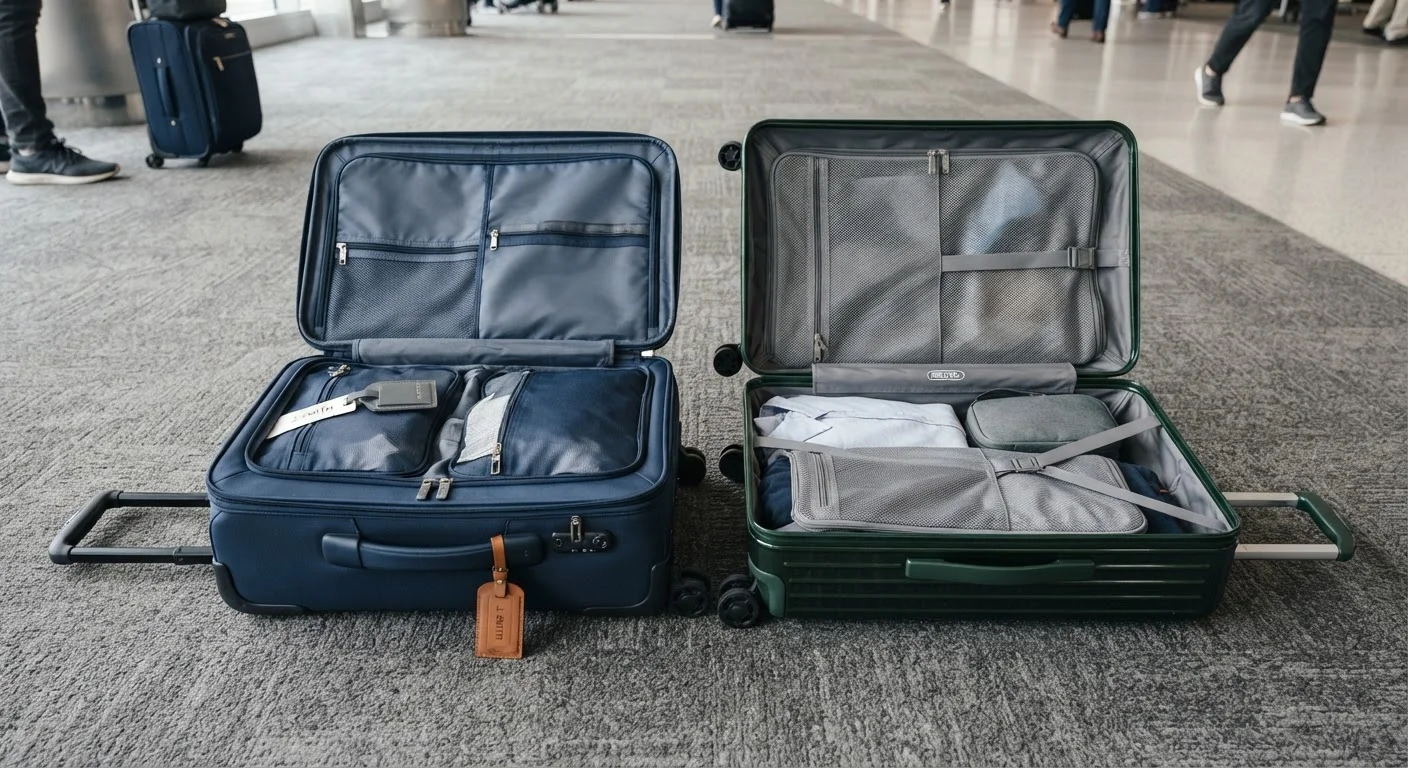
Soft-sided shells - typically nylon or polyester - have one advantage that rigid cases simply cannot replicate: they give. An overstuffed soft bag can still zip shut with some effort. A hard shell either closes or it doesn't. That flexibility matters when you're returning home with souvenirs, or when airline overhead bins are nearly full and you need to angle a bag in sideways.
Soft bags also tend to have exterior pockets - useful for boarding passes, earbuds, and snacks you want without opening the main compartment. Hard shells are almost universally pocket-free on the outside, trading convenience for a cleaner, structurally sound exterior.
Hard shells compensate with interior organization. Most feature two equal clamshell halves with compression straps and dividers that keep folded clothes flat - a real advantage if you're trying to keep dress shirts wrinkle-free. For strategies on that front, road warriors' packing priorities offers practical guidance on what frequent business travelers actually rely on.
Test the Zipper Before You Commit
On soft-sided bags, the zipper is the most likely failure point after years of travel. Look for double-stitched zipper tape, chunky pulls, and YKK or equivalent hardware. A quality zipper adds real longevity to an otherwise well-made bag - don't evaluate a soft case without opening and closing every zipper under some load.
Durability and What Rough Handling Actually Does
Hard shells absorb impact without transmitting force to contents - that's why they're the standard choice for checked bags carrying cameras, bottles, or fragile electronics. Polycarbonate cases flex on impact and return to shape; ABS plastic is stiffer and cheaper but can crack under sharp stress. Neither is indestructible, but both outperform fabric when a bag gets dropped from a cargo loader.
Soft-sided shells, by contrast, can absorb scuffs without showing them as dramatically. A scratch on hard-shell polycarbonate is permanent and visible. Nylon or ballistic fabric bags develop wear more gradually and often look functional long after a hard case looks battered. If aesthetics matter to you after years of travel, soft bags age more gracefully.
Water resistance is another real-world factor. Hard shells are essentially waterproof around the seams (though the zipper is always a weak point). Soft bags vary widely - some fabrics are treated for water resistance, but most aren't fully waterproof. If your route involves tarmac in the rain, this matters for checked luggage.
Weight, Size, and Airline Rules
A persistent myth is that hard shells are always heavier. In practice, the lightest carry-on bags on the market are a mix of both types. A well-constructed polycarbonate case can weigh less than a heavy-canvas soft bag. What matters is the specific model's empty weight, not the shell material.
That said, hard-shell bags have fixed volume. A 22-inch hard case holds exactly what its dimensions allow. A 22-inch soft case may expand slightly - or compress to fit a tighter space. For travelers who are right on the edge of carry-on size limits (which vary by airline and are worth verifying directly), the slight compressibility of soft bags can make the difference between gate-check and overhead storage.
If you're working to pack light through smarter planning decisions, the shell type is secondary to what you put inside. Both types can enable minimalist packing - or reward chronic overpacking. And if you're managing multiple climates in one bag, the strategies in packing for every climate apply regardless of which shell you choose.
Don't Assume Locks Protect Hard-Shell Bags
TSA-approved locks on hard-shell luggage deter opportunistic theft but don't prevent determined access. Checked hard-shell bags can be opened by cutting around the zipper or prying the shell. For truly valuable items, consider a personal item or carry-on rather than relying on a locked checked bag for security.