

Key Takeaways
Why Most Multi-Climate Packs Fail
Most travelers overpack for mixed-climate trips because they plan their bag around worst-case scenarios instead of layering systems. They pack a heavy coat for one cold night and a separate set of warm-weather clothes, ending up with a checked bag for a trip that could fit in a carry-on. The fix isn't willpower - it's strategy.
Before opening your suitcase, review your actual itinerary: What are the temperature ranges across each destination? What activities require specific dress codes? The planning decisions that shape what you pack happen well before you touch a garment. If you skip that step, no packing technique fully compensates.
The core principle here is that climate versatility comes from layering depth, not garment count. Three well-chosen pieces worn together can handle a 45°F morning and a 75°F afternoon - something five single-purpose items can't match.
Plan Your Itinerary Before Your Bag
The most effective packing decision you'll make happens before you touch a single garment. Mapping out each day's activities - including climate swings - shows you exactly where one versatile item can replace two single-purpose ones. Skipping this step is the primary reason travelers overpack for mixed-climate trips.
Fabric Choices That Do the Heavy Lifting
Fabric selection is where most packing guides lose the plot. Cotton is comfortable at home but it's a liability on the road: it absorbs moisture, dries slowly, and wrinkles heavily. For multi-climate travel, prioritize these categories:
- Merino wool: Naturally temperature-regulating, odor-resistant, and packable. A merino base layer works from desert mornings to cool mountain evenings and can go multiple days between washes.
- Lightweight synthetics (polyester/nylon blends): Fast-drying and durable. Ideal for active days or humid climates where you need quick turnaround between wears.
- Packable insulation: A down or synthetic-fill jacket that compresses to the size of a water bottle adds meaningful warmth without bulk. This is the single most efficient cold-weather tool in your bag.
For business or smart-casual requirements, wrinkle-resistant fabrics matter. The choices road warriors make around wrinkle-resistant fabrics apply equally to leisure trips when you need to look presentable after a long travel day.
What you will need
Building Your Climate-Flexible Wardrobe
A proven structure for a 7-10 day multi-climate trip fits in a single carry-on when you work from a neutral palette and commit to the layering system:
Define your temperature range, not just your destinations
Look up the actual daily high and low temperatures for each stop on your itinerary. Note the spread - a 30°F difference between morning and afternoon is your target to cover. This range, not the destination name, determines your layer count.
Choose a neutral color palette of 3-4 base colors
Select colors that mix and match without effort: navy, grey, black, and one muted accent. Every top should pair with every bottom. This multiplies outfit combinations without multiplying garments.
Pack a three-layer clothing system
Structure your clothing around three functional layers:
- Base layer: 2-3 merino or synthetic tops, 2 bottoms (one casual, one dressable)
- Mid layer: 1 lightweight fleece or long-sleeve top that adds warmth without bulk
- Outer layer: 1 packable jacket (down or synthetic-fill) that compresses small
This combination handles a 40°F range when worn together, and each piece functions independently in moderate conditions.
Limit shoes to two pairs maximum
Place shoes in reusable bags or shower caps to protect clothing, then position them heel-to-toe along the base of your bag. One versatile walking shoe and one specialty pair (sandals, dress shoes, or trail runners depending on your itinerary) is the sustainable maximum for most trips.
Pack and compress using cubes, then do a final weight check
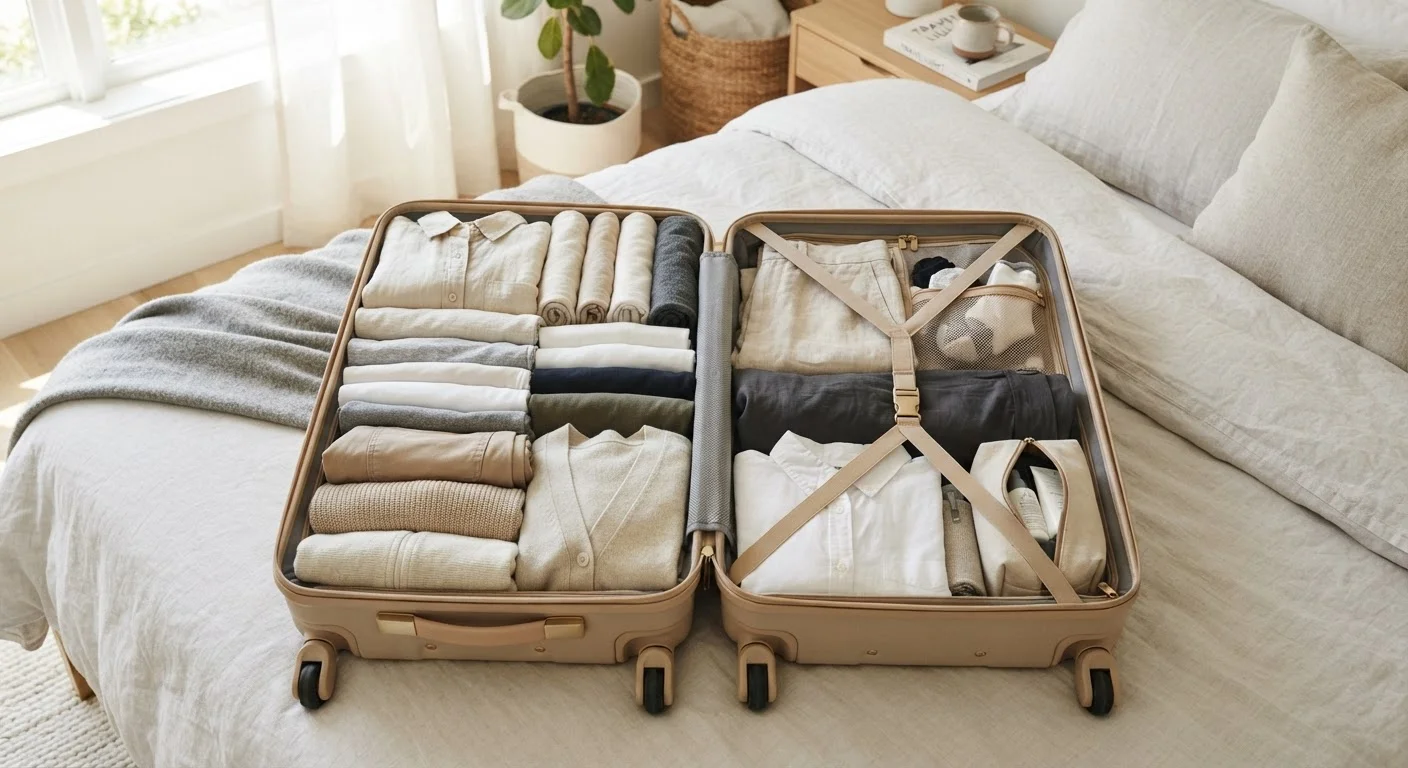
Sort garments into packing cubes by category (tops, bottoms, layers). Roll items before placing in cubes to reduce air pockets. Once packed, weigh the bag before adding toiletries and tech - this gives you a real buffer to work with rather than scrambling at the check-in counter.
Once you've selected items, the arrangement in your bag matters. Rolling instead of folding reduces creasing and often gains 10-15% more usable space. Compression packing cubes help segment categories without the diminishing returns of aggressive over-compression - a common misconception covered in detail when you separate packing fact from fiction.
If this is your first time building a system from scratch, the beginner's guide to building a capsule wardrobe walks through luggage types and repeatable pre-trip routines in more depth.
Don't Pack for Hypotheticals
The most common packing mistake is adding items for scenarios that are unlikely rather than planned. "What if it gets really cold?" and "just in case" reasoning accounts for roughly half the weight in most overpacked bags. Stick to your confirmed itinerary and temperature range - if something unexpected happens, most destinations have options for acquiring what you genuinely need.
Accessories and Footwear: Where Packs Go Wrong
Shoes and accessories consistently derail otherwise disciplined packs. A practical rule: bring no more than two pairs of shoes for any trip under two weeks. Choose one pair that handles 80% of your activities - a clean, versatile walking shoe - and one pair for edge cases (formal events, beach, hiking). Shoes go in first, against the wheel base of a hard-shell or at the bottom of a soft-sided bag, to stabilize weight distribution. See our comparison of soft-sided vs. hard-shell luggage if you're unsure which bag type suits multi-climate travel.
For accessories, a lightweight scarf is one of the most space-efficient items you can carry - it functions as a wrap on a cold flight, a layer at dinner, and sun protection in hot climates. Pack one, use it constantly.
Finally, toiletries and tech tend to expand into whatever space clothing leaves. Apply the same discipline: decant liquids into travel-sized containers, consolidate cables into a single small pouch, and cross-check against the room-by-room carry-on method to catch anything redundant before you zip up.