

Key Takeaways
Start here
Choosing the Right Luggage for Your Trip
Next
Building a Capsule Wardrobe for Travel
Then
Organizing What You Pack
Finally
Creating a Repeatable Pre-Trip Routine
Choosing the Right Luggage for Your Trip
Before you pack a single item, the container matters. Luggage choice shapes everything that follows - what fits, how you move through airports, and whether checked-bag fees eat into your budget.
Carry-on
A piece of luggage small enough to fit in an aircraft's overhead bin, avoiding checked-bag fees and baggage claim wait times. Size limits vary by airline.
Personal item
A smaller bag (such as a backpack or tote) that fits under the seat in front of you. Most airlines allow one personal item in addition to a carry-on.
Capsule wardrobe
A small set of versatile, mix-and-match clothing pieces in a cohesive color palette that maximizes outfit combinations while minimizing total items packed.
Packing cubes
Zippered fabric organizers used inside luggage to group clothing by category, compress volume, and make items easier to find without unpacking everything.
TSA 3-1-1 rule
A US Transportation Security Administration rule requiring carry-on liquids to be in containers of 3.4 oz (100ml) or less, all fitting in one quart-sized clear bag, one bag per passenger.
Three formats cover most solo trip scenarios:
- Hard-shell carry-on (21-22 inches): Best for trips of four to seven days with predictable weather. Protects fragile items, fits most overhead bins, and avoids checked-bag fees on domestic flights.
- Soft-sided duffel or spinner: More flexible to overstuff slightly (not recommended, but possible). Useful when packing bulky items like boots or a jacket that won't compress well.
- Travel backpack (30-45L): Ideal for trips involving trains, hostels, cobblestones, or frequent hotel changes. Leaves both hands free and avoids wheels catching on uneven surfaces.
If you're mapping out your first trip and haven't settled on an itinerary structure yet, this ground-up planning primer will help you make destination and transport decisions that inform what luggage makes sense.
Building a Capsule Wardrobe for Travel
The biggest packing mistake beginners make is packing outfits rather than pieces. A capsule approach reverses this: choose individual items that combine freely, so ten pieces yield far more than ten outfit options.
A workable seven-day capsule for a temperate destination typically includes:
- Two or three neutral bottoms (one pair of pants, one shorts or skirt, one versatile layer-able piece)
- Four to five tops in a cohesive palette
- One lightweight outer layer that compresses small
- Two pairs of shoes - one for walking, one for evenings or smarter settings
- Seven days of undergarments and socks (or fewer if you plan to wash)
Fabric matters more than most beginners expect. Merino wool and synthetic blends resist odor, dry fast after hand-washing, and wrinkle less than cotton. For mixed-climate trips, layering strategies that handle temperature swings can cut your clothing load further without leaving you underprepared.
Test Your Outfits Before You Pack Them
Lay out every clothing item you plan to bring and physically mix and match them before they go into the bag. If a piece only pairs with one other item, it's not earning its weight. Removing one low-versatility item at this stage is far easier than overpacking and paying a checked-bag fee at the airport.
Organizing What You Pack
Organization systems do two things: they compress what you're carrying and they make retrieval fast. Neither goal is achieved by loose packing.
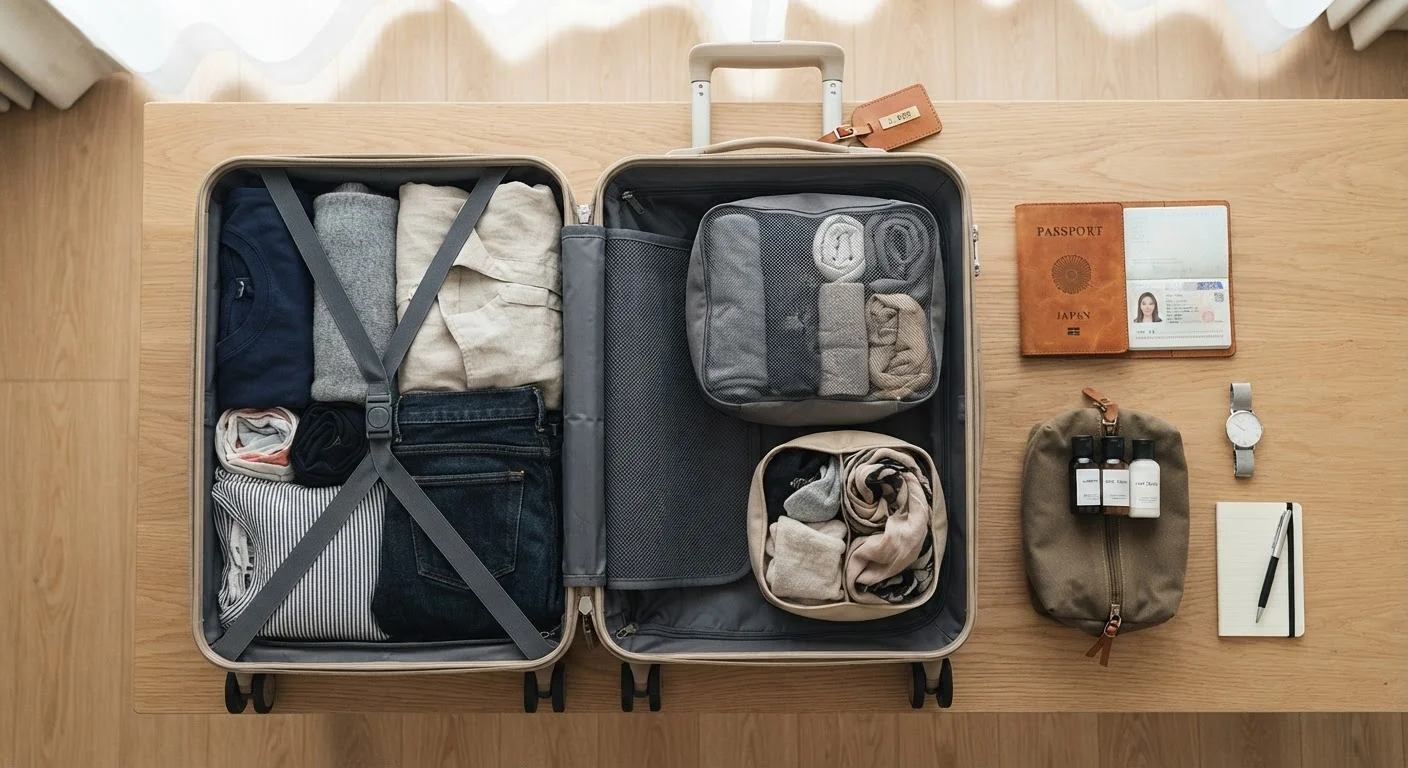
Packing cubes are the highest-return organizational tool. Assign one cube per category (tops, bottoms, undergarments) and roll rather than fold - rolling reduces wrinkles and lets you see everything at a glance without unpacking the cube. A separate small pouch for cables and chargers prevents the tangled-tech problem that slows every airport security line.
Toiletries deserve their own dedicated bag kept pre-stocked between trips. TSA's 3-1-1 rule (liquids in containers of 3.4 oz or less, all fitting in one quart-sized clear bag, one bag per traveler) applies to carry-on liquids on US domestic and international flights departing US airports. Keep this bag permanently assembled so it's never the thing you forget to pack.
For a practical walkthrough of fitting a full week into carry-on dimensions, this room-by-room carry-on method goes deeper on the mechanics.
Creating a Repeatable Pre-Trip Routine
The goal isn't to pack well once - it's to remove decision-making from future trips entirely. A master checklist and a consistent routine accomplish this.
Structure your master checklist in sections: documents and money, clothing, toiletries, electronics, and trip-specific items. Store it somewhere editable (a notes app works fine). After each trip, update it with anything you forgot or didn't use - the list improves with every trip you take.
A reliable pre-trip sequence looks like this:
- Four days out: Open your bag and place it where you'll see it. Add items as you think of them.
- Two days out: Run through your master checklist. Do a trial pack to confirm everything fits.
- Night before: Confirm documents, phone charger, and any prescription medications are in your personal item. Nothing critical should be in checked or gate-checked luggage.
Packing decisions are also shaped heavily by planning choices made earlier - how your itinerary structure affects what you need is worth reading before you finalize your list. Once your system is built, it becomes the foundation you refine across every trip that follows.