

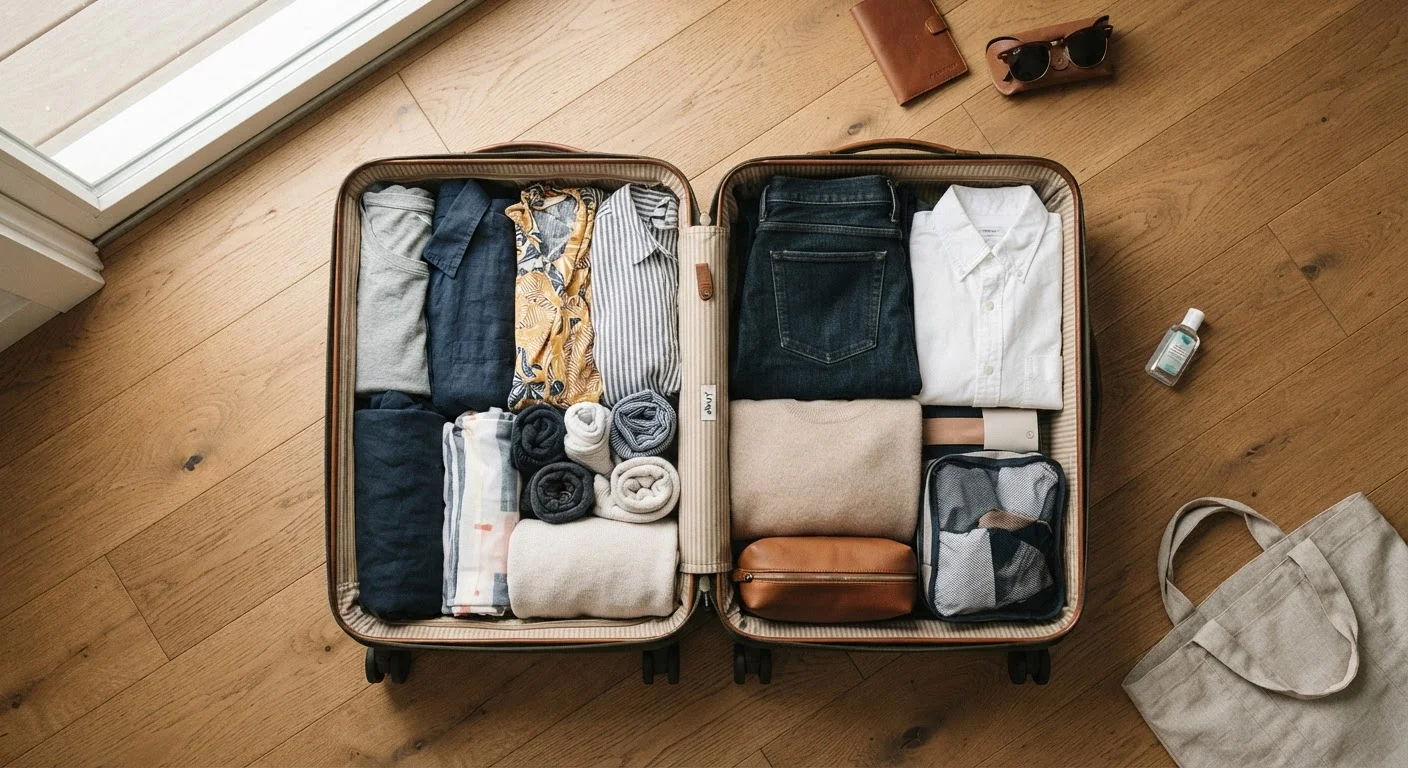
Key Takeaways
Option A
Rolling
The space-efficient, wrinkle-friendly option for casual packers.
Best for: Best for casual travelers packing soft, lightweight fabrics like t-shirts, jeans, and activewear.
Option B
Folding
The structured approach suited to formal and structured garments.
Best for: Best for business travelers or anyone packing dress shirts, blazers, and tailored trousers.
If you're packing mostly casual clothes for a leisure trip
Rolling
Rolling compresses soft fabrics efficiently and makes it easier to see every item at a glance without unpacking everything.
If your bag includes dress shirts, blazers, or tailored pants
Folding
Structured garments hold their shape better when flat-folded along their natural seams, reducing the need for ironing on arrival.
If you're fitting a week's worth of clothing into a carry-on
Rolling
Rolling creates cylindrical shapes that fill dead space in corners and along bag edges where flat stacks can't reach.
If you're a frequent business traveler with limited time to re-press clothes
Folding
Proper folding along factory creases keeps business attire ready to wear with minimal touch-up after arrival.
If you want the most versatile all-around approach
Rolling
For most travelers, rolling the majority of items while folding only structured pieces delivers the best balance of space and wrinkle control.
How Each Method Actually Works
Rolling involves tightly coiling garments into compact cylinders, which are then stacked side by side - often vertically - inside a bag. Folding stacks garments in flat layers, aligning seams to minimize creasing. The core difference isn't just shape: it's how each method interacts with available bag space and individual fabric behavior.
Rolling excels at filling irregular voids - the rounded corners of a duffel, the narrow channel beside a shoe. Folded stacks, by contrast, sit flat and predictably, making them easier to layer in a structured hard-shell suitcase. Neither technique is universally superior; the right choice depends on what you're packing and what kind of bag you're using.
For a deeper look at organizing a full week of clothing into a single bag, see our room-by-room carry-on guide.
| Criterion | Rolling | Folding |
|---|---|---|
| Space efficiency | Higher for soft, casual items | Better for thick or structured items |
| Wrinkle risk (casual fabrics) | Lower - avoids sharp crease lines | Moderate - fold points can crease |
| Wrinkle risk (formal garments) | Higher - distorts collars and seams | Lower - maintains garment structure |
| Visibility of contents | High - items visible side by side | Low - items hidden in layers |
| Best bag type | Duffels, soft-sided bags | Hard-shell suitcases |
| Time to pack | Slightly faster for most items | Slower but more precise |
| Suitability for business travel | Limited for formal attire | Preferred for office-ready clothes |
The Wrinkle Question: What Fabric Type Tells You
The method that causes fewer wrinkles depends less on rolling versus folding and more on what the garment is made of. Natural fibers like cotton and linen wrinkle regardless of technique - they respond to pressure and moisture, not just fold lines. Synthetic blends and performance fabrics are far more forgiving under either method.
Where rolling has a measurable edge is with casual knits and jersey fabrics: rolling avoids sharp crease lines that folding creates at the fold point. Where folding wins is with structured garments - a dress shirt folded along its placket and collar holds shape better than one rolled into a tube, which can distort the collar and shoulder seam.
10-20%
More items fit when rolling casual wear
Informal packing volume tests comparing rolled versus folded t-shirts and casual pants in standard carry-on bags consistently show this range of improvement.
~65%
Of travelers use a mix of both methods
Travel packing surveys suggest the majority of frequent travelers use a hybrid approach rather than a single method exclusively.
If wrinkle prevention is a priority for your trip type, consider pairing your packing method with wrinkle-resistant fabric choices. Our guide on business travel packing priorities covers which fabric types hold up best across long travel days.
Space Efficiency: What the Numbers Suggest
Rolling is widely credited with saving space, and the logic is sound: cylinders can be packed in multiple orientations and fill gaps that flat layers cannot. Informal packing tests and travel research consistently show that rolling casual items - t-shirts, underwear, socks, jeans - allows travelers to fit 10-20% more items into the same volume compared to flat folding.
However, folding remains more space-efficient for thicker, structured items like wool sweaters or denim jackets. Rolling a heavy sweater creates a bulky cylinder that occupies more height than a neat flat fold. The practical takeaway: use rolling as your default for lightweight to medium-weight casual wear, and fold anything with significant structure or thickness.
Packing cubes can amplify the benefits of both methods by keeping rolled or folded items compressed and separated. See our breakdown on how packing cubes work and who benefits for guidance on integrating them effectively.
The Hybrid Approach: Using Both Methods Strategically
Most experienced travelers don't pick one method exclusively - they use both based on garment type. A practical hybrid system looks like this: roll all t-shirts, underwear, activewear, pajamas, and casual pants; fold dress shirts (using the inside-out bundle method if space is tight), blazers, and structured trousers flat against the suitcase base.
This approach also works well with the principle of packing for multiple climates without overpacking. Our guide to packing for every climate in one suitcase pairs well with this method, as layering pieces benefit from the flat-fold treatment while base layers roll efficiently.
One common misconception worth flagging: overpacking undermines both methods equally. Compression alone - regardless of technique - causes wrinkles in pressure-sensitive fabrics. If your bag is straining to close, the method used to pack it matters far less than the volume of items inside. For more on separating packing fact from fiction, see common packing myths that waste space.